
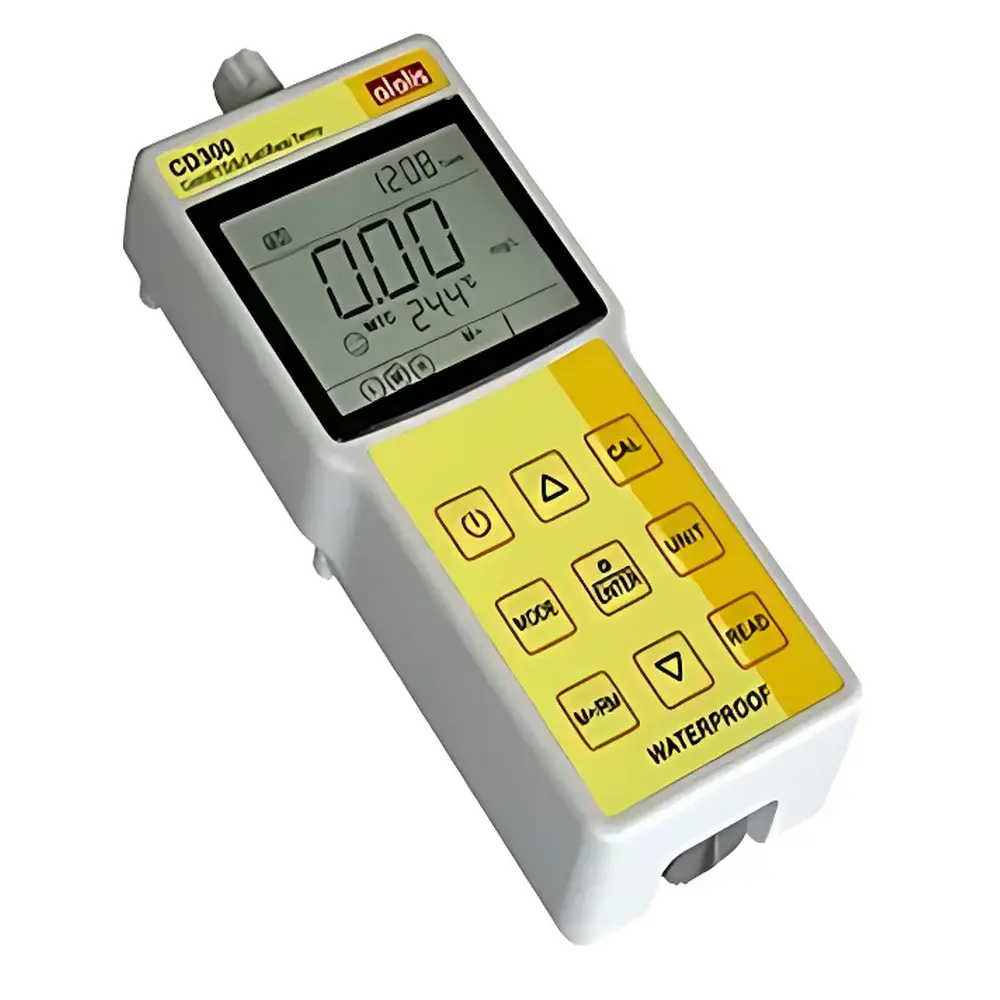
Alalis CD300 Portable Standard Conductivity Meter
| Brand | Alalis |
|---|---|
| Origin | Shanghai, China |
| Model | CD300 Standard |
| Portability | Portable |
| Conductivity Range | 0.00 μS/cm to 200.0 mS/cm (5-range auto-ranging) |
| TDS Range | 0–100 g/L |
| Resistivity Range | 0–100 MΩ·cm |
| Salinity Range | 0–100 ppt |
| Temperature Range | −10 to 110 °C |
| Accuracy | ±1.0% FS (conductivity), ±0.5 °C (temperature) |
| Resolution | 0.01 μS/cm (min), 0.1 °C (temperature) |
| Temperature Compensation | Automatic/manual (0–50.0 °C), selectable reference temp (15, 20, 25 °C) |
| Calibration | 1–4 point, with built-in calibration guidance and validation check |
| Data Storage | 100 sets (manual & auto), GLP-compliant |
| Interface | USB |
| IP Rating | IP57 |
| Display | 68 × 53 mm LCD with white backlight and real-time clock |
Overview
The Alalis CD300 Portable Standard Conductivity Meter is a rugged, field-deployable electrochemical analyzer engineered for high-reliability conductivity, TDS, salinity, and resistivity measurements across demanding industrial and pharmaceutical water quality applications. Designed around the fundamental principle of two-electrode AC conductometric measurement—where a low-frequency alternating current minimizes polarization effects and electrode fouling—the CD300 delivers stable, reproducible readings in thermally dynamic environments. Its extended temperature range (−10 to 110 °C) enables direct in-line or grab-sample analysis of boiler feedwater, condensate, multi-effect distillation (MED) effluent, heat exchanger coolants, and high-temperature industrial cleaning baths—environments where conventional benchtop meters fail due to thermal drift or sensor instability. The instrument employs a temperature-compensated (ATC) graphite or stainless-steel conductivity cell (K = 1.0 cm⁻¹, included), eliminating manual correction errors and ensuring traceable compliance with ASTM D1125, ISO 7888, and USP guidelines for purified water and water-for-injection (WFI) monitoring.
Key Features
- Five-segment auto-ranging conductivity measurement (0.00 μS/cm to 200.0 mS/cm), enabling seamless transition across ultrapure water (≥18.2 MΩ·cm) and high-salinity process streams without manual range switching
- Integrated ATC (Automatic Temperature Compensation) with user-selectable reference temperatures (15 °C, 20 °C, or 25 °C) and adjustable linear temperature coefficient (α) to match solution-specific compensation behavior
- 1–4 point calibration with on-screen step-by-step guidance, real-time electrode impedance verification, and automatic pass/fail assessment per IUPAC-recommended practices
- Dual display modes: stable averaging (for turbulent or aerated samples) and auto-hold (freezes reading upon signal stabilization, per ISO 5725-2 precision criteria)
- GLP-compliant data management: timestamped storage of 100 measurement records (including calibration logs, sample ID, operator ID, and temperature), with full audit trail export via USB
- IP57-rated enclosure ensures dust resistance and protection against immersion up to 1 m for 30 minutes—validated for use in wet mechanical workshops, sterilization tunnels, and outdoor utility corridors
- Backlit monochrome LCD (68 × 53 mm) with real-time clock, dual-unit temperature display (°C/°F), and low-battery warning—optimized for gloved operation and low-light facility environments
Sample Compatibility & Compliance
The CD300 supports aqueous solutions across a broad physicochemical spectrum: deionized water, steam condensate, saline brines, alkaline cleaning agents (pH 10–13), and mildly oxidizing coolants. Its K = 1.0 cm⁻¹ cell maintains linearity and minimal polarization error in solutions with conductivity >100 μS/cm, while its low-noise analog front-end preserves resolution down to 0.01 μS/cm for ultrapure water verification. The instrument conforms to electromagnetic compatibility (EMC) requirements per IEC 61326-1 (industrial environment) and meets electrical safety standards per IEC 61010-1 CAT II. All calibration protocols align with ISO/IEC 17025 metrological traceability principles; stored data includes calibration date, standard used (eight preloaded options: China GB/T 6682, ASTM D1125, USP , ISO 7888, etc.), and deviation metrics—supporting FDA 21 CFR Part 11 readiness when paired with validated USB data transfer software.
Software & Data Management
The included PC software (Windows-compatible, distributed on optical disc) provides secure, non-editable export of raw datasets in CSV and PDF formats. Each record contains measurement value, uncertainty estimate (±1.0% FS), temperature, date/time stamp, calibration status flag, and operator-defined metadata fields. Audit logs capture all configuration changes—including electrode constant updates, temperature coefficient edits, and factory reset events—enabling full GMP/GLP traceability. USB communication uses HID-class protocol, requiring no driver installation; data transfers are authenticated via session handshake to prevent accidental overwrites. Firmware updates are performed offline via encrypted .bin file import, preserving calibration constants and user settings.
Applications
- Pharmaceutical water systems: On-site verification of purified water (PW) and water-for-injection (WFI) conductivity per USP Stage 1–3 limits at point-of-use locations
- Power generation: Condensate polishing loop monitoring, boiler blowdown control, and feedwater purity assurance in subcritical and supercritical cycles
- Food & beverage: CIP rinse water validation, brine concentration tracking, and RO permeate quality checks
- Electroplating & metal finishing: Real-time bath conductivity control during alkaline cleaning, acid activation, and anodizing processes
- Environmental field labs: Surface water salinity profiling, wastewater effluent screening, and landfill leachate characterization under variable ambient conditions
FAQ
Does the CD300 support calibration with non-standard K-values?
Yes—the instrument allows manual entry of electrode constants from 0.01 to 10.00 cm⁻¹, accommodating custom or aged cells with certified K-value certificates.
Can it measure conductivity in viscous or particulate-laden samples?
It is optimized for clear, low-viscosity aqueous media; suspended solids >50 mg/L or glycerol-based solutions may require periodic cell cleaning and viscosity correction per ISO 7888 Annex B.
Is the USB interface compatible with modern macOS or Linux systems?
The included software is Windows-only; however, exported CSV files are OS-agnostic and fully compatible with Python Pandas, MATLAB, or LabVIEW for cross-platform analysis.
How is temperature accuracy maintained at extremes (e.g., 105 °C)?
The integrated Pt1000 RTD sensor is factory-calibrated across the full −10 to 110 °C range; accuracy remains ±0.5 °C per IEC 60751 Class B specifications, verified with NIST-traceable dry-block calibrators.
What documentation is provided for regulatory audits?
Each unit ships with a Certificate of Conformance, factory calibration report (traceable to NIM, China), and GLP-compliant user manual—sufficient for ISO 9001, ISO 13485, and EU GMP Annex 15 submissions.
Related Products





