
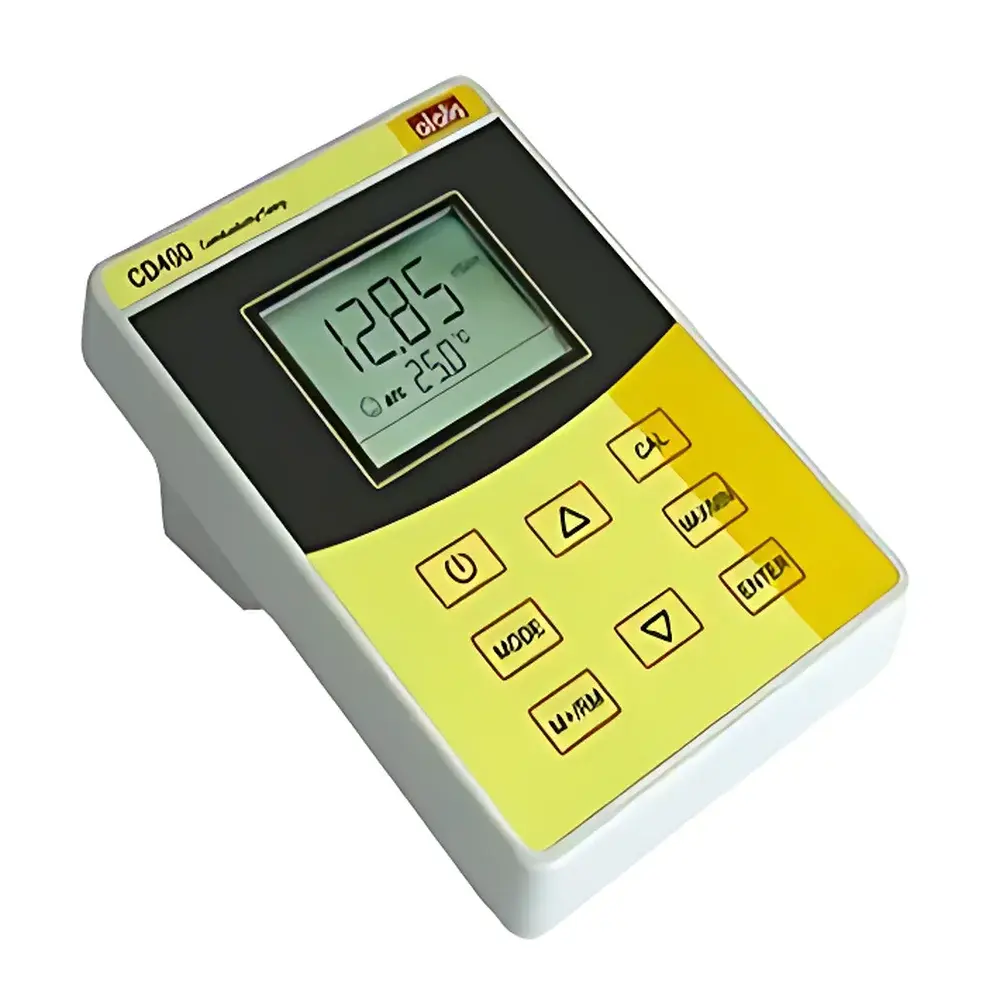
Alalis CD400 Benchtop Conductivity Meter
| Brand | Alalis |
|---|---|
| Origin | Shanghai, China |
| Model | CD400 Basic |
| Form Factor | Benchtop |
| Conductivity Range | 0–200 mS/cm |
| TDS Range | 0–100 g/L |
| Resistivity Range | 0–100 MΩ·cm |
| Salinity Range | 0–100 ppt |
| Temperature Range | 0–100 °C |
| Accuracy | ±1.0% FS |
| Minimum Resolution | 0.1 μS/cm |
| Calibration | 1–3 point auto-calibration with guidance & verification |
| Electrode Constants Supported | K = 0.1, 1, 10 |
| Temp Compensation | Auto/manual (0–50 °C) |
| Data Storage | 50 manual entries with min/max tracking |
| Display | 80 × 58 mm LCD, large-font |
| IP Rating | IP54 |
| Compliance | CE-marked for laboratory and industrial use |
Overview
The Alalis CD400 Benchtop Conductivity Meter is a precision-engineered electrochemical instrument designed for continuous and spot-check monitoring of ionic concentration in demanding aqueous environments. Operating on the principle of two-electrode or four-electrode conductometric measurement—depending on selected probe configuration—the CD400 quantifies solution conductivity by applying an alternating current across a pair of electrodes and measuring the resulting conductance, which is inversely proportional to electrical resistance. Its extended temperature range (0–100 °C) and robust thermal compensation architecture make it particularly suited for applications involving high-temperature process streams, including pharmaceutical purified water systems (e.g., multi-effect distillation units), boiler feedwater and condensate loops, heat exchanger monitoring, industrial cleaning baths, and closed-loop cooling circuits. Unlike portable meters optimized for field sampling, the CD400’s benchtop form factor prioritizes long-term stability, operator ergonomics, and integration readiness within quality-controlled lab or plant-floor environments.
Key Features
- Triple-range conductivity measurement (0–200 μS/cm, 200–2000 μS/cm, 2.00–200.0 mS/cm) with automatic range switching and resolution down to 0.1 μS/cm in low-conductivity mode
- Integrated Automatic Temperature Compensation (ATC) with user-selectable β coefficient (0.0–10.0 %/°C) and dual-mode operation (auto/manual, 0–50 °C)
- Intelligent calibration protocol supporting 1–3 point calibration using either CH-series or USA-series standard solutions (total of eight recognized standards)
- Configurable cell constant selection (K = 0.1, 1.0, or 10.0 cm⁻¹) to match electrode geometry and application-specific conductivity regime
- Stable endpoint detection algorithm that suppresses transient noise and ensures reproducible readings under dynamic flow or thermal drift conditions
- Large-format 80 × 58 mm backlit LCD display with high-contrast, oversized numerals—optimized for glove-compatible operation in controlled environments
- IP54-rated enclosure with sealed electrode ports and rubber protective caps, ensuring operational integrity in humid or splash-prone settings
- Non-volatile memory storing up to 50 manually triggered measurements, each timestamped with associated min/max values and temperature metadata
Sample Compatibility & Compliance
The CD400 is validated for use with deionized water, purified water (PW), water for injection (WFI)-adjacent streams, saline solutions, acid/base rinses, and industrial coolant formulations. It complies with ISO 7888:2019 (Water quality — Determination of electrical conductivity), ASTM D1125-22 (Standard Test Methods for Electrical Conductivity and Resistivity of Water), and supports alignment with pharmacopeial requirements (USP , EP 2.2.38). While not inherently 21 CFR Part 11 compliant out-of-the-box, its deterministic calibration logging, fixed data storage structure, and factory-reset traceability enable integration into GLP/GMP workflows when paired with documented SOPs and audit-trail-enabled LIMS interfaces.
Software & Data Management
Data acquisition is fully manual—no proprietary software or USB/Bluetooth connectivity is embedded. All stored entries are accessible directly via front-panel navigation and may be exported manually via visual transcription. The instrument maintains internal calibration history (date, standard used, slope, offset) and retains configuration parameters across power cycles. For regulated environments, users may implement external validation protocols to document firmware version, calibration certificate linkage, and operational verification per IQ/OQ guidelines. The “Factory Reset” function clears all user data and restores default settings—providing a defined baseline prior to requalification.
Applications
- Pharmaceutical water system validation: real-time monitoring of distillate purity in multi-effect stills and vapor compression units
- Power generation: condensate polisher performance verification and feedwater contamination detection
- Electroplating and metal finishing: bath conductivity control during alkaline cleaning and acid descaling processes
- Food & beverage: CIP rinse water verification and brine concentration management
- Research laboratories: electrolyte characterization, buffer preparation QC, and membrane fouling studies
- Environmental testing labs: wastewater effluent screening and leachate analysis in compliance with local discharge permits
FAQ
Does the CD400 support GLP-compliant data export?
No—data must be recorded manually. For GLP/GMP environments, users should supplement with external logbooks or integrate via analog output (if equipped) into validated SCADA systems.
Can the CD400 measure ultra-pure water resistivity accurately?
Yes—within its 0–100 MΩ·cm range and ±1.0% FS accuracy specification; however, optimal results require a dedicated low-K (0.01 cm⁻¹) electrode and strict avoidance of atmospheric CO₂ absorption during measurement.
Is temperature compensation mandatory for accurate conductivity reporting?
Yes—conductivity is intrinsically temperature-dependent. The CD400 applies linear compensation (based on user-defined β) unless disabled intentionally for specialized research protocols.
What maintenance is required for long-term reliability?
Regular electrode cleaning with mild detergent or 0.1 M HNO₃, periodic verification against certified standards, and annual verification of ATC sensor drift per manufacturer-recommended intervals.
Can the CD400 be used in hazardous locations?
No—it lacks intrinsic safety certification (ATEX, IECEx) and is rated only for general-purpose indoor laboratory or industrial floor use under IP54 conditions.
Related Products






