
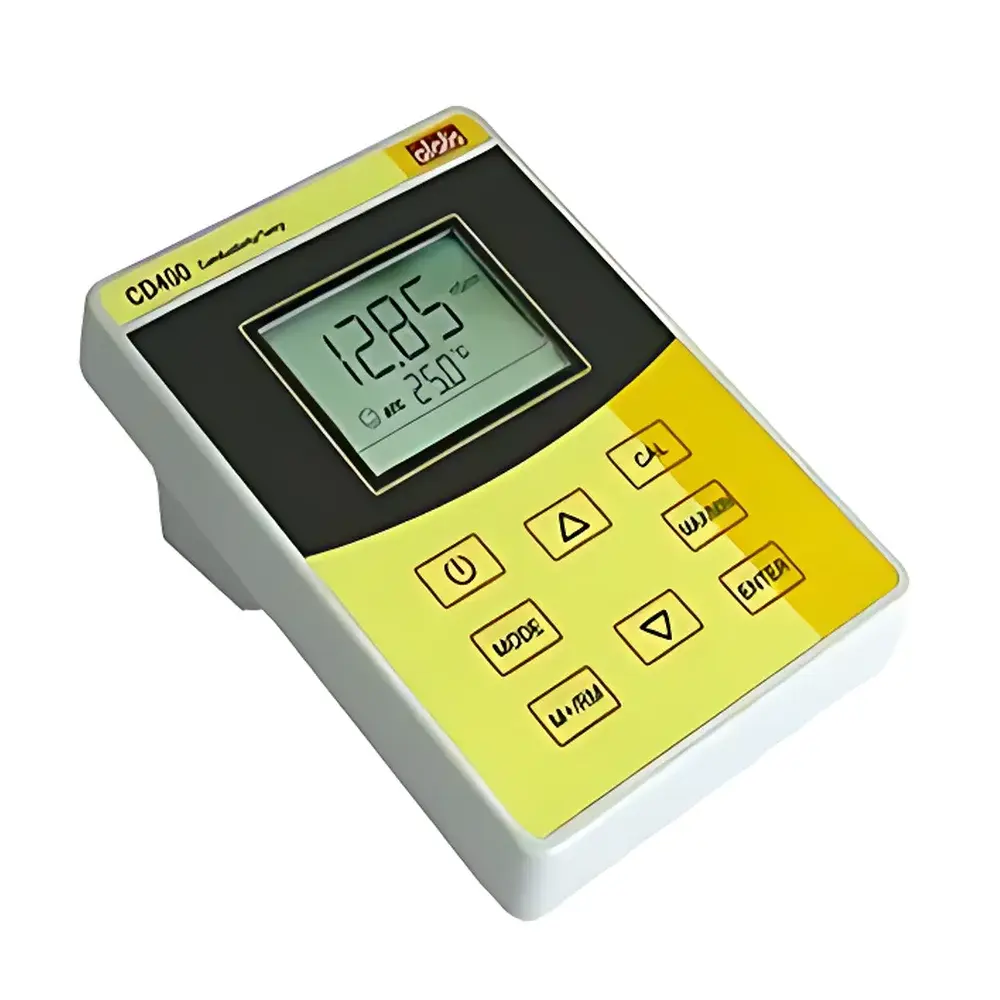
Alalis CD400 Standard Benchtop Conductivity Meter
| Brand | Alalis |
|---|---|
| Origin | Shanghai, China |
| Model | CD400 Standard |
| Form Factor | Benchtop |
| Measurement Parameters | Single-parameter (Conductivity) |
| Conductivity Range | 0–200 mS/cm |
| TDS Range | 0–100 g/L |
| Resistivity Range | 0–100 MΩ·cm |
| Salinity Range | 0–100 ppt |
| Temperature Range | 0–100 °C |
| Accuracy | ±1.0% FS |
| Minimum Resolution | 0.1 µS/cm |
| Calibration | 1–3 point auto-calibration with guidance and validation |
| Electrode Constants Supported | K = 0.1, 1.0, 10.0 cm⁻¹ |
| Temp. Compensation | Automatic/manual (0–50 °C), selectable °C/°F |
| Display | 80 × 58 mm backlit LCD with large-font digits |
| Data Storage | 200 sets with min/max tracking |
| Interface | RS-232 with PC communication software |
| Ingress Protection | IP54 |
| Compliance | Designed for GLP-compliant laboratory and industrial process monitoring environments |
Overview
The Alalis CD400 Standard Benchtop Conductivity Meter is a precision-engineered electrochemical instrument designed for reliable, high-stability conductivity measurement in demanding industrial and regulated laboratory environments. Operating on the principle of two-electrode or four-electrode conductometric analysis—depending on selected probe configuration—the CD400 delivers traceable, temperature-compensated readings across an extended dynamic range (0–200 mS/cm). Its architecture supports continuous operation in elevated-temperature applications such as pharmaceutical multi-effect distillation water systems, boiler feedwater and condensate monitoring, heat exchanger loop integrity assessment, and high-temperature industrial cleaning processes. The meter adheres to fundamental metrological principles defined in ASTM D1125 (Standard Test Methods for Electrical Conductivity and Resistivity of Water) and aligns with ISO 7888 for conductivity measurement methodology. Its wide operating temperature range (0–100 °C for sample measurement, with automatic compensation from 0–50 °C) ensures consistent performance under thermal transients common in steam-cycle and thermal processing infrastructure.
Key Features
- Intelligent 1–3 point auto-calibration with real-time calibration validation and step-by-step on-screen guidance for operator-assisted setup
- Automatic recognition of eight certified conductivity standards across CH (Chinese) and USA (NIST-traceable) series, minimizing manual input errors
- Selectable cell constants (K = 0.1, 1.0, 10.0 cm⁻¹) to match electrode geometry and application-specific conductivity regimes—from ultrapure water (low K) to concentrated brines (high K)
- Endpoint stabilization algorithm that dynamically adjusts response time based on signal stability, improving reproducibility in viscous or particulate-laden samples
- Backlit 80 × 58 mm LCD display with high-contrast, large-digit rendering optimized for ambient lighting conditions in control rooms and QC labs
- Dual-mode temperature compensation: automatic linear compensation (0–50 °C) or manual offset entry; configurable in °C or °F
- Integrated data management: stores 200 measurement records with timestamped min/max values, accessible via front-panel navigation without external software
- RS-232 serial interface compliant with EIA/TIA-232-F standard, enabling bidirectional communication with LIMS or SCADA systems using provided ASCII protocol
- IP54-rated enclosure with sealed connector ports and rubber protective caps—suitable for semi-industrial lab spaces with controlled dust and incidental splash exposure
Sample Compatibility & Compliance
The CD400 accommodates aqueous solutions across broad ionic strength gradients—from deionized water (resistivity up to 100 MΩ·cm) to saturated saline media (up to 100 ppt salinity). Its K=1 ATC (Automatic Temperature Compensation) electrode enables direct immersion in flowing or static samples at temperatures up to 100 °C, with thermal drift mitigation via integrated Pt1000 sensor. For regulatory workflows, the instrument supports audit-ready operation: all calibrations are logged with date/time stamps, user ID fields (via optional firmware upgrade), and parameter verification flags. While not inherently 21 CFR Part 11 compliant out-of-the-box, its data export functionality (via RS-232) allows integration into validated electronic record systems meeting FDA, EU Annex 11, and ISO/IEC 17025 requirements when deployed within documented SOPs.
Software & Data Management
The CD400 communicates via ASCII-based RS-232 protocol using standard baud rates (9600 bps default). Included Windows-compatible software provides raw data download, calibration history review, and export to CSV or Excel formats. All stored entries retain full metadata: conductivity value, temperature, date/time, electrode constant, and calibration status. The firmware implements non-volatile memory with write-cycle protection to ensure data integrity during power interruption. Optional batch reporting tools support GLP-aligned documentation, including calibration certificate generation with uncertainty estimation per ISO/IEC 17025 Clause 7.7.
Applications
- Pharmaceutical water systems: Real-time conductivity verification of purified water (PW) and water for injection (WFI) per USP <645> and EP 2.2.38
- Power generation: Monitoring condensate purity, boiler blowdown conductivity, and turbine lube oil contamination screening
- Food & beverage: Batch consistency checks in CIP rinse cycles, brine concentration control, and syrup dilution verification
- Electroplating and metal finishing: Bath conductivity profiling for nickel, copper, and chromium electrolytes
- Environmental labs: Field-deployable bench verification of surface water, wastewater effluent, and desalination product streams
FAQ
Does the CD400 support four-electrode conductivity measurement?
No—the CD400 is configured for two-electrode measurement with ATC. Four-electrode capability requires the CD400-PRO variant with optional dual-potentiostatic module.
Can the instrument be used for USP <645> Water Conductivity testing?
Yes—when paired with a calibrated K=1 electrode and operated within the specified temperature window (10–30 °C for Stage 1), it meets USP <645> system suitability requirements for conductivity verification.
Is the RS-232 interface optically isolated?
No—it is electrically isolated via onboard DC-DC converter but does not include optical isolation. For high-noise industrial environments, use of shielded twisted-pair cabling and proper grounding is recommended.
What is the maximum allowable sample temperature for continuous immersion?
The standard K=1 ATC electrode is rated for continuous operation up to 80 °C. Short-term exposure to 100 °C is permissible but may accelerate electrode aging.
How often should calibration be performed?
Per ISO/IEC 17025 and internal quality protocols, calibration frequency depends on usage intensity and criticality—typically daily for production-critical applications, or before each analytical session in regulated labs.





