
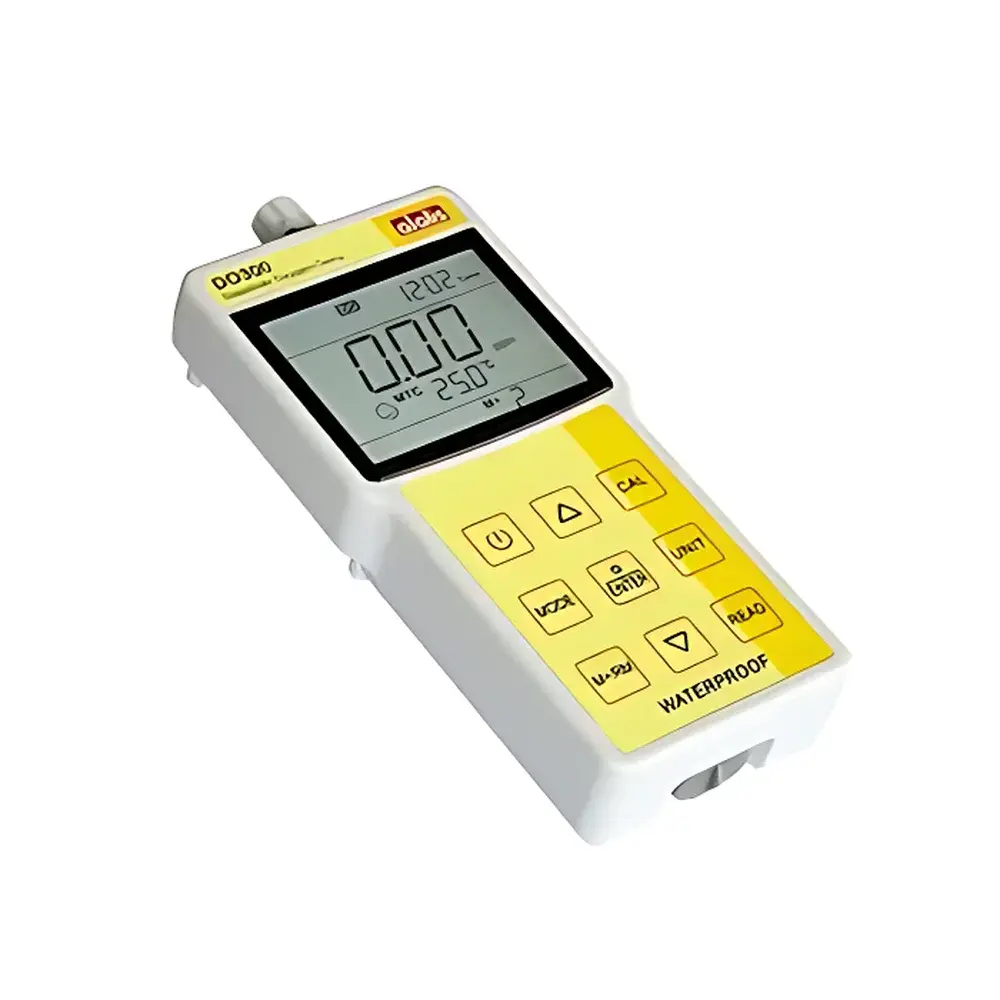
Alalis DO300(1.5m) Portable Dissolved Oxygen Meter
| Brand | Alalis |
|---|---|
| Origin | Shanghai, China |
| Model | DO300(1.5m) |
| Instrument Type | Portable |
| Measurement Principle | Electrochemical Clark-type Polarographic Probe |
| Range | 0–20.00 mg/L |
| Accuracy | ±0.30 mg/L |
| Repeatability | 0.1% |
| Detection Limit | 0.10 mg/L |
| Temperature Compensation | Automatic (0–45 °C) |
| Salinity Compensation | Automatic (0–45 ppt) |
| Barometric Pressure Compensation | Manual (80–105 kPa) |
| Response Time | 30 s (90% at 25 °C) |
| Display | 68 × 53 mm LCD with white backlight and time stamp |
| Data Storage | 500 sets (manual & auto), GLP-compliant |
| IP Rating | IP57 |
| Interface | USB |
| Operating Temperature | −10 to 110 °C |
| Resolution | DO: 0.01/0.1 mg/L |
| Saturation | 0.1/1 % |
| Temp | 0.1 °C |
| Residual Current | ≤0.10 mg/L |
Overview
The Alalis DO300(1.5m) Portable Dissolved Oxygen Meter is a field-deployable electrochemical analyzer engineered for precise, real-time measurement of dissolved oxygen (DO) concentration in aqueous environments using the Clark-type polarographic principle. It employs a membrane-covered amperometric sensor where molecular oxygen diffuses through a selective gas-permeable membrane and is reduced at a cathode surface, generating a current linearly proportional to the partial pressure of O₂ in the sample. This fundamental electrochemical response—calibrated against air-saturated water—is inherently sensitive to temperature, salinity, and atmospheric pressure; the DO300 integrates automatic temperature and salinity compensation algorithms alongside manual barometric adjustment to ensure traceable accuracy across diverse sampling conditions—from freshwater streams and estuarine zones to wastewater effluents and aquaculture tanks.
Key Features
- Integrated polarographic DO probe with built-in thermistor and salinity compensation circuitry—no external modules required
- Automatic temperature compensation (0–45 °C) and salinity compensation (0–45 ppt) aligned with Winkler-derived calibration standards
- Manual barometric pressure input (80–105 kPa) enabling site-specific correction per ISO 5814:2012 guidelines
- Pre-calibrated air-saturation mode with rapid electrode polarization (3–5 minutes), facilitated by replaceable membrane caps and optimized internal electrolyte formulation
- High-contrast 68 × 53 mm backlit LCD display supporting dual-unit temperature readout (°C/°F), real-time clock, and saturation percentage alongside mg/L values
- IP57-rated enclosure ensuring dust resistance and protection against immersion up to 1 m for 30 minutes—validated per IEC 60529
- GLP-compliant data management: 500-stored records with timestamp, probe ID, calibration history, and environmental parameters (T, S, P)
- USB interface with dedicated PC software for data export, audit trail generation, and CSV-compatible reporting—supports basic 21 CFR Part 11 readiness via user-defined login and session logging
Sample Compatibility & Compliance
The DO300(1.5m) is validated for use in natural waters (lakes, rivers, coastal zones), municipal and industrial wastewater, aquaculture systems, and process water streams. Its 1.5-meter cable length enables direct in-situ profiling without ancillary deployment hardware. The instrument complies with core performance criteria outlined in ASTM D888-22 (Standard Test Methods for Dissolved Oxygen in Water) and ISO 5814:2012 (Water Quality — Determination of Dissolved Oxygen — Electrochemical Probe Method). While not certified for regulated pharmaceutical or clinical applications, its GLP-aligned data structure—including immutable timestamps, operator identifiers, and calibration metadata—supports routine environmental monitoring under EPA Method 360.1 and EU Water Framework Directive (WFD) field protocols.
Software & Data Management
The bundled Windows-compatible software enables secure download, visualization, and annotation of stored measurements. Each dataset retains full contextual metadata: date/time, probe serial number, calibration status (zero/span points), ambient temperature/salinity/pressure inputs, and operator notes. Export options include tab-delimited (.txt) and comma-separated (.csv) formats compatible with LIMS integration. Audit logs record all configuration changes, calibrations, and memory operations—supporting internal QA reviews and third-party verification. Firmware updates are delivered via USB without proprietary dongles or cloud dependencies.
Applications
- Aquaculture management: Monitoring DO minima in pond and recirculating aquaculture systems (RAS) to prevent hypoxia-induced mortality
- Wastewater treatment: Tracking aerobic zone DO profiles during activated sludge process control and nitrification optimization
- Environmental field surveys: Rapid assessment of eutrophication stress in lakes and reservoirs per OECD TG 201 guidance
- Drinking water distribution: Verifying residual oxygen stability post-chlorination and during storage tank inspection
- Research-grade limnology: Multi-point vertical profiling in stratified water columns using the 1.5 m probe cable
- Education and training: Robust platform for undergraduate environmental chemistry labs emphasizing sensor fundamentals and error propagation analysis
FAQ
What calibration standards are required for routine operation?
Air-saturated water (prepared per ASTM D888-22 Section 7.3) is the primary two-point calibration reference. Zero-point calibration may be performed using sodium sulfite solution (0 mg/L) when measuring anoxic zones.
Is the probe suitable for seawater applications?
Yes—the integrated salinity compensation (0–45 ppt) and ruggedized membrane cap design enable stable operation across marine, brackish, and hypersaline environments.
How is data integrity ensured during field use?
All stored entries include immutable timestamps, probe identification, environmental compensation parameters, and operator-assigned tags—enabling full traceability per ISO/IEC 17025:2017 Clause 7.7 requirements.
Can the instrument operate continuously underwater?
No—the DO300 is rated IP57, permitting temporary submersion up to 1 meter for ≤30 minutes; it is not designed for long-term submerged deployment.
Does the software support multi-user access control?
The current version supports single-user session logging; role-based permissions require integration with enterprise LIMS platforms via exported CSV files.







