
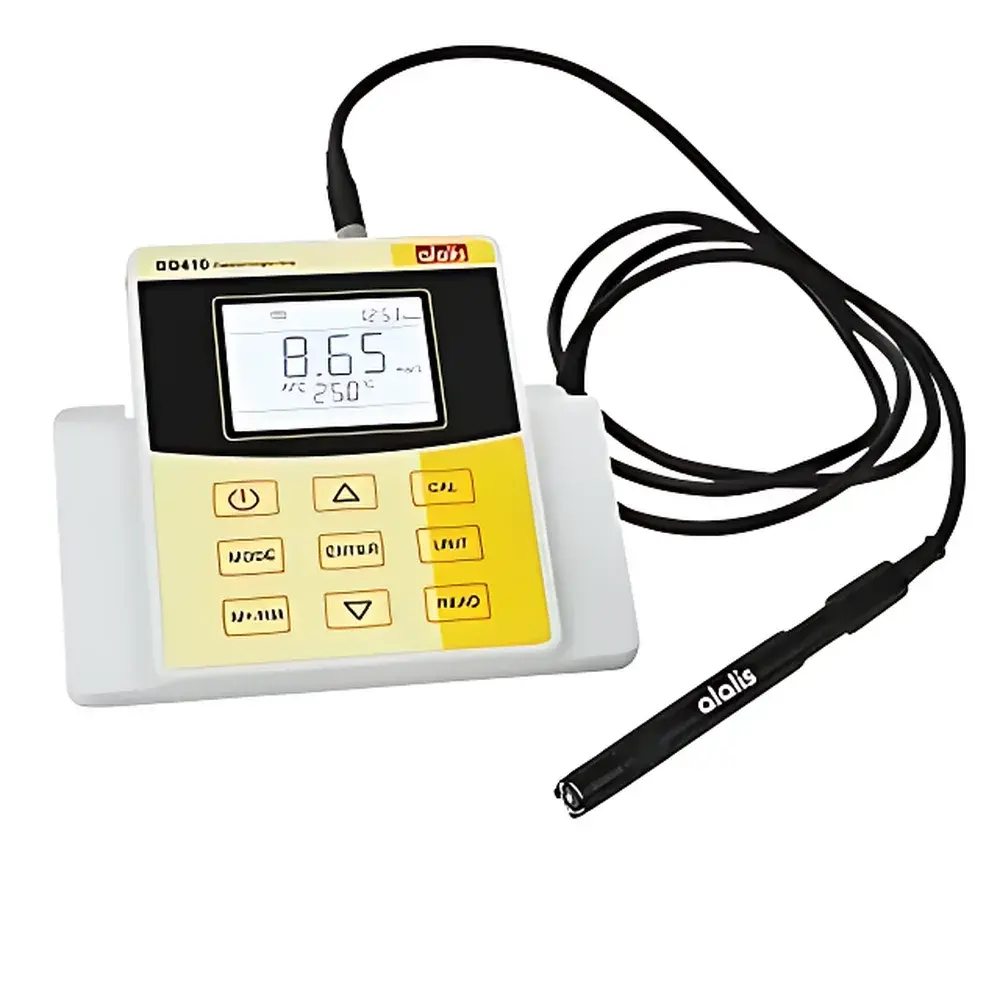
Alalis DO410 Benchtop Dissolved Oxygen Meter
| Brand | Alalis |
|---|---|
| Model | DO410 |
| Origin | Shanghai, China |
| Instrument Type | Laboratory Benchtop Meter |
| Measurement Principle | Polarographic Electrochemical Probe |
| Dissolved Oxygen Range | 0–20.00 mg/L (ppm) |
| Saturation Range | 0.0–200.0 % |
| Temperature Range | −10 to 110 °C |
| Accuracy (DO) | ±0.30 mg/L |
| Accuracy (Temp) | ±0.4 °C |
| Resolution (DO) | 0.01/0.1 mg/L |
| Resolution (Saturation) | 0.1/1 % |
| Resolution (Temp) | 0.1 °C |
| Repeatability | 0.1 % |
| Detection Limit | 0.10 mg/L |
| Response Time | 30 s (90 % at 25 °C) |
| Residual Current Equivalent | 0.10 mg/L |
| Temperature Compensation | Automatic (0–45 °C) |
| Salinity Compensation | Automatic (0–45 ppt) |
| Atmospheric Pressure Compensation | Automatic (80–105 kPa) |
| Data Storage | 500 sets (manual & auto) |
| Display | 90 × 68 mm LCD with white backlight and time stamp |
| IP Rating | IP54 |
| Interface | USB port with included software and cable |
| Power | 9 V AC adapter |
| Electrode | Integrated temperature- and salinity-compensated polarographic probe with replaceable membrane cap and internal electrolyte |
Overview
The Alalis DO410 Benchtop Dissolved Oxygen Meter is a precision-engineered electrochemical instrument designed for reliable, trace-level measurement of dissolved oxygen (DO) concentration in aqueous solutions. It operates on the Clark-type polarographic principle: molecular oxygen diffuses through a gas-permeable polytetrafluoroethylene (PTFE) membrane into an electrolyte-filled chamber, where it undergoes reduction at a cathode (typically gold or platinum) held at a constant polarizing voltage (−0.6 to −0.8 V vs. Ag/AgCl). The resulting diffusion-limited current is linearly proportional to the partial pressure of oxygen—and thus to its concentration in mg/L (ppm) or % saturation—enabling quantitative analysis with high reproducibility. Engineered for laboratory environments, the DO410 meets fundamental requirements for method validation in water quality monitoring, environmental compliance testing, bioprocess control, and academic research. Its robust architecture supports routine use under GLP-aligned workflows, with built-in audit-trail-capable data management.
Key Features
- Triple automatic compensation: temperature (0–45 °C), salinity (0–45 ppt), and barometric pressure (80–105 kPa), minimizing systematic error across diverse sample matrices including freshwater, estuarine, and wastewater.
- Polarographic sensor with integrated Pt cathode and Ag/AgCl reference, paired with a replaceable PTFE membrane cap and pre-filled electrolyte—ensuring consistent response and rapid electrode polarization (<5 min).
- GLP-compliant data handling: 500-point internal memory with timestamped entries (manual or auto-triggered), USB export capability, and dedicated PC software for raw data review, calibration history logging, and report generation.
- High-contrast 90 × 68 mm LCD display with white backlight, real-time clock, dual-unit support (°C/°F), and intuitive menu navigation—including one-button factory reset for configuration recovery.
- IP54-rated enclosure with rubber-sealed ports and protective electrode jack caps, ensuring operational integrity in humid or splash-prone lab settings.
- Bundled intelligent magnetic stirrer and universal electrode stand optimize hydrodynamic conditions during measurement, reducing boundary layer effects and improving response stability.
Sample Compatibility & Compliance
The DO410 is validated for use with natural waters (lakes, rivers, seawater), treated effluents, process streams in aquaculture and fermentation, and quality-controlled samples in beverage production (e.g., wine, brewing). Its polarographic probe design accommodates turbid, particulate-laden, or low-conductivity samples without significant drift—provided membranes remain intact and electrolyte levels are maintained. The instrument adheres to foundational metrological practices outlined in ISO 5814:2012 (Water quality — Determination of dissolved oxygen — Electrochemical probe method) and supports documentation requirements aligned with EPA Method 360.1 and ASTM D888-22. While not certified for regulated GMP manufacturing, its GLP-mode functionality—including user-defined ID entry, calibration lockout, and non-editable storage timestamps—facilitates audit readiness in contract laboratories and university core facilities.
Software & Data Management
The included Windows-compatible software enables full bidirectional communication via USB. Users can download stored measurements, view calibration curves (zero and span points), annotate sessions with sample IDs and notes, and generate CSV or PDF reports compliant with internal QA protocols. Audit trail features record operator login, calibration events, parameter changes, and data exports—supporting traceability per FDA 21 CFR Part 11 guidelines when deployed with appropriate system controls (e.g., password-protected access, electronic signatures). No cloud connectivity or remote access is implemented; all data remains locally managed to preserve confidentiality and regulatory alignment.
Applications
- Environmental monitoring: Routine DO profiling in surface water bodies to assess eutrophication risk, hypoxia events, and compliance with national water quality standards (e.g., China’s GB 3838-2002, US EPA Clean Water Act criteria).
- Wastewater treatment: Process control of activated sludge systems, where DO concentration directly influences nitrification efficiency and energy consumption in aeration basins.
- Aquaculture and fisheries: Real-time assessment of oxygen stress thresholds in hatcheries and recirculating aquaculture systems (RAS), supporting feed optimization and mortality prevention.
- Biopharmaceutical R&D: Monitoring dissolved oxygen in shake flasks and benchtop bioreactors during microbial or mammalian cell culture development.
- Food & beverage QC: Verification of deaeration efficacy in wine musts and bottled products, where residual oxygen accelerates oxidation and flavor degradation.
FAQ
What calibration standards are required for the DO410?
The instrument supports two-point calibration using air-saturated water (100 % saturation) and zero-oxygen solution (e.g., sodium sulfite). A dedicated calibration sleeve is supplied to facilitate rapid, reproducible air-saturation preparation.
Can the DO410 measure in seawater with variable salinity?
Yes—the built-in salinity compensation algorithm accepts user-input or auto-detected salinity values (0–45 ppt), correcting for oxygen solubility changes per the Garcia & Gordon (1992) equation.
Is the electrode suitable for long-term continuous immersion?
The polarographic probe is rated for intermittent or semi-continuous use. For extended deployment (>8 h), periodic membrane cleaning and electrolyte replenishment are recommended to maintain baseline stability and response time.
Does the DO410 comply with ISO/IEC 17025 documentation requirements?
While the device itself is not accredited, its GLP-mode data structure—including immutable timestamps, operator IDs, and calibration metadata—supports traceable recordkeeping essential for ISO/IEC 17025 Clause 7.5 implementation in accredited labs.
How often should the membrane cap be replaced?
Under typical laboratory use (5–10 measurements/day), replacement every 4–6 weeks ensures optimal signal-to-noise ratio and minimizes drift; frequency increases with exposure to oils, surfactants, or high-sediment samples.







