
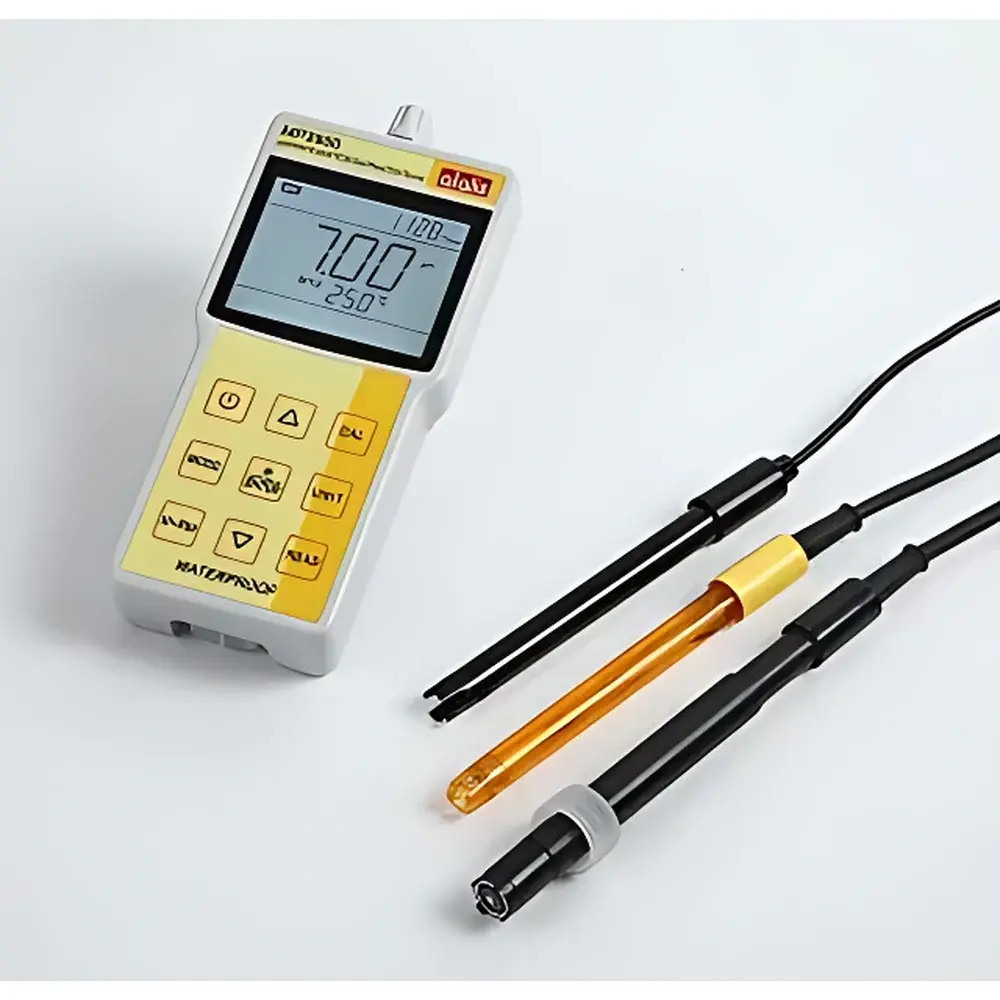
Alalis MP3500 Multi-Parameter Portable Dissolved Oxygen Meter
| Brand | Alalis |
|---|---|
| Origin | Shanghai, China |
| Model | MP3500 |
| Instrument Type | Portable |
| Measurement Principle | Polarographic Electrochemical Probe |
| DO Range | 0–20.00 mg/L |
| Accuracy (DO) | ±0.30 mg/L |
| Repeatability | 0.1% |
| Detection Limit | 0.01 mg/L |
| DO Temperature Compensation | 0–45 °C |
| DO Salinity Compensation | 0–45 ppt |
| Barometric Pressure Compensation | 80–105 kPa |
| IP Rating | IP57 |
| Data Storage | 1000 sets (GLP-compliant) |
| Display | 68 × 53 mm LCD with white backlight |
| Interface | USB |
Overview
The Alalis MP3500 Multi-Parameter Portable Dissolved Oxygen Meter is an engineered field instrument designed for simultaneous, high-fidelity measurement of dissolved oxygen (DO), pH, and conductivity in diverse aqueous environments. It employs a Clark-type polarographic sensor — a proven electrochemical transduction method relying on oxygen reduction at a cathode under controlled polarization voltage — to deliver stable, trace-level DO quantification in real time. Unlike optical or galvanic sensors, the polarographic design offers superior long-term stability, low drift, and well-documented response kinetics suitable for regulatory and research-grade monitoring. The MP3500 integrates temperature, salinity, and barometric pressure compensation algorithms per ISO 5814:2012 and ASTM D888–22, ensuring metrological traceability across freshwater, estuarine, and brackish matrices. Its ruggedized housing, IP57 ingress protection, and extended battery operation make it suitable for unattended deployment in remote sampling campaigns, wastewater outfalls, aquaculture ponds, and surface water quality surveys.
Key Features
- Triple-parameter capability: Simultaneous DO, pH, and conductivity measurement using a single handheld platform.
- Polarographic DO probe with integrated temperature and salinity compensation — eliminates manual correction errors and supports compliance with EPA Method 360.1 and ISO 5814.
- Auto-calibration guidance for pH (1–5 point) and conductivity (1–4 point), supporting CH, USA, and NIST buffer series (15 total pH standards; 8 conductivity standards).
- GLP-compliant data management: 1000 memory slots with timestamp, electrode ID, calibration history, and user-defined sample IDs — fully exportable via USB to PC-based software.
- Dual-mode display: Real-time stabilization indicator + auto-hold function for field measurements under variable conditions.
- Specialized operating modes: High-purity water pH/conductivity mode, ammonia-compensated pH mode for power plant feedwater, and selectable temperature coefficient (α) and reference temperature (e.g., 25 °C vs. 20 °C).
- Modular electrode architecture: 8-pin waterproof connector, triple-junction pH electrode with refillable KCl electrolyte, ATC-equipped conductivity cell (K = 1.0 cm⁻¹), and replaceable DO membrane cap with pre-filled electrolyte.
- Configurable environmental compensation: Automatic DO temperature compensation (0–45 °C), salinity compensation (0–45 ppt), and manual barometric pressure input (80–105 kPa).
Sample Compatibility & Compliance
The MP3500 is validated for use with natural waters (lakes, rivers, coastal zones), treated effluents, aquaculture systems, fermentation broths, and process cooling loops. Its polarographic DO sensor exhibits minimal interference from common ions (Cl⁻, NO₃⁻, SO₄²⁻), hydrogen sulfide (<50 µg/L), and moderate organic loadings — consistent with performance thresholds defined in US EPA OW-2019-001 and ISO/IEC 17025:2017 for environmental testing laboratories. All calibration and measurement records adhere to GLP principles, including audit trails, operator authentication prompts, and non-erasable metadata. The device meets IEC 61000-4 electromagnetic compatibility requirements and conforms to RoHS Directive 2011/65/EU. While not FDA 21 CFR Part 11 certified out-of-the-box, its data export format (CSV/Excel-compatible) supports integration into validated LIMS environments requiring electronic signature and change control.
Software & Data Management
The included PC software enables full configuration, firmware updates, and bidirectional data exchange. Raw measurement logs include DO concentration (mg/L and % saturation), pH, mV, conductivity, TDS, resistivity, salinity, temperature, atmospheric pressure, and electrode status flags (e.g., membrane integrity warning). Each entry is tagged with UTC timestamp, user ID, and calibration verification codes. Data can be filtered by date range, parameter, or site ID; exported reports comply with ISO 14001 environmental audit documentation standards. Optional CSV-to-LabArchives or ELN ingestion scripts are available upon request for GxP-aligned workflows.
Applications
- Environmental monitoring: Routine DO profiling in lakes, streams, and marine ecosystems per USGS NWIS protocols.
- Wastewater treatment: Aeration basin optimization, nitrification/denitrification control, and discharge compliance verification against local NPDES permits.
- Aquaculture: Real-time DO surveillance in recirculating aquaculture systems (RAS) to prevent hypoxia-induced mortality.
- Pharmaceutical water systems: Monitoring purified water (PW) and water-for-injection (WFI) loop DO levels during sanitization cycles.
- Research & education: Field-based limnology studies, biogeochemical flux modeling, and undergraduate analytical chemistry labs.
FAQ
What is the recommended warm-up and polarization time for the DO electrode?
Polarization requires 3–5 minutes prior to first use or after membrane replacement; subsequent measurements stabilize within 15–30 seconds under continuous operation.
Can the MP3500 measure dissolved oxygen in seawater?
Yes — automatic salinity compensation (0–45 ppt) and pressure correction ensure accuracy across marine salinities; verify calibration using saturated air or Winkler titration reference values.
Is the instrument compatible with third-party electrodes?
No — the 8-pin interface and embedded compensation algorithms are proprietary to Alalis-certified electrodes; use of non-OEM probes voids calibration validity and GLP compliance.
How is traceability maintained for field calibrations?
Each calibration event stores buffer lot numbers, expiration dates, ambient temperature, and operator ID; all metadata is retained in the 1000-entry log and exported with raw data.
Does the device support ISO/IEC 17025-compliant uncertainty estimation?
While the MP3500 does not compute expanded uncertainty internally, its documented accuracy (±0.30 mg/L DO), repeatability (0.1%), and environmental compensation residuals align with typical Type B uncertainty components used in accredited lab uncertainty budgets.
Related Products







