
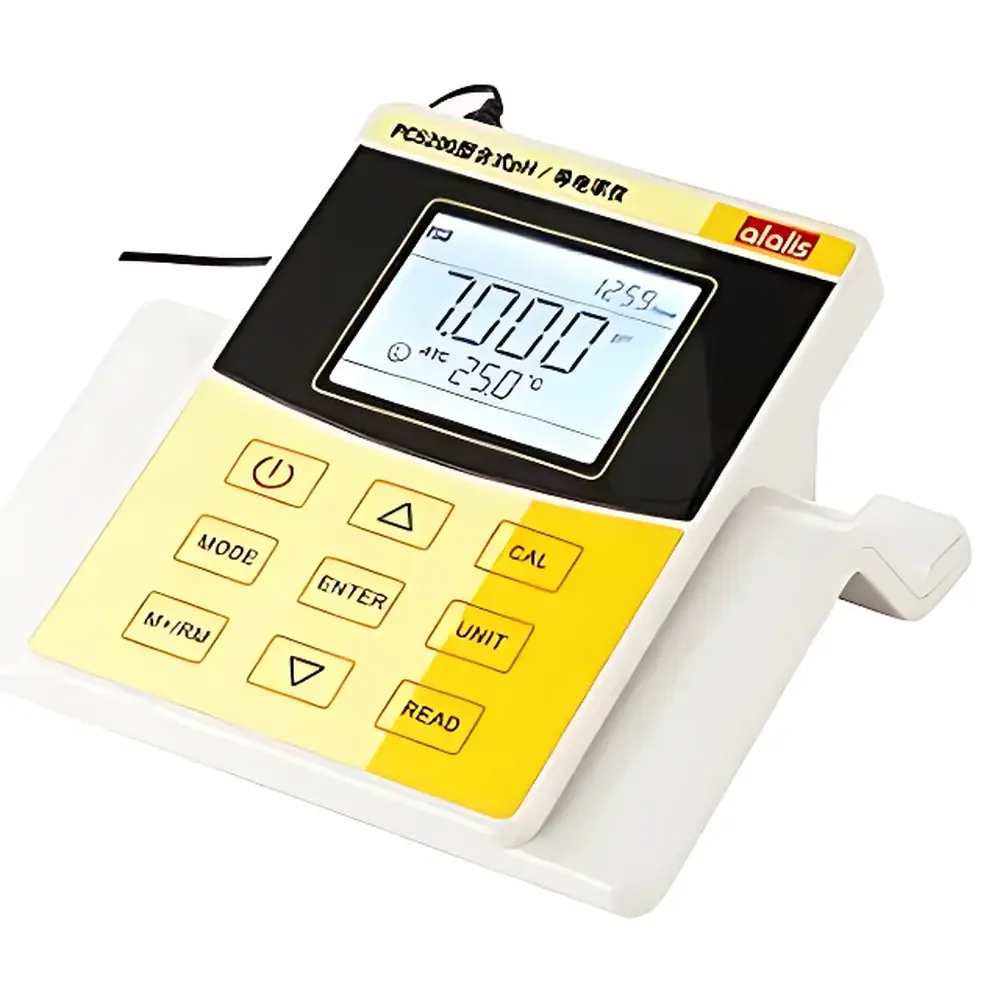
Alalis PC5200 Benchtop Multiparameter pH/Conductivity Meter
| Brand | Alalis |
|---|---|
| Origin | Shanghai, China |
| Model | PC5200 |
| Form Factor | Benchtop |
| pH Range | −2.000 to 19.999 pH |
| pH Resolution | 0.001 pH |
| pH Accuracy | ±0.002 pH |
| mV Range | ±1999.9 mV |
| mV Resolution | 0.1 mV |
| mV Accuracy | ±0.03% FS |
| Conductivity Range | 0.00 μS/cm to 2000 mS/cm (6 sub-ranges) |
| Conductivity Resolution | 0.01/0.1/1 μS/cm |
| Conductivity Accuracy | ±0.5% FS |
| Resistivity Range | 0 to 100 MΩ·cm |
| TDS Range | 0 to 100 g/L |
| Salinity Range | 0 to 100 ppt |
| Temperature Range | −10 to 100 °C |
| Temperature Resolution | 0.1 °C |
| Temperature Accuracy | ±0.4 °C |
| Temperature Compensation | Automatic or manual (0–50.0 °C) |
| Electrode Constant Selection | Yes |
| Temp. Coefficient Selection | Yes |
| Data Storage | 1000 sets (manual & auto) |
| Interface | USB |
| Compliance | GLP-compliant data management |
| IP Rating | IP54 |
| Display | 90 × 68 mm LCD with white backlight and time stamp |
Overview
The Alalis PC5200 Benchtop Multiparameter pH/Conductivity Meter is an engineered solution for laboratories and industrial quality control environments requiring simultaneous, high-fidelity measurement of pH, conductivity, resistivity, TDS, salinity, redox potential (mV), and temperature. Designed around electrochemical sensing principles—including potentiometric pH determination via glass membrane electrodes and conductometric measurement based on Ohm’s law—the instrument delivers traceable, reproducible results across a broad operational envelope. Its architecture supports rigorous regulatory workflows, particularly in pharmaceutical water system validation (e.g., USP , EP 2.2.38), boiler feedwater monitoring (ASME PTC 19.11), and high-purity steam condensate analysis where low-conductivity (10.5) measurements demand specialized compensation algorithms and electrode stability.
Key Features
- Multi-point calibration support: up to 5-point pH auto-calibration and 4-point conductivity auto-calibration, with real-time guidance and validation feedback
- Comprehensive standard solution compatibility: 15 pH buffer options (CH, USA, NIST series + user-defined) and 8 conductivity standards (CH, USA series + custom)
- Dedicated high-purity water modes: optimized pH measurement for ultrapure water (including ammonia-doped systems) and low-conductivity (<0.1 µS/cm) resistivity calculation with cell constant correction
- Redox (ORP) measurement capability with mV readout (±1999.9 mV, ±0.03% FS)
- Intelligent endpoint detection: auto-hold function with stability threshold adjustment and configurable response delay for viscous or low-ionic-strength samples
- Large 90 × 68 mm backlit LCD with time/date stamp, multi-parameter simultaneous display, and intuitive icon-driven navigation
- Full temperature management: automatic/manual compensation (−10 to 100 °C), selectable reference temperature (20 °C or 25 °C), and adjustable linear/non-linear β coefficient
- Robust mechanical design: IP54-rated enclosure with sealed electrode ports and rubber protective caps for environmental resilience
Sample Compatibility & Compliance
The PC5200 accommodates aqueous matrices ranging from aggressive industrial effluents (pH −2 to 19.999, conductivity up to 2000 mS/cm) to ultrapure water systems (resistivity up to 100 MΩ·cm). Its dual-electrode configuration—comprising a high-precision glass composite pH electrode and an ATC-equipped conductivity cell (K = 1.0 cm⁻¹)—enables accurate, drift-resistant measurements without cross-contamination. The instrument adheres to Good Laboratory Practice (GLP) requirements through timestamped, operator-ID-tagged data logging (1000 entries), audit-trail-capable USB export, and non-volatile memory retention. While not certified for 21 CFR Part 11 compliance out-of-the-box, its structured data format and deterministic calibration history support integration into validated workflows under ISO/IEC 17025 or ASTM D1125 frameworks.
Software & Data Management
Data acquisition and reporting are facilitated via included Windows-compatible communication software, enabling bidirectional transfer of calibration records, measurement logs, and instrument settings. All stored entries include parameter values, date/time stamps, electrode IDs (if tagged), temperature, and calibration status flags. Export formats include CSV and plain-text for LIMS or ELN ingestion. Firmware updates are performed via USB interface, ensuring long-term maintainability. The system supports full factory reset with one-button operation, preserving configuration integrity during technician handover or revalidation cycles.
Applications
- Pharmaceutical water systems: PW, WFI, and pure steam condensate monitoring per USP and EU GMP Annex 1
- Power generation: boiler feedwater, condensate polishing, and turbine cycle chemistry control
- Microelectronics: rinse bath conductivity verification and deionized water purity assurance
- Chemical manufacturing: reaction mixture pH tracking, catalyst wash water characterization, and corrosion inhibitor dosing verification
- Academic research: electrochemistry teaching labs, environmental water quality studies, and membrane filtration performance evaluation
FAQ
Does the PC5200 support automatic temperature compensation for both pH and conductivity measurements?
Yes—ATC is implemented independently for each parameter using integrated Pt1000 or NTC thermistors embedded in the supplied electrodes. User-selectable reference temperatures (20 °C or 25 °C) and temperature coefficient (α) values ensure alignment with industry-specific standards.
Can the instrument store calibration data separately for multiple electrodes?
Calibration records are saved per measurement mode (pH/conductivity/mV) but not per individual electrode ID. However, all calibration events are timestamped and include slope, offset, and R² values for traceability.
Is the USB interface compatible with modern operating systems?
The included software supports Windows 10/11 (64-bit). No native macOS or Linux drivers are provided; data export via CSV remains fully functional on all platforms.
What maintenance is required for long-term accuracy?
Regular verification against certified reference standards is recommended per ISO 8655-5. Electrodes should be cleaned with appropriate solutions (e.g., pepsin/HCl for protein fouling, dilute HNO₃ for metal deposits) and stored per manufacturer guidelines. Conductivity cells require periodic K-value verification using traceable standards.
Does the PC5200 meet any international safety or EMC standards?
The instrument complies with IEC 61010-1 (safety) and IEC 61326-1 (EMC) for laboratory equipment. CE marking applies to the EU market; additional regional certifications (e.g., FCC, KC) are not held by default.






