
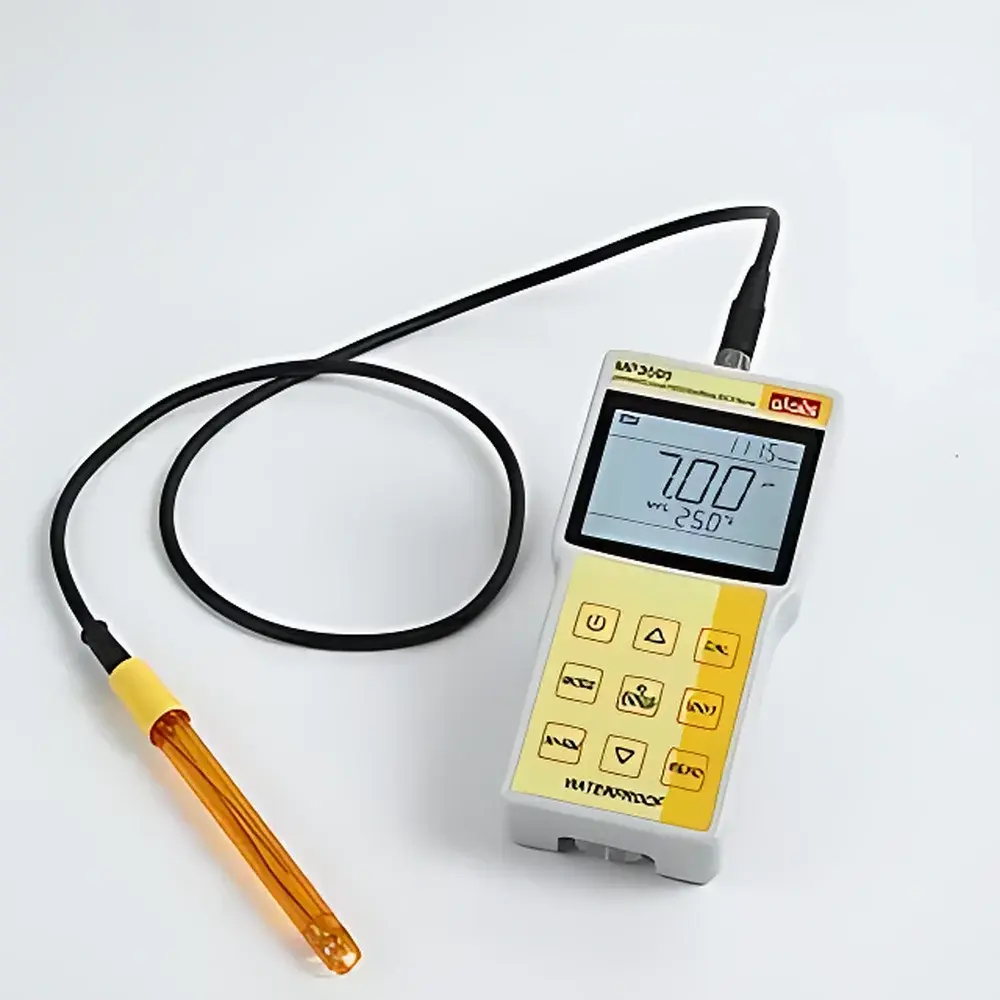
Alalis PD320 Dual-Parameter Portable pH and Dissolved Oxygen Meter
| Brand | Alalis |
|---|---|
| Origin | Shanghai, China |
| Model | PD320 |
| Instrument Type | Portable |
| Measurement Principle | Electrochemical Clark-type Polarographic Probe |
| Dissolved Oxygen Range | 0.0–20.0 mg/L |
| Accuracy (DO) | ±0.30 mg/L |
| Repeatability | 0.1% |
| Detection Limit (DO) | 0.10 mg/L |
| pH Range | −2.00–19.99 pH |
| mV Range | ±1999 mV |
| Temperature Range | −10–110 °C |
| DO Saturation Range | 0.0–200.0 % |
| pH Resolution | 0.01/0.1 pH |
| mV Resolution | 1 mV |
| DO Saturation Resolution | 0.1/1 % |
| Temperature Resolution | 0.1 °C |
| pH Accuracy | ±0.01 pH |
| mV Accuracy | ±0.1% FS |
| Temperature Accuracy | ±0.4 °C |
| Response Time (DO) | 30 s (90% at 25 °C) |
| Residual Current | 0.10 mg/L |
| IP Rating | IP57 |
| Data Storage | 1000 sets (manual & auto) |
| Interface | USB |
| Compliance | GLP-compliant data management |
Overview
The Alalis PD320 Dual-Parameter Portable pH and Dissolved Oxygen Meter is an integrated field-deployable instrument engineered for simultaneous, high-fidelity measurement of pH and dissolved oxygen (DO) in aqueous environmental and process samples. It employs a dual-sensor architecture: a robust tri-combination pH electrode with built-in temperature sensing, and a Clark-type polarographic DO probe featuring a replaceable membrane cap and electrolyte-filled cathode chamber. The DO measurement principle relies on electrochemical reduction of molecular oxygen at a polarized gold cathode under a fixed applied voltage (−0.6 V vs. Ag/AgCl), generating a diffusion-limited current proportional to the partial pressure of O₂—calibrated to concentration (mg/L) using temperature-, salinity-, and barometric pressure-compensated algorithms. This architecture ensures stable, low-drift performance across variable field conditions—from freshwater streams and wastewater effluents to aquaculture ponds and bioreactor monitoring points. Designed for rugged outdoor use, the PD320 meets IP57 ingress protection standards, enabling reliable operation in rain, dust, or temporary submersion up to 1 m for 30 minutes.
Key Features
- Simultaneous real-time display of pH, mV, DO concentration (mg/L), DO saturation (%), and temperature on a 68 × 53 mm backlit LCD with time stamping.
- Comprehensive automatic compensation: pH temperature (0–100.0 °C), DO temperature (0–45 °C), salinity (0–45 ppt), and manual barometric pressure (80–105 kPa).
- Advanced pH calibration suite supporting up to five-point auto-calibration with guided prompts and validation feedback; compatible with CH, USA, and NIST buffer series (15 total standard solutions).
- Dedicated high-purity water and ammonia-doped pure water pH modes—minimizing sodium error and junction potential artifacts in low-conductivity matrices.
- GLP-compliant data management: 1000 storage slots with timestamp, electrode ID, calibration history, and environmental parameters; USB interface for secure export to PC-based analysis software.
- Rapid sensor stabilization: DO electrode polarization time ≤5 minutes; response time ≤30 seconds (90% step change at 25 °C).
- Modular, field-serviceable design: 8-pin waterproof electrode connector; interchangeable DO membrane caps and refillable internal electrolyte; factory-replaceable pH reference system.
Sample Compatibility & Compliance
The PD320 is validated for use across natural waters (lakes, rivers, estuaries), municipal and industrial wastewater, aquaculture systems, fermentation broths, and drinking water distribution networks. Its DO probe operates reliably in turbid, particulate-laden, or low-flow environments due to the hydrophobic Teflon membrane’s resistance to fouling and biofilm adhesion. pH measurements maintain accuracy in low-ionic-strength samples (<50 µS/cm) via adaptive junction potential correction. The instrument conforms to fundamental requirements of ISO 5814:2012 (electrochemical determination of dissolved oxygen) and ASTM D888-22 (measuring dissolved oxygen in water). Data logging adheres to GLP principles—including user authentication, audit trail metadata, and immutable timestamping—supporting regulatory readiness for environmental monitoring programs aligned with EPA Method 360.5 and EU Water Framework Directive reporting frameworks.
Software & Data Management
The included Windows-compatible communication software enables bidirectional data transfer, calibration report generation, and trend visualization. All stored records include full contextual metadata: measurement date/time, operator ID (configurable), electrode serial numbers, calibration slopes/offsets, ambient pressure/salinity inputs, and stability flags. Export formats include CSV and Excel-compatible .xlsx, facilitating integration into LIMS or QA/QC databases. Audit logs capture every configuration change, calibration event, and memory overwrite action—meeting traceability requirements under ISO/IEC 17025 and FDA 21 CFR Part 11 when used with electronic signature-enabled workflows. No cloud dependency: all data resides locally unless explicitly exported by authorized personnel.
Applications
- Field-based environmental assessment: compliance monitoring of surface water DO thresholds per state TMDL programs or WHO drinking water guidelines (≥5 mg/L).
- Aquaculture management: real-time optimization of aeration cycles in shrimp, salmon, or tilapia ponds based on diurnal DO fluctuations.
- Wastewater treatment: tracking DO profiles across activated sludge basins to verify nitrification/denitrification kinetics and prevent filamentous bulking.
- Research-grade limnology: longitudinal profiling of hypolimnetic oxygen depletion in stratified lakes during summer turnover studies.
- Pharmaceutical water system validation: verification of purified water (PW) and water-for-injection (WFI) DO levels per USP and EP 2.2.45 specifications.
FAQ
What calibration standards are required for routine DO verification?
A saturated air calibration (100% air saturation at local temperature, pressure, and salinity) is mandatory before each field session. For higher accuracy, a zero-oxygen standard (sodium sulfite solution) may be used to verify residual current (≤0.10 mg/L).
Can the PD320 measure DO in seawater with salinity >45 ppt?
No—the built-in salinity compensation algorithm is validated only up to 45 ppt. For hypersaline environments (e.g., solar evaporation ponds), manual correction using published solubility tables is recommended.
Is the instrument suitable for continuous immersion or long-term unattended deployment?
The PD320 is rated IP57 for temporary immersion but is not designed for permanent submersion or moored buoy applications. For extended deployments, consider fixed-mount DO/pH transmitters with telemetry interfaces.
How does the high-purity water pH mode improve measurement accuracy?
It applies dynamic liquid junction potential correction and reduces alkali error by optimizing reference electrolyte flow rate and minimizing sodium ion leaching—critical for ultrapure water systems where conventional electrodes exhibit drift >0.2 pH units.
Does the USB interface support direct connection to modern macOS or Linux systems?
The included software is Windows-only; however, raw CSV exports can be parsed on any OS. Driver-free CDC-ACM serial emulation is not implemented—third-party terminal emulation requires virtual COM port configuration via Windows VM.
Related Products







