
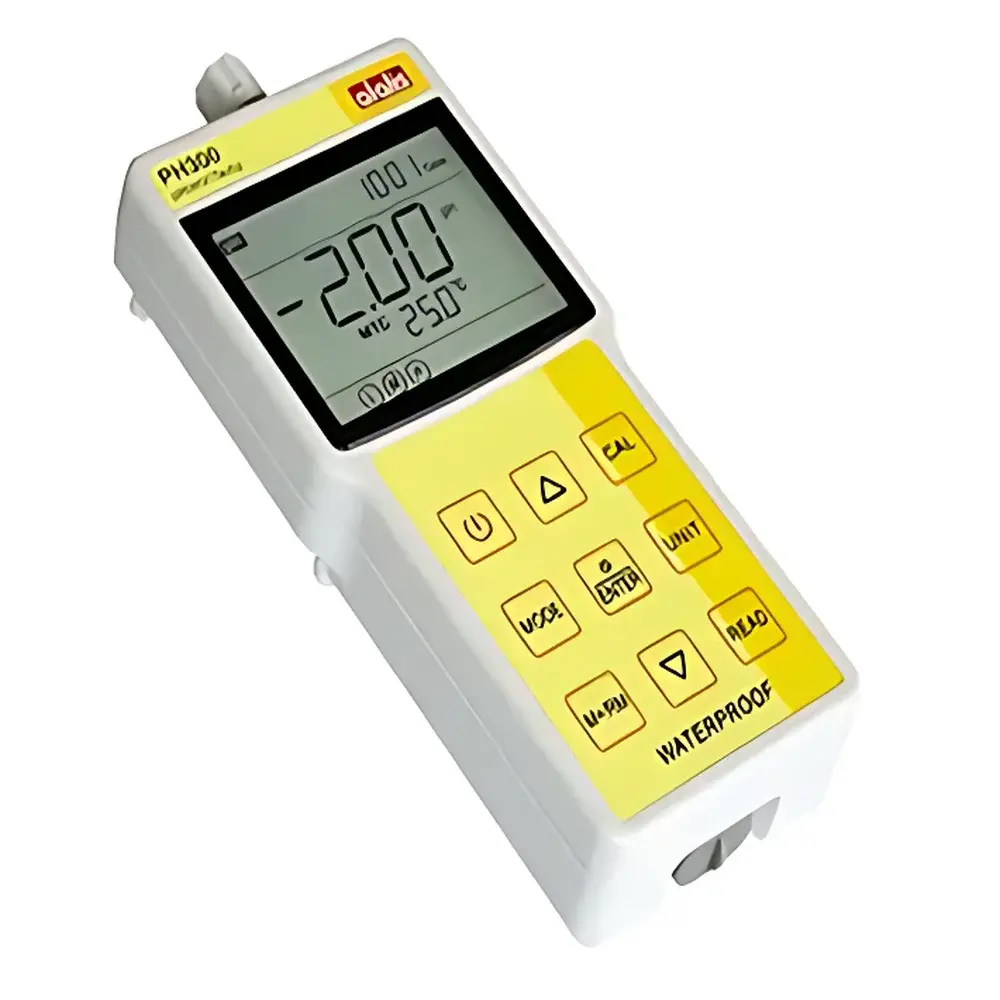
Alalis pH300 Portable Standard pH Meter
| Brand | Alalis |
|---|---|
| Model | pH300 Standard |
| Type | Portable pH Meter |
| Measurement Range | -2.00 to 19.99 pH |
| Resolution | 0.01/0.1 pH |
| Accuracy | ±0.01 pH |
| Temperature Compensation | Automatic/Manual (0–100 °C) |
| Calibration Buffers | CH, USA, and NIST series (15 total) |
| Data Storage | 500 groups with USB export |
| Display | 68 × 53 mm LCD with white backlight |
| IP Rating | IP57 |
| Input Connector | 8-pin waterproof socket |
| Compliance | Supports GLP-compliant data logging and audit-ready calibration records |
Overview
The Alalis pH300 Portable Standard pH Meter is a field-deployable, dual-parameter electrochemical instrument engineered for high-reproducibility pH and mV measurements in diverse liquid-phase environments. Based on potentiometric measurement principles—utilizing a glass pH sensing electrode and reference junction system—the pH300 delivers traceable, stable readings across an extended pH range of −2.00 to 19.99, accommodating highly acidic, neutral, and strongly alkaline solutions encountered in industrial process control, environmental monitoring, and quality assurance laboratories. Its robust architecture integrates temperature-compensated electrode response using either built-in or external Pt1000 sensors, ensuring thermodynamic accuracy per IUPAC-recommended Nernst equation corrections. Designed for compliance-critical workflows, the instrument supports traceable calibration documentation, real-time timestamping, and non-volatile memory retention—making it suitable for routine use in ISO/IEC 17025-accredited labs, FDA-regulated manufacturing (e.g., pharmaceutical water systems), and HACCP-certified food production facilities.
Key Features
- Multi-point calibration support: 1–5 point automatic pH calibration with on-screen step-by-step guidance and buffer recognition for CH, USA, and NIST standard series (15 total certified buffers)
- Intelligent diagnostics: Real-time self-check of electrode impedance, junction potential, and battery status; alerts displayed via icon-based interface
- Dual-resolution mode: Selectable 0.01 pH (high-precision mode) or 0.1 pH (rapid survey mode) resolution based on application requirements
- Stable endpoint detection: Auto-hold function activates upon signal stabilization (±0.01 pH over 3 sec), minimizing operator-dependent reading errors
- GLP-ready data management: Stores up to 500 measurement records with date/time stamp, electrode ID, calibration history, and temperature metadata; exportable via USB to PC
- Ruggedized field design: IP57-rated enclosure with sealed rubber cap protection for all connectors; 8-pin waterproof electrode interface compatible with integrated tri-combination pH electrodes
- Configurable thermal compensation: Manual or automatic temperature compensation (−10 to 110 °C), with user-selectable °C/°F units and adjustable β-coefficient for non-aqueous media
- Extended operational autonomy: Auto-power-off after 10 minutes of inactivity; low-battery indicator and replaceable AA batteries (4 × 1.5 V)
Sample Compatibility & Compliance
The pH300 is validated for aqueous and mildly organic media, including wastewater effluents, fermentation broths, pharmaceutical purified water (PW), clean-in-place (CIP) rinse solutions, and aquaculture pond samples. It complies with ASTM D1293 (Standard Test Method for pH of Water), ISO 7888 (Water Quality — Determination of pH), and USP (pH Measurement). When used with optional ORP electrodes, it meets ASTM D3223 for oxidation-reduction potential assessment. All calibration events generate time-stamped logs with buffer lot numbers and operator IDs—supporting 21 CFR Part 11 readiness when paired with validated software. The instrument’s construction adheres to IEC 61010-1 safety standards for portable electrical equipment in laboratory and field environments.
Software & Data Management
The included Windows-compatible communication software enables bidirectional data transfer, calibration report generation (PDF/CSV), and firmware updates. Each stored record contains full contextual metadata: measurement timestamp (real-time clock synchronized), electrode serial number, calibration date and buffer IDs, ambient temperature, and user-defined sample ID fields. Audit trails are immutable and exportable for internal QA review or regulatory submission. Software supports batch export, statistical summary (mean, SD, min/max), and customizable report templates aligned with ISO/IEC 17025 clause 7.7 (Results reporting).
Applications
- Environmental monitoring: Field testing of surface water, groundwater, and wastewater treatment streams per EPA Method 150.1
- Pharmaceutical manufacturing: On-site verification of purified water and water-for-injection (WFI) systems during routine QC checks
- Food & beverage QA: pH validation of raw materials, intermediate products, and final packaged goods for HACCP and SQF compliance
- Academic research: Teaching labs requiring robust, entry-level instrumentation with full traceability for undergraduate analytical chemistry courses
- Aquaculture & hydroponics: Routine monitoring of nutrient solution pH stability and CO₂-driven acidification effects
- Chemical process control: In-line verification of reaction mixture acidity during batch synthesis or neutralization titrations
FAQ
What calibration standards are supported by the pH300?
The instrument recognizes 15 certified buffer solutions across CH (Chinese National Standard), USA (NIST-traceable), and NIST (National Institute of Standards and Technology) series—including pH 1.68, 4.01, 6.86, 7.00, 9.18, 10.01, and 12.45.
Does the pH300 meet regulatory requirements for GMP/GLP environments?
Yes—when operated with enabled timestamping, calibration logging, and secure data export, it satisfies core GLP documentation requirements and supports 21 CFR Part 11 compliance through controlled software access and electronic signature capability.
Can the pH300 measure redox potential (ORP)?
Yes—using an optional ORP electrode connected via the same 8-pin waterproof interface, the meter measures mV values from −1999 to +1999 mV with 1 mV resolution and ±0.1% FS accuracy.
Is temperature compensation mandatory for accurate pH readings?
While manual input is permitted, automatic temperature compensation (ATC) is strongly recommended to correct for the temperature dependence of electrode slope (typically −0.198 mV/°C per pH unit at 25 °C) as defined in ISO 3696 and ASTM D1293.
How is electrode performance monitored during operation?
The built-in diagnostic mode evaluates electrode asymmetry potential, junction resistance, and response time—displaying warnings if deviations exceed IUPAC-specified thresholds for routine calibration validity.
Related Products






