
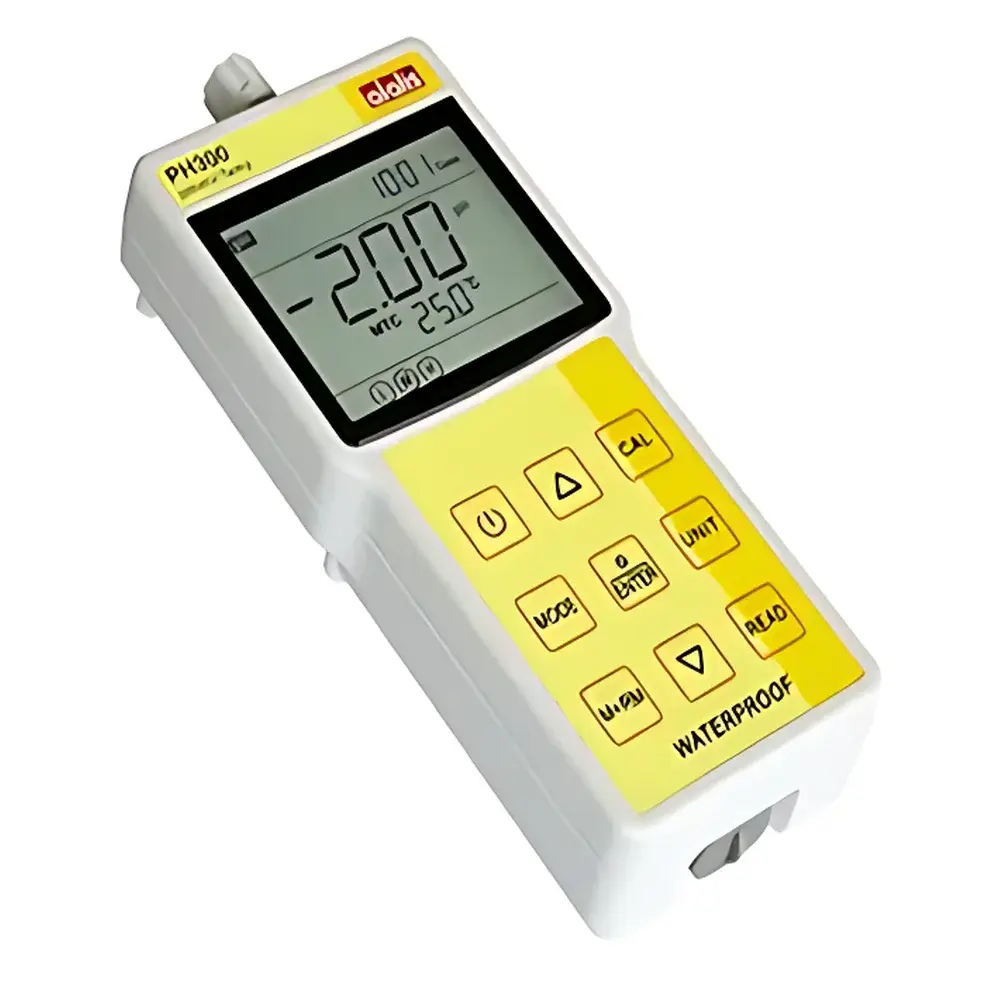
Alalis pH300 Professional Portable pH Meter
| Brand | Alalis |
|---|---|
| Model | pH300 Professional |
| Type | Portable pH Meter |
| Measurement Parameters | Dual (pH & mV) |
| pH Range | −2.00 to 19.99 pH |
| pH Resolution | 0.01 / 0.1 pH |
| pH Accuracy | ±0.01 pH |
| mV Range | ±1999 mV |
| mV Resolution | 1 mV |
| Temperature Range | −10 to 110 °C |
| Temperature Resolution | 0.1 °C |
| Temperature Accuracy | ±0.5 °C |
| Calibration Buffers | CH, USA, and NIST series (15 total) |
| Calibration Points | 1–5 point auto-calibration with on-screen guidance |
| Temperature Compensation | Automatic or manual (0–100 °C) |
| Data Storage | 500 groups with timestamp, recall, and deletion |
| Connectivity | USB interface with PC software |
| Display | 68 × 53 mm LCD with white backlight and real-time clock |
| Enclosure Rating | IP57 |
| Electrode Interface | 8-pin waterproof socket |
| Default Electrodes | Tri-combination pH electrode + plastic-body ORP electrode |
| Special Modes | High-purity water pH mode, ammonia-added pure water pH mode |
| Power | Auto-off with low-battery indicator |
| Compliance | Designed for GLP-compliant field and lab use |
Overview
The Alalis pH300 Professional Portable pH Meter is a dual-parameter electrochemical instrument engineered for high-precision, field-deployable measurement of hydrogen ion activity (pH) and redox potential (mV) in aqueous solutions. Based on potentiometric principle using a glass membrane pH electrode and reference junction system, the pH300 delivers traceable, reproducible readings across an extended pH range of −2.00 to 19.99 — enabling characterization of highly acidic, neutral, and strongly alkaline media encountered in industrial process control, environmental monitoring, and pharmaceutical water systems. Its integrated temperature sensor supports automatic or manual compensation (−10 to 110 °C), ensuring thermodynamic consistency per Nernst equation derivation. The device meets functional requirements for routine QC in regulated environments, including those aligned with USP , ISO 17025, and EPA Method 150.1 for pH determination.
Key Features
- 1–5 point automated pH calibration with interactive on-screen prompts and built-in calibration diagnostics — reducing operator error and improving method adherence.
- Selectable resolution modes (0.01 or 0.1 pH) to match application sensitivity requirements without compromising readability.
- Comprehensive buffer compatibility: supports CH, USA, and NIST standard buffer series (15 total formulations), with programmable calibration due-date alerts and full calibration history logging.
- Stable endpoint detection and auto-hold function ensure reliable recording at electrochemical equilibrium — critical for low-conductivity or viscous samples.
- IP57-rated enclosure with rubber-sealed ports and 8-pin waterproof electrode connector ensures operational integrity in humid, dusty, or splash-prone settings (e.g., wastewater treatment plants, fermentation tanks, outdoor sampling sites).
- Dual-mode pH measurement: dedicated algorithms for high-purity water (low ionic strength) and ammonia-dosed pure water applications — correcting for liquid junction potential drift and carbonate interference.
- Real-time clock stamping of all measurements and calibrations; 500-group internal memory with USB export capability for audit-ready data transfer.
- Integrated ORP measurement channel with plastic-body composite electrode — suitable for disinfection efficacy monitoring and redox-controlled bioprocesses.
Sample Compatibility & Compliance
The pH300 is validated for use with aqueous liquid samples ranging from deionized water (≥1 µS/cm) to concentrated caustic solutions and buffered biological media. It accommodates standard tri-combination pH electrodes and optional specialized probes (e.g., low-temperature, high-temperature, or food-grade variants). All firmware and data handling routines support GLP documentation workflows: calibration events are time-stamped, user-identifiable, and non-erasable until full memory reset. While not FDA 21 CFR Part 11–certified out-of-the-box, the instrument’s audit trail structure (including calibration logs, measurement timestamps, and operator-initiated resets) aligns with Annex 11 and ISO/IEC 17025 data integrity expectations for accredited laboratories.
Software & Data Management
The included Windows-compatible PC software enables bidirectional communication via USB. Users can download stored datasets (with pH, mV, temperature, date/time, and electrode ID metadata), generate calibration reports, and export CSV or PDF formats for QA review. The software enforces structured data naming conventions and supports batch-level annotation — facilitating integration into LIMS or electronic lab notebook (ELN) systems. Firmware updates are distributed through secure vendor channels, with version rollback capability retained for method validation continuity.
Applications
- Environmental field testing: surface water, groundwater, effluent streams, and soil leachates per EPA and ISO protocols.
- Pharmaceutical water systems: PW, WFI, and pure steam condensate monitoring under EU GMP Annex 1 and USP .
- Food & beverage quality assurance: raw material screening, fermentation broth tracking, and final product release testing compliant with HACCP and SQF standards.
- Chemical manufacturing: titration endpoint verification, catalyst bath monitoring, and corrosion inhibitor performance assessment.
- Aquaculture and hydroponics: real-time nutrient solution management and biofilter health evaluation.
FAQ
Does the pH300 support automatic temperature compensation during calibration?
Yes — the instrument applies ATC during both calibration and measurement when a compatible temperature-sensing electrode is connected. Manual TC entry is also supported.
Can I use third-party pH electrodes with the pH300?
The 8-pin waterproof interface is proprietary; only Alalis-certified electrodes guarantee full functionality, including automatic recognition and optimized slope/offset compensation.
Is the internal memory battery-backed?
No — stored data persists only while the main batteries retain charge. Users are advised to regularly export records via USB to prevent loss during prolonged storage.
What does “high-purity water mode” correct for?
This mode applies a modified Nernstian algorithm that accounts for reduced liquid junction potential stability and sodium error in low-conductivity (<10 µS/cm) samples, improving accuracy in ultrapure water systems.
How often should calibration be performed?
Calibration frequency depends on usage intensity and sample matrix. For GLP compliance, daily calibration before first use — plus bracketing calibrations between sample batches — is recommended. The instrument’s calibration reminder function supports scheduled maintenance planning.
Related Products




