
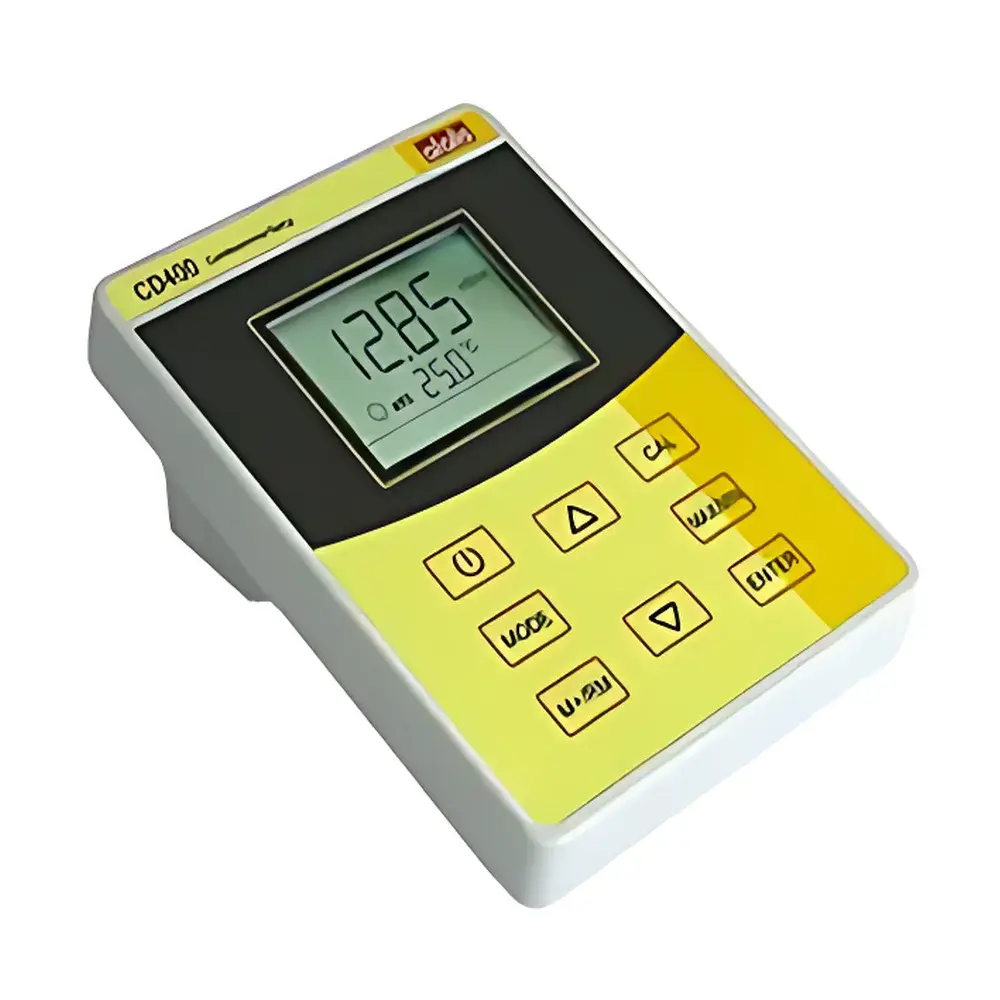
Alalis pH400 Benchtop pH Meter
| Brand | Alalis |
|---|---|
| Model | pH400 Basic |
| Type | Benchtop pH Meter |
| Measurement Parameters | pH and mV (ORP) |
| pH Range | 0.00–14.00 |
| pH Resolution | 0.01 / 0.1 |
| pH Accuracy | ±0.01 |
| Temperature Compensation | Automatic or Manual (0–100 °C) |
| Temperature Resolution | 0.1 °C |
| Temperature Accuracy | ±0.5 °C |
| mV Range | ±1999 mV |
| mV Resolution | 1 mV |
| mV Accuracy | ±0.1% FS |
| Calibration Options | 1–3 point, with CH and USA buffer series (6 total standard buffers) |
| Data Storage | 50 manual entries with min/max recall |
| Display | 80 × 58 mm LCD, large-font interface |
| Enclosure Rating | IP54 |
| Default Electrode | Plastic-body tri-combination pH electrode |
| Power | 9 V DC adapter |
Overview
The Alalis pH400 Benchtop pH Meter is a precision electrochemical instrument engineered for reliable, routine pH and redox potential (ORP) measurements in laboratory, quality control, and industrial process environments. Based on potentiometric measurement principles—detecting the voltage difference between a pH-sensitive glass electrode and a stable reference electrode—the pH400 delivers traceable, reproducible results across the full aqueous pH scale (0.00–14.00). Its dual-parameter capability supports both pH quantification and millivolt (mV) mode for direct electrode potential assessment, making it suitable for applications ranging from raw material verification to finished-product release testing. Designed for compliance-driven workflows, the instrument incorporates features aligned with GLP (Good Laboratory Practice) documentation expectations, including manual data logging with timestamp-agnostic storage, endpoint stabilization logic, and configurable temperature units (°C/°F) to accommodate regional regulatory reporting formats.
Key Features
- 1–3 point pH calibration with on-screen step-by-step guidance and support for both CH-series (Chinese national standard) and USA-series (NIST-traceable) buffer solutions—total of six certified calibration points.
- Intelligent self-diagnostic system that identifies and displays common operational anomalies (e.g., electrode drift, open circuit, low battery) with actionable prompts.
- Selectable pH resolution: user-configurable between 0.01 and 0.1 pH units to balance precision requirements with display clarity.
- Stable endpoint detection algorithm minimizes reading instability caused by slow electrode response or low-conductivity samples, improving measurement repeatability.
- Large-format 80 × 58 mm LCD with high-contrast, enlarged font ensures legibility under varied ambient lighting conditions—including shared lab benches and production-floor settings.
- Comprehensive temperature compensation: automatic (via integrated ATC probe input) or manual entry across 0–100 °C, with accuracy of ±0.5 °C and 0.1 °C resolution.
- IP54-rated enclosure with rubber-sealed electrode ports provides protection against dust ingress and incidental water splashes during routine handling and cleaning.
- One-touch factory reset function enables rapid restoration of default configuration—critical for multi-user labs requiring consistent baseline instrument behavior.
Sample Compatibility & Compliance
The pH400 is optimized for aqueous and mildly buffered liquid samples typical in environmental monitoring, pharmaceutical water systems (Purified Water, WFI), food processing, and municipal wastewater treatment. It accommodates standard 12-mm diameter combination electrodes—including the included plastic-body tri-combination pH electrode—and supports optional ORP electrodes for oxidation-reduction assessments. While not equipped with electronic audit trail or 21 CFR Part 11–compliant software out-of-the-box, its manual data storage (50 entries), min/max value tracking, and stable endpoint output support internal SOPs aligned with ISO/IEC 17025 Clause 7.7 (result reporting) and USP pH measurement guidelines. The instrument meets general safety and EMC requirements per IEC 61010-1 for laboratory electrical equipment.
Software & Data Management
Data handling is performed locally via the front-panel interface. Users may manually store up to 50 measurement records—including pH, mV, and temperature values—with immediate recall of stored entries, as well as real-time display of running minimum and maximum values. No proprietary PC software or USB connectivity is provided; however, recorded values can be transcribed into LIMS or Excel-based QA templates using standard lab documentation protocols. The absence of automated export does not preclude integration into validated workflows when paired with documented procedural controls—such as defined transcription checklists and second-person verification steps—commonly applied in HACCP and QS certification audits.
Applications
- Environmental laboratories: monitoring influent/effluent pH in wastewater treatment plants per EPA Method 150.1.
- Pharmaceutical manufacturing: verifying pH of purified water (PW) and clean-in-place (CIP) rinse solutions in accordance with USP and EU GMP Annex 1.
- Food & beverage QA/QC: batch testing of dairy products, juices, sauces, and fermentation broths where pH correlates directly with microbial stability.
- Aquaculture and hydroponics: routine nutrient solution monitoring to maintain optimal ion availability and prevent precipitation.
- Academic teaching labs: introducing core concepts of electrochemistry, calibration theory, and measurement uncertainty through hands-on potentiometric experiments.
FAQ
Does the pH400 support automatic calibration recognition (Auto-Read)?
No—it uses manual endpoint confirmation with visual stability indication, allowing users to determine acceptable equilibrium based on application-specific criteria.
Can the instrument be used with refillable or gel-filled electrodes?
Yes—its BNC input accepts standard pH electrodes with compatible reference junctions; however, the included plastic tri-combination electrode is non-refillable and intended for general-purpose use.
Is temperature compensation mandatory for accurate pH readings?
While not strictly mandatory, automatic or manual temperature compensation is strongly recommended for measurements outside 25 °C, as pH electrode response exhibits inherent thermal dependence per the Nernst equation.
What buffer standards are supplied with the unit?
The standard kit includes three pH 4.01, 7.00, and 10.01 buffer sachets compliant with CH-series specifications; USA-series buffers (e.g., pH 4.01, 7.00, 10.01 NIST SRM equivalents) are available separately.
How is instrument performance verified between calibrations?
Users should perform daily verification using a fresh, mid-range buffer (e.g., pH 7.00) and document deviation; drift exceeding ±0.02 pH warrants recalibration or electrode inspection per internal SOPs.
Related Products





