
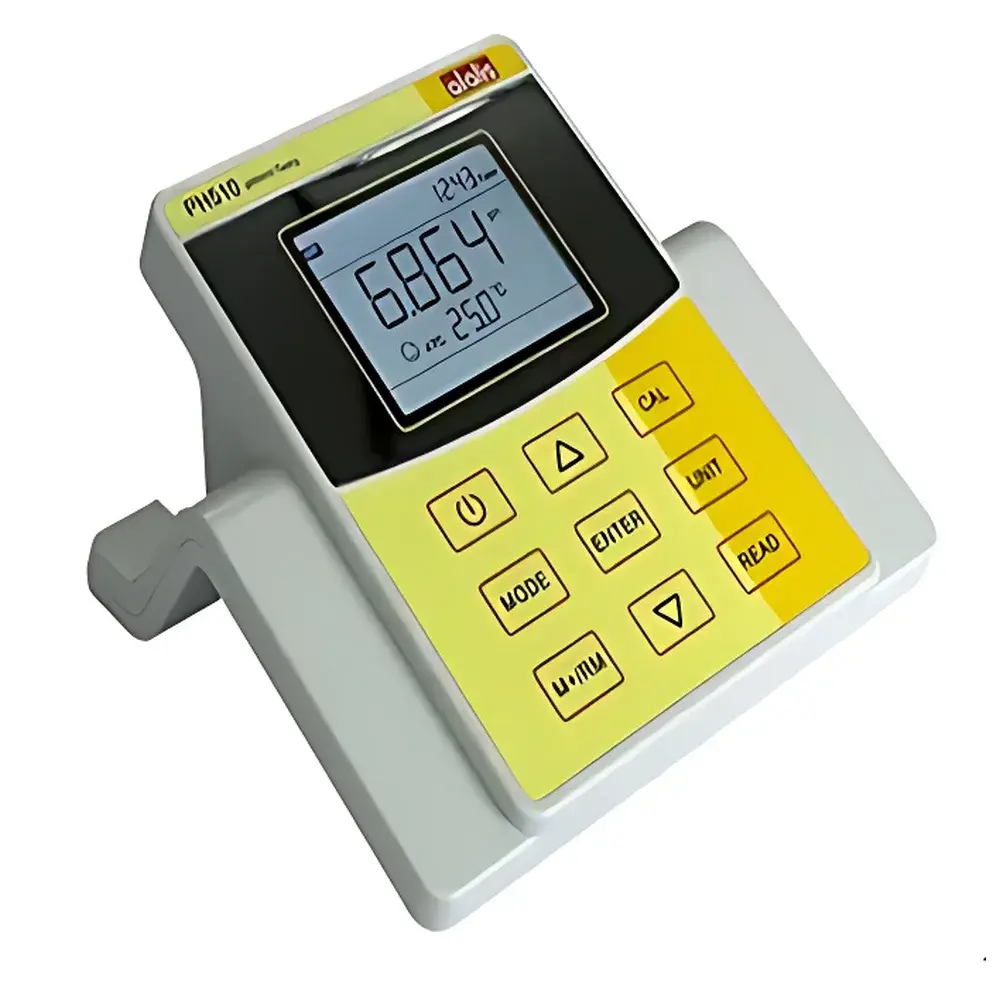
Alalis pH510 Benchtop pH Meter
| Brand | Alalis |
|---|---|
| Model | pH510 Basic |
| Type | Benchtop pH/mV/Temperature Meter |
| Measurement Principle | Potentiometric pH Determination via Glass Electrode |
| pH Range | −2.000 to 19.999 pH |
| pH Resolution | 0.001 / 0.01 / 0.1 pH (selectable) |
| pH Accuracy | ±0.002 pH |
| mV Range | ±1999.9 mV |
| mV Resolution | 0.1 mV |
| mV Accuracy | ±0.03% FS |
| Temperature Range | −10.0 to 110.0 °C |
| Temperature Resolution | 0.1 °C |
| Temperature Accuracy | ±0.4 °C |
| Calibration Options | CH, USA, and NIST buffer series (15 total standard buffers) |
| Calibration Points | 1–5 point automatic calibration with guided prompts and electrode diagnostics |
| Temperature Compensation | Automatic or manual (0.0 to 100.0 °C) |
| Display | 90 × 68 mm LCD with white backlight, large-font numeric readout, real-time clock |
| Data Storage | 500 sets (manual + auto-log), min/max tracking |
| GLP Compliance | Timestamped records, electrode ID logging, calibration history retention |
| Connectivity | USB interface with PC software |
| Environmental Rating | IP54 (dust-protected, splash-resistant) |
| Power | 7.9 V DC adapter |
| Electrode | Integrated high-quality plastic-body triple-junction pH electrode with built-in temperature sensor |
| Special Modes | High-purity water pH mode, ammonia-added pure water mode, redox (E<sub>H</sub>) mode, auto-hold endpoint stabilization |
Overview
The Alalis pH510 Benchtop pH Meter is a precision potentiometric instrument engineered for laboratory-grade pH, mV, and temperature measurement in aqueous and low-ionic-strength media. It operates on the fundamental Nernst equation principle, utilizing a glass membrane electrode to generate a voltage proportional to hydrogen ion activity—converted and displayed as pH with traceable accuracy. Designed for routine quality control, environmental monitoring, and regulated manufacturing environments, the pH510 meets the functional requirements of ISO/IEC 17025-accredited labs and supports compliance-driven workflows including HACCP, ISO 22000, and pharmaceutical water system validation per USP . Its extended pH range (−2.000 to 19.999) accommodates highly acidic or alkaline process streams, while dual-parameter capability enables simultaneous pH and redox potential (EH) assessment—critical for corrosion studies, disinfection efficacy testing, and electrochemical process optimization.
Key Features
- Intelligent 1–5 point automatic calibration with real-time electrode diagnostics and step-by-step on-screen guidance—reducing operator dependency and minimizing calibration drift.
- Multi-standard buffer compatibility: supports all 15 certified reference buffers across CH (Chinese), USA (ASTM E70), and NIST traceable series—ensuring metrological traceability and inter-laboratory comparability.
- Dedicated high-purity water (HPW) and ammonia-added HPW modes apply non-linear temperature and liquid junction compensation algorithms to correct for low-conductivity artifacts—essential for power plant condensate, semiconductor rinse water, and purified water (PW/WFI) systems.
- Redox (EH) measurement mode compliant with ASTM D1129 and ISO 10523, enabling quantitative assessment of oxidizing/reducing capacity in wastewater, bioreactors, and disinfectant solutions.
- Endpoint stabilization logic with configurable response threshold and auto-hold function—optimizing repeatability in kinetic titrations and batch release testing.
- GLP-compliant data management: each stored reading includes timestamp, electrode serial number, calibration status, ambient temperature, and user ID—fully auditable for FDA 21 CFR Part 11 readiness when paired with validated software.
- Rugged IP54-rated enclosure with sealed electrode ports and rubber protective caps—designed for shared lab benches, QC floors, and field-deployable use in humid or particulate-prone environments.
Sample Compatibility & Compliance
The pH510 is validated for use with aqueous samples, buffered solutions, fermentation broths, municipal and industrial effluents, pharmaceutical process water, food extracts, and electroplating baths. It excludes non-aqueous, viscous, or highly proteinaceous matrices without appropriate electrode conditioning and sample dilution protocols. The instrument conforms to IEC 61010-1 (safety), IEC 61326-1 (EMC), and EN 62366-1 (usability). Its calibration traceability aligns with ISO/IEC 17025 Clause 6.4.10; buffer standards are certified to NIST SRM 186, NIST SRM 187, and GBW(E)130001–GBW(E)130015. For regulated industries, full audit trails—including calibration event logs, electrode performance history, and data export metadata—are retained locally and exportable via USB in CSV or proprietary binary format.
Software & Data Management
The included Windows-compatible PC software provides secure data import, trend visualization, statistical analysis (mean, SD, RSD, confidence intervals), and customizable report generation (PDF/Excel). All communications adhere to USB CDC ACM protocol with no driver installation required on modern OS versions. Data files include embedded digital signatures verifying integrity and origin—supporting ALCOA+ principles (Attributable, Legible, Contemporaneous, Original, Accurate). When deployed in GxP environments, the software may be qualified per IQ/OQ protocols; raw data files retain uneditable timestamps and checksums to satisfy FDA 21 CFR Part 11 Subpart B requirements for electronic records and signatures.
Applications
- Environmental labs: Surface water, groundwater, and wastewater pH/EH profiling per EPA Method 150.1 and ISO 10523.
- Pharmaceutical manufacturing: Purified water (PW) and water for injection (WFI) monitoring per USP , cleaning validation rinse testing.
- Food & beverage QA: Acidification control in dairy, juice, and fermented products; HACCP critical limit verification.
- Chemical R&D: Catalyst stability screening, hydrolysis kinetics, and buffer capacity evaluation.
- Academic teaching labs: Electrochemistry fundamentals, Nernst equation validation, and sensor response characterization.
FAQ
Does the pH510 support automatic temperature compensation (ATC) with external probes?
Yes—it accepts Pt1000 and thermistor-based ATC probes (not included), in addition to its built-in temperature sensor.
Can calibration data be exported for audit purposes?
Yes—calibration events, including date/time, buffer IDs, slope/mV/pH values, and electrode offset, are stored and exportable via USB in human-readable CSV format.
Is the triple-junction pH electrode compatible with aggressive solvents or HF-containing solutions?
No—the standard electrode is designed for aqueous media only; HF, strong oxidizers, or organic solvents require specialized electrodes with ceramic or PTFE junctions.
What is the maximum storage duration for logged data before overwrite?
Data persists indefinitely until manually cleared or overwritten; the 500-entry buffer operates on FIFO (first-in, first-out) logic when full.
Does the instrument meet GLP requirements out-of-the-box?
It provides GLP-ready functionality (timestamped logs, calibration history, electrode tracking); formal GLP compliance requires site-specific SOPs and periodic instrument verification per internal quality procedures.





