
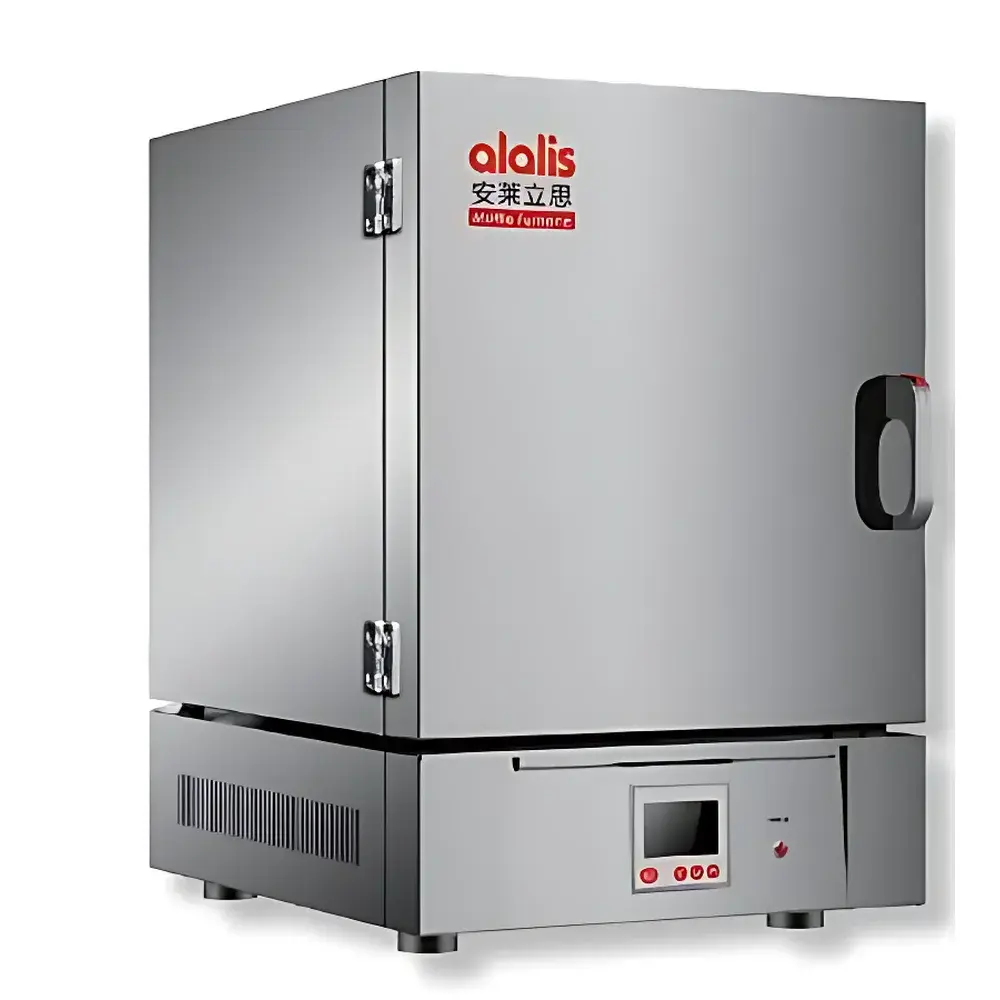
Alalis SX-1107 Professional Box-Type Muffle Furnace
| Brand | Alalis |
|---|---|
| Origin | USA |
| Model | SX-1107 |
| Instrument Type | Box-Type Muffle Furnace |
| Maximum Temperature | 1100 °C |
| Temperature Control Accuracy | ±3 °C |
| Rated Power | 3 kW |
| Heating Time to Max Temp | 35–65 min |
| Internal Dimensions | 200 × 300 × 120 mm (L × W × H) |
| External Dimensions | 460 × 650 × 674 mm (L × W × H) |
| Chamber Volume | 7 L |
| Heating Element | Fe-Cr-Al Alloy Wire |
| Insulation Material | Alumina Ceramic Fiber |
| Thermocouple Type | K-Type |
| Power Supply | 220 V, 50/60 Hz, Single Phase |
| Weight | 45 kg |
| Programmable Stages | Multi-segment |
| Data Storage | USB Interface (Optional) |
| Safety Features | Overtemperature Protection, Door Interlock, Overcurrent & Overload Protection, Surface Cooling Fan, Auto-Calibration, Power-Fail Memory |
Overview
The Alalis SX-1107 Professional Box-Type Muffle Furnace is an engineered thermal processing system designed for precise, repeatable high-temperature operations in analytical laboratories, materials research facilities, and quality control environments. Operating on resistive heating principles via Fe-Cr-Al alloy heating elements, the furnace achieves stable thermal equilibrium across its 7 L alumina ceramic fiber-insulated chamber—enabling uniform heat distribution and minimal thermal lag. With a maximum operating temperature of 1100 °C and continuous duty capability up to 1000 °C, the SX-1107 supports standardized thermal treatments including ashing, calcination, sintering, annealing, and heat treatment of small metallic components. Its compliance with IEC 61000-4 electromagnetic compatibility standards and adherence to UL/CSA electrical safety requirements ensure safe integration into regulated laboratory workflows.
Key Features
- Microprocessor-based P.I.D. temperature controller with auto-tuning and real-time deviation compensation for ±3 °C thermal stability at setpoint
- Multi-segment programmable controller supporting up to 7 user-defined thermal profiles, each with ramp-hold-soak sequences and power-fail memory retention
- High-purity alumina ceramic fiber insulation (density ~128 kg/m³) providing low thermal conductivity (<0.08 W/m·K at 800 °C) and extended service life under cyclic operation
- Front-loading design with spring-assisted, counterbalanced stainless steel (SUS304) door and integrated interlock switch that de-energizes heating elements upon opening
- Active surface cooling system: rear-mounted low-noise axial fan maintains external cabinet temperature below 55 °C during extended operation
- Integrated flue chimney with natural draft ventilation—supports controlled atmosphere conditions by facilitating volatiles removal and minimizing internal condensation
- Optional USB data logging interface enables traceable temperature history export in CSV format for GLP/GMP documentation and audit readiness
Sample Compatibility & Compliance
The SX-1107 accommodates crucibles, boats, and shallow trays up to 200 mm × 300 mm base footprint and 120 mm height, compatible with platinum, alumina, silicon carbide, and quartz ware. It meets ASTM E1112 (Standard Specification for Laboratory Muffle Furnaces), ISO 5659-2 (fire testing—smoke production), and USP heavy metal residue ashing protocols. The furnace’s K-type thermocouple sensor conforms to IEC 60584-1 tolerance Class 2 (±2.5 °C or ±0.75% of reading). All electrical architecture complies with IEC 61010-1:2010 for laboratory equipment safety, including reinforced insulation, double-pole isolation switching, and earth leakage detection.
Software & Data Management
While the standard configuration features a dedicated front-panel controller with intuitive rotary encoder navigation, optional firmware upgrade supports RS-485 Modbus RTU communication for integration into centralized lab management systems (e.g., LabWare LIMS, Thermo Fisher SampleManager). Temperature profiles are stored in non-volatile EEPROM with timestamped execution logs. When equipped with the USB module, users may export full-cycle thermal records—including ramp rates, dwell durations, peak deviations, and alarm events—for FDA 21 CFR Part 11-compliant review when paired with validated electronic signature software. Audit trail functionality includes operator ID tagging, parameter change history, and firmware version tracking.
Applications
- Gravimetric ash content determination per AOAC 942.05, EPA Method 1694, and ISO 1171 for food, soil, and polymer matrices
- Pre-treatment of catalyst supports and ceramic green bodies prior to sintering in materials development labs
- Controlled oxidation of metallic alloys for microstructural homogenization in metallurgical QA/QC
- Thermal decomposition studies of pharmaceutical excipients under inert or ambient air atmospheres
- Calibration of thermogravimetric analyzers (TGA) using certified reference materials (CRMs) traceable to NIST SRM 720e
- Residue-on-ignition (ROI) testing for inorganic impurities in APIs per ICH Q5D guidelines
FAQ
What is the recommended maintenance interval for the SX-1107 furnace?
Routine inspection of door gasket integrity, thermocouple calibration verification, and visual assessment of heating element continuity should be performed every 200 operational hours or quarterly—whichever occurs first.
Can the SX-1107 operate under inert gas purge?
Yes; the chimney port and door gap allow passive nitrogen or argon purging. For active flow control, optional inlet/outlet fittings (PN: SX-GAS-KIT) support mass flow rates up to 2 L/min.
Is the furnace compliant with GLP documentation requirements?
When configured with the USB data logger and used with validated third-party software, it satisfies ALCOA+ data integrity principles—including attributable, legible, contemporaneous, original, and accurate recordkeeping.
Does the controller support remote monitoring via Ethernet or Wi-Fi?
Not natively; however, the RS-485 Modbus interface permits connection to industrial gateways (e.g., Moxa EDS-G205A) for protocol translation to TCP/IP networks.
What is the expected service life of the heating elements under normal usage?
Fe-Cr-Al alloy wires typically exceed 3,000 hours of cumulative operation at ≤1000 °C, assuming proper thermal cycling practices and avoidance of rapid quenching or corrosive sample volatiles.



