
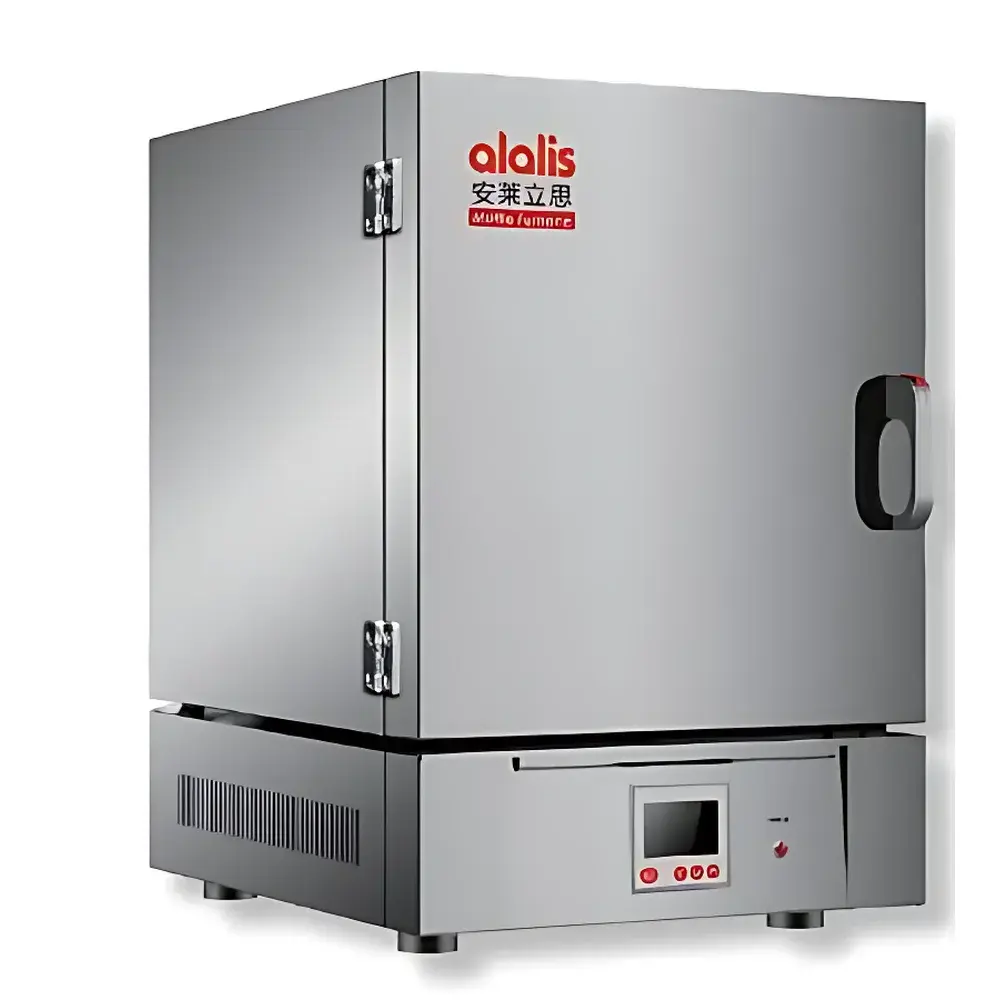
alalis SX-1212 Professional Box-Type Muffle Furnace
| Brand | alalis |
|---|---|
| Origin | USA |
| Manufacturer Type | Authorized Distributor |
| Product Category | Imported Equipment |
| Model | SX-1212 |
| Instrument Type | Box-Type Muffle Furnace |
| Maximum Temperature | 1200 °C |
| Temperature Control Accuracy | ±3 °C |
| Rated Power | 4 kW |
| Heating Time to Max Temp | 30–52 min |
| Internal Chamber Dimensions | 300 × 200 × 200 mm (L×W×H) |
| External Dimensions | 490 × 690 × 730 mm (L×W×H) |
| Chamber Volume | 12 L |
| Heating Element Material | Fe-Cr-Al Alloy Wire |
| Insulation Material | Alumina Ceramic Fiber |
| Thermocouple Type | K-Type |
| Power Supply | 220 V, 50/60 Hz, Single Phase |
| Weight | 67 kg |
| Programmable Stages | Multi-segment (up to 7 preset programs) |
| Safety Features | Overtemperature Protection, Door Interlock Switch, Overcurrent & Overload Protection, Surface Cooling Fan, Auto-Calibration PID Controller |
| Optional Data Interface | USB (for program export/import) |
Overview
The alalis SX-1212 Professional Box-Type Muffle Furnace is a high-performance, laboratory-grade thermal processing instrument engineered for precision heat treatment, ashing, calcination, sintering, and thermal analysis applications. Operating on the principle of resistive heating via Fe-Cr-Al alloy heating elements enclosed within a fully insulated alumina ceramic fiber chamber, the furnace delivers stable, uniform temperature distribution across its 12 L working volume. Designed to meet the rigorous demands of academic research laboratories, quality control departments in materials science, metallurgy, and environmental testing labs, the SX-1212 supports continuous operation up to 1100 °C and peak temperatures of 1200 °C — compliant with ASTM E1112 (Standard Specification for Laboratory Muffle Furnaces) and aligned with ISO/IEC 17025 requirements for thermal calibration traceability. Its compact footprint and lightweight construction—enabled by advanced ceramic fiber insulation—reduce thermal mass and improve energy efficiency without compromising structural integrity or thermal stability.
Key Features
- Microprocessor-based PID temperature controller with auto-tuning capability, ensuring ±3 °C control accuracy across the full operating range (room temperature to 1200 °C)
- Multi-segment programmable logic controller supporting up to 7 user-defined thermal profiles, including ramp-soak-hold sequences for controlled annealing, sintering, or ashing protocols
- Alumina ceramic fiber insulation (density ≥ 128 kg/m³) providing superior thermal retention, low heat loss, and extended service life under repeated thermal cycling
- Robust Fe-Cr-Al heating element configuration optimized for longevity and resistance to oxidation at elevated temperatures
- Integrated chimney ventilation system with front-door air intake, facilitating complete combustion of organic residues and efficient removal of volatile byproducts during ashing procedures
- Surface cooling fan and rear-mounted low-noise exhaust system maintaining external cabinet temperature below 55 °C during extended operation
- SUS304 stainless steel exterior housing with embossed finish, corrosion-resistant and compatible with routine laboratory decontamination protocols
- Dual safety architecture: hardware-level overtemperature cutoff (independent of main controller) plus software-enforced door interlock and real-time fault diagnostics
Sample Compatibility & Compliance
The SX-1212 accommodates crucibles, boats, and sample holders made from alumina, quartz, silicon carbide, or platinum—compatible with ASTM D3174 (ash content determination in coal and coke), USP (residue on ignition), and ISO 1171 (determination of ash in solid mineral fuels). Its sealed muffle design isolates samples from direct flame contact and combustion gases, ensuring contamination-free thermal processing essential for elemental analysis (e.g., ICP-OES sample preparation) and GLP-compliant residue testing. The furnace meets IEC 61010-1:2010 safety standards for electrical equipment used in laboratory environments and includes documentation supporting IQ/OQ validation protocols required under FDA 21 CFR Part 11 and EU Annex 11 for regulated laboratories.
Software & Data Management
While the base configuration features an intuitive front-panel interface with LED display and tactile membrane keys, optional USB connectivity enables program export/import and firmware updates. All temperature logs—including setpoint, actual reading, ramp rate, hold time, and alarm events—are timestamped and stored in non-volatile memory. The controller supports power-failure recovery with automatic resume functionality and retains all user presets after shutdown (non-volatile memory with >100,000 write cycles). For integrated lab informatics, the device outputs analog signals (0–5 V or 4–20 mA) compatible with SCADA systems and LIMS platforms requiring audit-trail-capable thermal process records.
Applications
- Quantitative ash analysis in food, pharmaceuticals, and environmental matrices per AOAC 942.05 and EPA Method 2540E
- Thermal pre-treatment of catalysts, battery electrode materials, and ceramic precursors prior to XRD or SEM characterization
- Heat treatment of small-scale metal specimens (e.g., tool steels, aluminum alloys) for microstructural studies
- Calcination of precipitated oxides and hydroxides in inorganic synthesis workflows
- Residue-on-ignition testing for USP/EP monographs in pharmaceutical excipient qualification
- High-temperature sterilization validation of refractory labware and custom fixtures
FAQ
What is the recommended maintenance interval for the SX-1212 furnace?
Routine inspection of heating elements, thermocouple calibration, and ceramic fiber integrity is advised every 200 operational hours or quarterly—whichever occurs first.
Can the furnace be operated under inert atmosphere conditions?
The standard SX-1212 is not gas-tight; however, it may be adapted for limited nitrogen purging using optional inlet/outlet ports—consult technical support for compatibility assessment and safety review.
Is the USB data port included as standard equipment?
No—the USB interface is an optional accessory; units shipped without this feature require retrofitting by authorized service personnel.
Does the controller support RS-485 or Ethernet communication?
Not natively; only analog output (0–5 V / 4–20 mA) and USB (optional) are supported. Modbus RTU integration requires third-party gateway hardware.
How is temperature uniformity verified across the chamber?
Uniformity is validated per ASTM E2203 using a 9-point thermocouple mapping procedure at 1000 °C; typical deviation is ≤ ±5 °C within the central 70% volume.



