
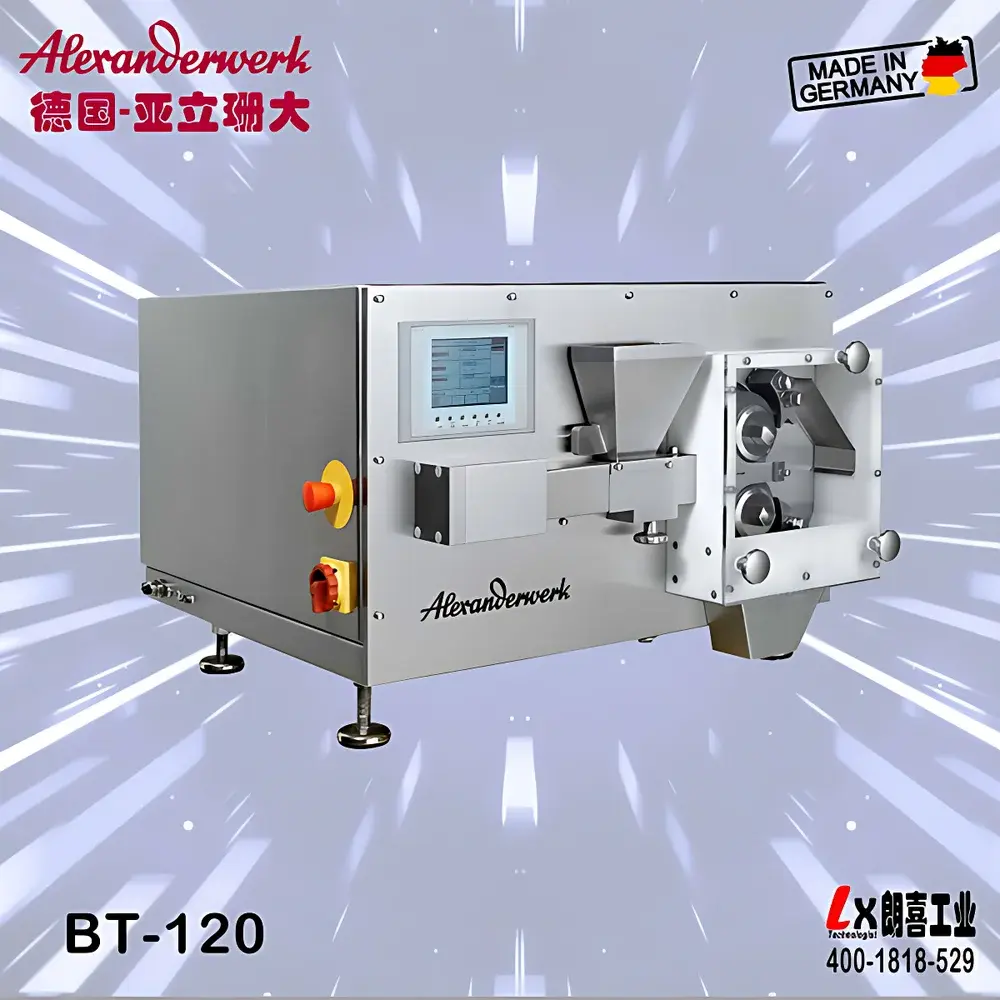
Alexanderwerk BT-120 Laboratory-Scale Dry Granulator
| Brand | Alexanderwerk |
|---|---|
| Origin | Germany |
| Model | BT-120 |
| Throughput | Up to 8 kg/h (lactose reference) |
| Construction | Fully stainless steel (AISI 316L), FDA-compliant non-metallic components |
| Drive System | Servo-controlled hydraulic roller pressure |
| Control | PLC-based HMI with recipe management |
| Design | cGMP-compliant, modular, tabletop, mobile base option |
| Roller Configuration | Cantilevered roll design with interchangeable surface finishes (smooth, grooved, patterned, square-profile) |
| Sealing | Circumferential roller seals + isolation-seal technology |
| Compliance | EU GMP Annex 15, ISO 9001, FDA 21 CFR Part 11–ready audit trail (optional), ICH Q5A/Q5B relevant for biologics processing |
Overview
The Alexanderwerk BT-120 is a laboratory-scale dry granulator engineered specifically for early-phase pharmaceutical development and formulation screening of oral solid dosage forms. It operates on the principle of roller compaction—a continuous, solvent-free powder densification process wherein pre-blended powder is fed between two counter-rotating, hydraulically actuated rollers under controlled pressure to form a compacted ribbon. This ribbon is subsequently milled and sized to yield uniform granules suitable for tableting or capsule filling. Unlike wet granulation, the BT-120 eliminates thermal and moisture stress, making it ideal for moisture-sensitive APIs, thermolabile biologics, potent compounds, and highly soluble excipients. Its compact footprint, integrated control architecture, and modular mechanical layout enable seamless transition from feasibility studies through Phase I/II clinical batch production—fully aligned with ICH Q5A (viral safety), Q5B (protein structure), and Q8(R2) (pharmaceutical development) guidance.
Key Features
- cGMP-compliant construction: Entire product-contact surfaces fabricated from electropolished AISI 316L stainless steel; non-metallic elastomers certified to US FDA 21 CFR §177.2600 for food/pharma contact.
- Cantilevered roller assembly: Eliminates side-load bearing constraints, enabling precise axial alignment, reduced maintenance intervals, and consistent ribbon thickness across full width (±0.05 mm repeatability).
- Modular tooling system: Rollers, feed hoppers, chutes, and mill assemblies disassemble without tools in under 15 minutes—validated per ASTM E2500-13 for equipment qualification traceability.
- PLC-integrated HMI: Touchscreen interface with password-protected user roles, real-time parameter logging (pressure, torque, feed rate, ribbon thickness), and electronic batch record export compliant with ALCOA+ data integrity principles.
- Scalable process mapping: Predefined operating envelopes (e.g., 5–40 kN roller force, 5–25 rpm roll speed, 0.5–3.0 mm gap setting) correlate directly to Alexanderwerk’s pilot-scale (BT-P) and production-scale (BT-M) systems—supporting QbD-driven tech transfer per ICH Q5E.
Sample Compatibility & Compliance
The BT-120 accommodates a broad spectrum of active and inactive materials—including low-density APIs (<0.3 g/cm³), high-potency compounds (OEL ≤10 µg/m³), amorphous dispersions, and lyophilized biologics—without degradation or phase separation. Its sealed feed zone and isolation-compatible roller housing meet containment requirements per ISPE APQ Annex 2 (potent compound handling). All material contact parts comply with EU Directive 2006/42/EC (Machinery Directive) and PED 2014/68/EU (Pressure Equipment Directive). Non-destructive testing (NDT) reports, material certificates (EN 10204 3.1), and FAT/SAT documentation are supplied as standard. The system supports GLP/GMP audits with full electronic signature capability (21 CFR Part 11 optional add-on).
Software & Data Management
Control firmware runs on a Beckhoff TwinCAT 3 platform with deterministic real-time cycle times (<1 ms). Process data—including roller force profiles, motor current harmonics, and ribbon density trends—are time-stamped and stored locally on encrypted industrial SSDs. Export formats include CSV, PDF eBR, and XML for integration with LIMS (e.g., LabVantage, Thermo Fisher SampleManager) and MES platforms. Audit trails capture all parameter changes, user logins, and calibration events with immutable hash verification. Optional OPC UA server enables secure IIoT connectivity for centralized fleet monitoring across R&D sites.
Applications
- Formulation optimization of direct compression blends and high-dose API tablets
- Granule generation for inhalation powders requiring narrow PSD (D90 < 50 µm)
- Process characterization of hot-melt extrusion intermediates prior to milling
- Stability assessment of moisture-sensitive peptides under inert gas purge (N₂/Ar compatible)
- Development of sustained-release matrix granules using polymer-coated rollers
- Reference standard preparation for dissolution method validation (USP , Ph. Eur. 2.9.3)
FAQ
Can the BT-120 be used for toxicology batches intended for first-in-human (FIH) studies?
Yes—when operated under Class C cleanroom conditions with validated containment and environmental monitoring, BT-120 batches meet ICH M3(R2) and FDA Guidance for Industry on Nonclinical Safety Studies requirements.
Is roller surface customization available for specific adhesion or release behavior?
Yes—standard options include smooth, longitudinal groove (0.3 mm depth), diamond-patterned (1.2 mm pitch), and square-profile (2.0 × 2.0 mm) configurations; custom topographies can be machined per ISO 25178 surface texture specifications.
Does the system support automated cleaning validation protocols?
The modular design allows for full disassembly and ATP bioluminescence swab testing per PDA Technical Report No. 29; CIP compatibility requires optional heated rinse manifold (not included standard).
How is scale-up assurance documented for regulatory submissions?
Alexanderwerk provides a Process Scale-Up Dossier (PSUD) containing dimensionless number correlations (e.g., Bond number, Capillary number), ribbon tensile strength vs. compaction pressure curves, and comparative granule friability data across BT-120 → BT-P → BT-M platforms.



