
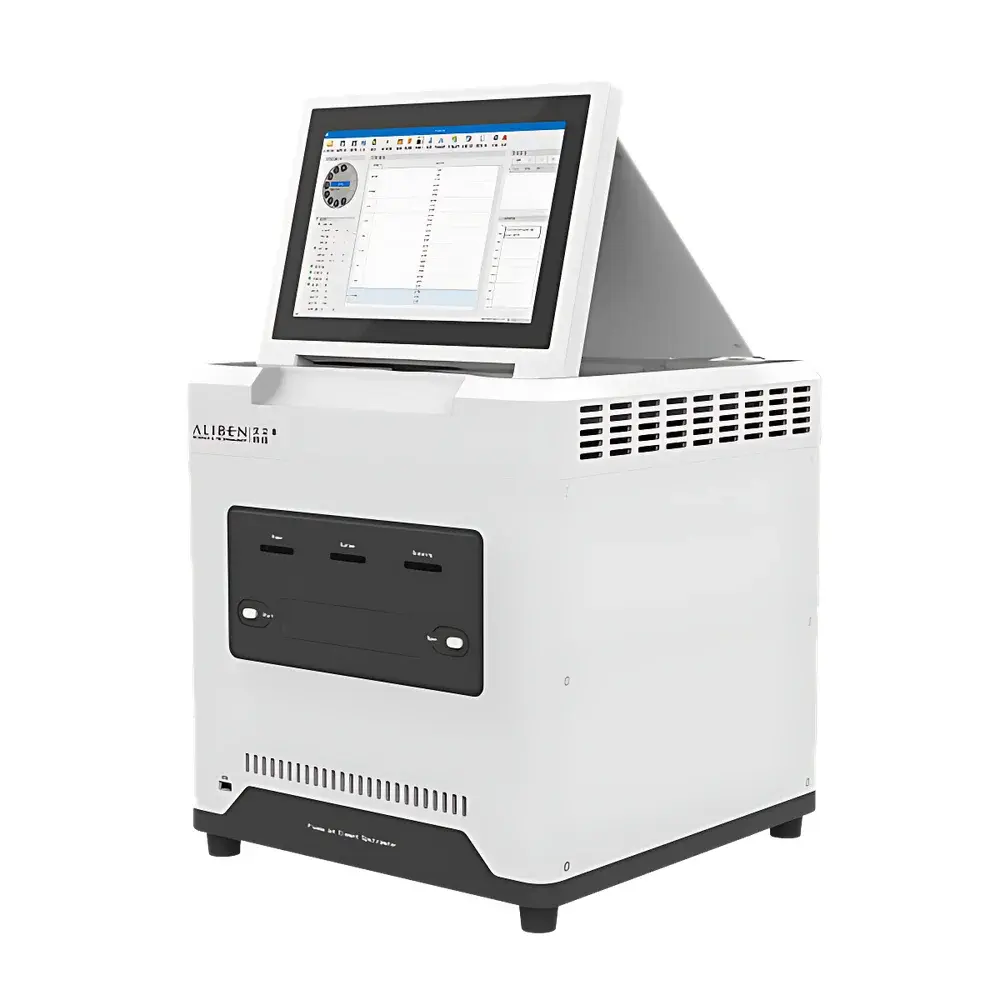
Aliben PJ-10 Microwave Plasma Atomic Emission Spectrometer
| Brand | Aliben |
|---|---|
| Origin | Sichuan, China |
| Manufacturer Type | Original Equipment Manufacturer (OEM) |
| Country of Origin | China |
| Model | PJ-10 |
| Pricing | Available upon Request |
| Excitation Source | Microwave-induced Plasma (MIP) |
| Optical Range | 190–1100 nm |
| Spectral Resolution | 0.10–0.25 nm |
| Detection Limit (Cd) | 0.01 ppm |
| Analysis Time | <60 s |
| Sample Form | Direct Solid Analysis |
| Sample Preparation | Minimal—homogenization and pelletization only (no acid digestion) |
| Power Supply | 110–260 VAC |
| Dimensions (Closed) | 400 × 410 × 427 mm (L×W×H) |
| Dimensions (Open) | 400 × 410 × 662 mm |
| Weight | 32 kg |
| Power Consumption | 200 W |
| Display | 12-inch capacitive touchscreen |
| Storage | 128 GB SSD |
| Data Interfaces | 4× USB, 1× Ethernet |
| Warm-up Time to Stability | 15 min |
| Detectable Elements | Cd, Cr, Cu, Pb, Zn, Ca, Fe, and others |
Overview
The Aliben PJ-10 Microwave Plasma Atomic Emission Spectrometer (MP-AES) is a benchtop solid-sample elemental analyzer engineered for direct, rapid, and quantitative multi-element analysis without wet chemical digestion. Unlike conventional inductively coupled plasma (ICP) or arc/spark optical emission spectrometers, the PJ-10 employs a proprietary high-energy-density microwave plasma source operating at 2.45 GHz. This compact, self-contained plasma generator produces localized temperatures exceeding 5,000 K at the sample surface—sufficient to volatilize, atomize, and electronically excite constituent elements in solid matrices. Emitted photons from de-exciting atoms and ions are collected via an optimized Czerny–Turner optical path and dispersed across a high-throughput echelle grating spectrometer. The full spectral range (190–1100 nm) is captured simultaneously using a back-illuminated, deep-depletion CCD detector with thermoelectric cooling, enabling robust line identification and interference-free quantification—even for complex heterogeneous solids such as alloys, geological powders, ceramics, and environmental particulates.
Key Features
- Direct solid analysis capability—eliminates hazardous acid digestion, reducing turnaround time and laboratory exposure risk.
- Automated sample handling with motorized sample chamber and precision XY-stage positioning; supports up to 24 pre-loaded pellets per batch.
- Adaptive plasma power modulation: real-time feedback control adjusts microwave output based on sample composition and surface morphology to maintain optimal excitation efficiency and signal stability.
- Self-diagnostic startup sequence verifies optical alignment, plasma ignition integrity, detector baseline, and thermal equilibrium before initiating analysis—ensuring consistent measurement readiness within 15 minutes.
- Integrated intelligent protection system monitors plasma impedance, chamber vacuum integrity (if applicable), cooling airflow, and detector temperature; triggers immediate shutdown under anomalous conditions to preserve optical components and plasma source longevity.
- One-touch workflow automation—from pellet loading to spectral acquisition, peak integration, calibration application, and report generation—reducing operator dependency and inter-analyst variability.
Sample Compatibility & Compliance
The PJ-10 accommodates pressed pellets (diameter: 10–13 mm, thickness: 2–5 mm), fused beads, and flat conductive solids (e.g., metal coupons) with minimal preparation. It complies with ISO/IEC 17025:2017 requirements for analytical method validation when used with certified reference materials (CRMs) traceable to NIST or BAM standards. Its detection limits (e.g., Cd: 0.01 ppm) meet regulatory thresholds specified in RoHS Directive 2011/65/EU Annex II and IEC 62321-5:2013 for restricted substances screening. While not FDA 21 CFR Part 11–compliant out-of-the-box, audit-trail-enabled software modules (available as optional upgrade) support GLP/GMP environments by logging user actions, method parameters, raw spectra, and calibration history with timestamped digital signatures.
Software & Data Management
The embedded PJ-OS platform runs on a Linux-based real-time OS and features a 12-inch capacitive touchscreen interface with gesture navigation. Spectral acquisition, background correction, multivariate peak deconvolution, and internal standard normalization are performed in real time. Quantitative results are generated using external calibration curves or comparative ratio methods against matrix-matched CRMs. All raw data (intensity vs. wavelength arrays), processed spectra, and metadata—including instrument configuration, ambient temperature/humidity logs, and plasma operational parameters—are stored in vendor-neutral HDF5 format on the onboard 128 GB SSD. Export options include CSV, PDF analytical reports, and XML-compatible structured data for LIMS integration via Ethernet or USB. Remote diagnostics and firmware updates are supported over secure HTTPS.
Applications
The PJ-10 serves laboratories requiring high-throughput elemental screening in quality control, regulatory compliance, and R&D settings. Typical use cases include: incoming raw material verification for electronics-grade metals and ceramics; rapid screening of soil and sediment samples for heavy metals (Cd, Pb, Cr, As) per EPA Method 6010D equivalents; compositional verification of recycled battery cathode materials (Li, Co, Ni, Mn); and routine analysis of construction aggregates for alkali-silica reactivity predictors (Na, K, Ca). Its low power consumption (200 W) and compact footprint make it suitable for mobile labs, field-deployable units, and teaching laboratories where ICP-OES infrastructure is impractical.
FAQ
Does the PJ-10 require argon or other carrier gases?
No—the PJ-10 operates exclusively on ambient air; its microwave plasma is sustained without external gas supply, eliminating recurring gas costs and cylinder logistics.
Can it analyze non-conductive samples such as polymers or biological tissues?
Yes—when homogenized and pressed into conductive pellets with graphite or cellulose binders, non-conductive matrices yield reproducible results. Method development kits with binder optimization protocols are available.
Is spectral library matching supported for unknown sample identification?
Yes—the software includes a searchable database of >120 elemental emission lines with secondary transition wavelengths and intensity ratios, supporting qualitative fingerprinting and interference diagnosis.
What maintenance intervals are recommended?
Plasma source lifetime exceeds 5,000 hours; optical window cleaning is advised every 200 analyses; annual calibration verification with NIST SRM 2782 (Stainless Steel) is recommended for ISO/IEC 17025 accreditation.
Can the PJ-10 be integrated into an automated production line?
Yes—RS-232 and Modbus TCP interfaces (optional) enable PLC-triggered analysis cycles and pass/fail result output to SCADA systems. Custom API documentation is provided under NDA.




