
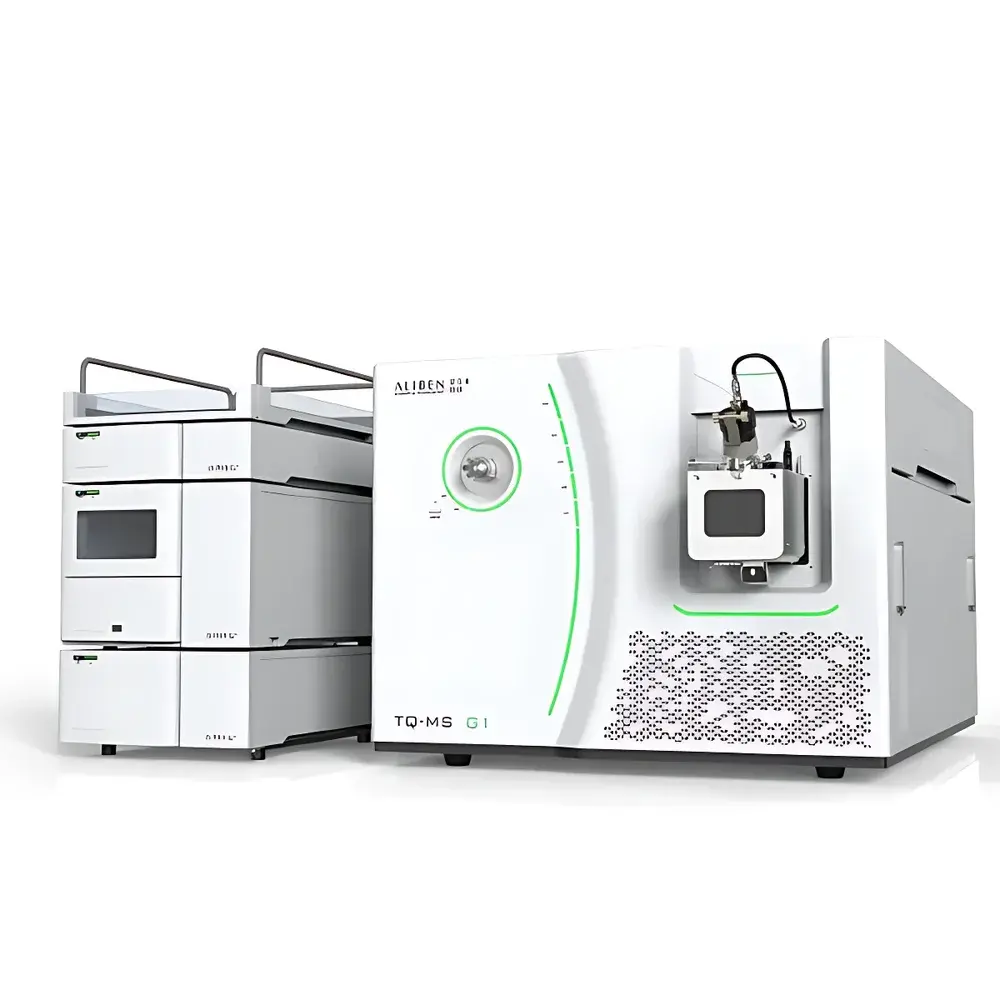
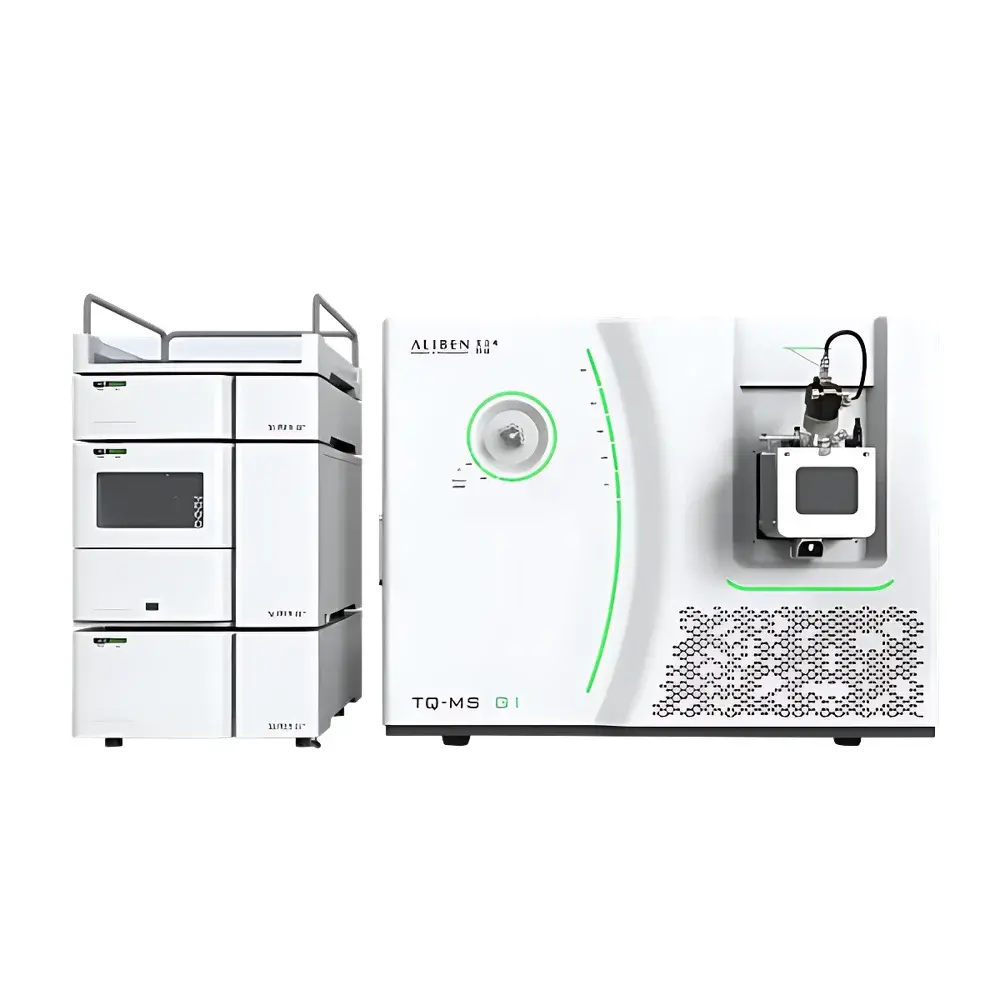
Aliben UHPLC Triple Quadrupole Liquid Chromatography Tandem Mass Spectrometer (TQMS) G1
| Brand | Aliben |
|---|---|
| Origin | Sichuan, China |
| Manufacturer Type | Original Equipment Manufacturer (OEM) |
| Product Origin | Domestic (China) |
| Model | UHPLC TQMS G1 / LC-MS/MS |
| Mass Range | 2–1500 amu (standard), 2–2000 amu (G1s variant) |
| Resolution | 0.4 / 0.7 / 1.5 FWHM (full width at half maximum) |
| Application Scope | General-purpose quantitative and qualitative analysis |
Overview
The Aliben UHPLC Triple Quadrupole Liquid Chromatography Tandem Mass Spectrometer (TQMS) G1 is a fully domestically engineered benchtop LC-MS/MS system designed for high-sensitivity, high-selectivity targeted quantitation and structural confirmation in complex matrices. Built upon electrospray ionization (ESI) and atmospheric pressure chemical ionization (APCI) sources, the system integrates ultra-high-performance liquid chromatography (UHPLC) with a triple quadrupole mass analyzer operating in multiple reaction monitoring (MRM), precursor ion scan, neutral loss scan, and product ion scan modes. Its core architecture employs a robust ion optical pathway—including a high-stability ion source, multi-stage ion transmission optics, pre-filter quadrupole, segmented collision cell with controlled collision energy, off-axis high-gain electron multiplier detector, and precision-tuned RF/DC quadrupole power supply—enabling reproducible ion transmission and low-noise signal detection across the full mass range.
Key Features
- Fully indigenous design and manufacturing: All critical subsystems—including ion source, RF-driven quadrupoles, collision cell, detector electronics, and vacuum control—are developed and produced in-house by Aliben, ensuring supply chain continuity and long-term serviceability.
- Triple quadrupole mass analyzer with selectable resolution settings (0.4, 0.7, or 1.5 FWHM) to balance sensitivity, selectivity, and duty cycle based on application requirements.
- UHPLC integration supporting sub-2 µm particle columns, flow rates up to 2 mL/min, and gradient dwell volumes <100 µL for enhanced chromatographic peak capacity and reduced analysis time.
- High-efficiency ESI/APCI dual-mode source with heated capillary interface, adjustable desolvation gas flow, and real-time source parameter optimization during method execution.
- Modular vacuum architecture featuring dual-stage turbomolecular pumps and intelligent pressure regulation to maintain stable operation under variable load conditions.
Sample Compatibility & Compliance
The Aliben TQMS G1 supports broad sample compatibility across aqueous, organic, and semi-polar extracts without requiring extensive derivatization. It is routinely deployed for residual pesticide screening in food commodities (per GB 23200 series and ISO 17025-accredited workflows), trace-level pharmaceutical impurity profiling (aligned with ICH Q2(R2) and USP <1225> validation guidelines), environmental contaminant analysis (e.g., PFAS, PAHs, and endocrine disruptors per EPA Method 1694), and clinical small-molecule biomarker quantification (in compliance with CLIA and CAP laboratory standards). The instrument’s firmware and data acquisition engine are engineered to support audit trails, electronic signatures, and secure user role management—facilitating alignment with FDA 21 CFR Part 11, EU Annex 11, and GLP/GMP documentation requirements when implemented within validated laboratory information management systems (LIMS).
Software & Data Management
Aliben’s proprietary LC-MS Workstation software provides an integrated environment for instrument control, method development, data acquisition, and quantitative processing. The interface features context-aware workflow guidance, drag-and-drop sequence building, and embedded method templates for common regulatory applications (e.g., pesticide MRM libraries, veterinary drug panels). Automatic tuning and calibration routines optimize detector gain, quadrupole mass accuracy, and collision energy profiles without manual intervention. Quantitative processing is performed via a dedicated module supporting internal standard normalization, matrix-matched calibration curves, QC sample flagging, and automated report generation compliant with ISO/IEC 17025 reporting conventions. Raw data files adhere to open mzML format, enabling interoperability with third-party tools including Skyline, Compound Discoverer, and OpenMS.
Applications
- Food safety: Multi-residue analysis of pesticides, mycotoxins, veterinary drugs, and adulterants in fruits, grains, dairy, and processed foods.
- Environmental testing: Quantification of emerging contaminants—including per- and polyfluoroalkyl substances (PFAS), brominated flame retardants (BFRs), and microplastic degradation markers—in water, soil, and biota samples.
- Clinical research: Targeted quantitation of endogenous metabolites, therapeutic drugs, and toxicological analytes in plasma, urine, and cerebrospinal fluid.
- Pharmaceutical quality control: Impurity identification and quantification per ICH Q3B(R3), extractables/leachables profiling, and stability-indicating assay development.
- Forensic toxicology: Confirmation and quantitation of controlled substances, novel psychoactive substances (NPS), and metabolites in biological specimens.
FAQ
Is the Aliben TQMS G1 compliant with FDA 21 CFR Part 11 requirements?
Yes—the system supports electronic signature capture, audit trail logging with immutable timestamps, and role-based access control when configured with appropriate IT infrastructure and procedural controls.
What is the typical mass accuracy and retention time stability over a 24-hour run?
Under routine operation with internal lock mass correction enabled, mass accuracy remains within ±0.2 amu and retention time drift is typically ≤0.05 min across 24 h using standard UHPLC gradients.
Can the instrument be upgraded to support high-resolution MS/MS capabilities?
The G1 platform is optimized for unit-resolution triple quadrupole performance; high-resolution capability (e.g., Q-TOF or Orbitrap) is available in Aliben’s next-generation platforms but not retrofittable to the G1 hardware architecture.
Does the system support API 4000 or Sciex QTRAP-style scheduled MRM transitions?
Yes—the workstation implements dynamic dwell time allocation and scheduled MRM with retention time windows, enabling >1000 transitions per run while maintaining optimal dwell and cycle time.
What level of technical support and service coverage is offered outside mainland China?
Aliben partners with regional distributors and certified service engineers in Southeast Asia, the Middle East, and Latin America; remote diagnostics and firmware updates are provided globally via secure TLS-encrypted channels.






