
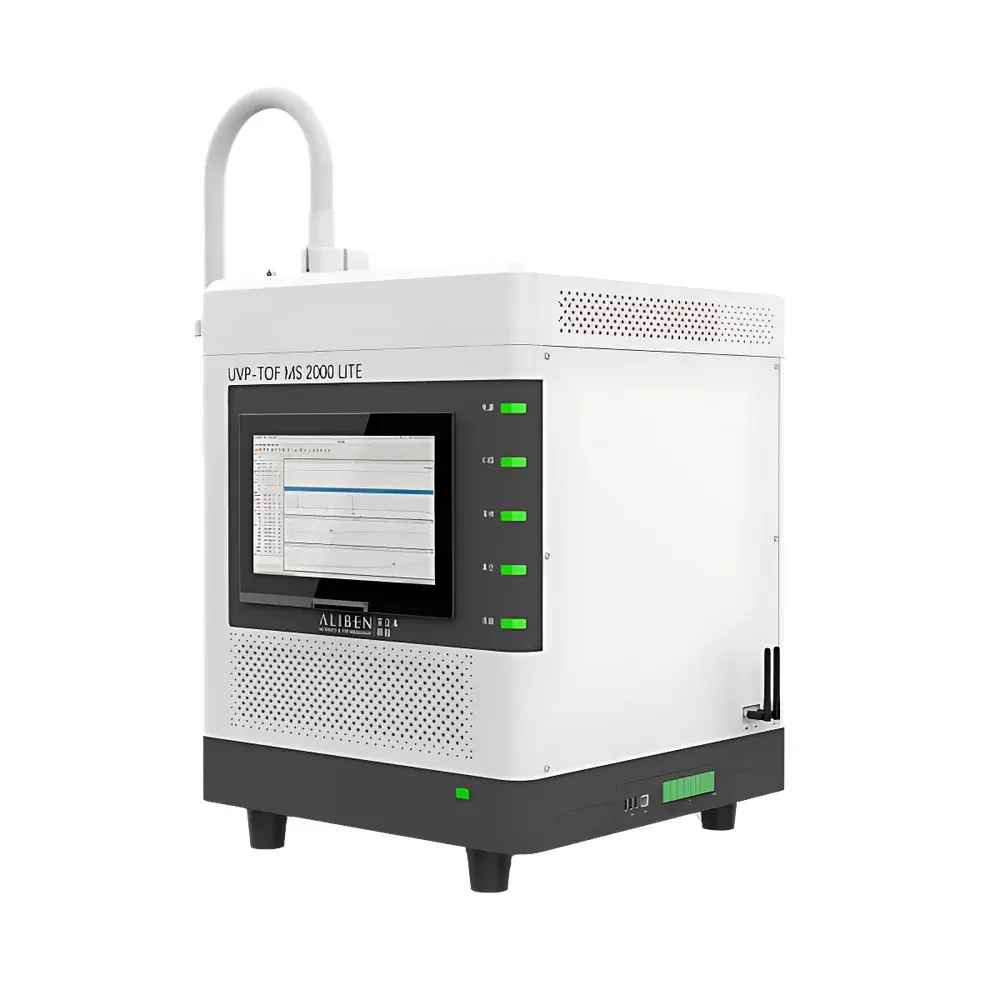
Aliben UVP-TOF MS 2000 LITE Real-Time Online VOC Monitoring Time-of-Flight Mass Spectrometer
| Brand | Aliben |
|---|---|
| Origin | Sichuan, China |
| Manufacturer Type | Original Equipment Manufacturer (OEM) |
| Product Category | Domestic |
| Model | UVP-TOF MS 2000 LITE |
| Detection Principle | Vacuum Ultraviolet Photoionization (VUV-PI) coupled with Time-of-Flight Mass Spectrometry |
| Instrument Type | Online Analyzer |
| Configuration | Multi-Component VOC & Inorganic Gas Monitor |
| Detection Range | 0–1 ppbv (extendable to % v/v) |
| Mass Resolution (FWHM) | >2000 |
| Accuracy | RSD <3% |
| Response Time | <1 s |
Overview
The Aliben UVP-TOF MS 2000 LITE is a compact, field-deployable time-of-flight mass spectrometer engineered for real-time, non-separative quantification of volatile organic compounds (VOCs) and selected inorganic gases—including SO₂, NO, NO₂, NH₃, H₂S, and Cl₂—in ambient air, industrial stack emissions, and aqueous headspace. Unlike GC-MS systems requiring chromatographic separation, this instrument employs vacuum ultraviolet (VUV) photoionization at 10.6 eV, enabling soft, near-threshold ionization of most VOCs while minimizing fragmentation. Coupled with orthogonal acceleration TOF mass analysis, it delivers full-spectrum acquisition at sub-second duty cycles—capturing transient plumes, mobile emission sources, or dynamic process streams without retention-time calibration or method development overhead. Its design prioritizes operational robustness under variable environmental conditions, making it suitable for regulatory monitoring, emergency response, fugitive emission surveys, and research-grade atmospheric chemistry studies.
Key Features
- VUV photoionization source (10.6 eV) enabling simultaneous ionization of aromatic, aliphatic, oxygenated, and halogenated VOCs alongside key inorganic gases—without chemical derivatization or thermal degradation.
- High-resolution TOF mass analyzer (>2000 FWHM at m/z 100) ensuring baseline separation of isobaric interferences (e.g., C₇H₈ vs. C₆H₅N⁺), critical for unambiguous identification in complex matrices.
- Sub-1-second system response time with continuous full-mass-range data acquisition (m/z 10–300) at 10 Hz frame rate—optimized for vehicle-mounted mobile monitoring and rapid plume mapping.
- Integrated touch-screen industrial computer (embedded Windows OS) with adjustable tilt mount, shock-absorbing chassis, and passive cooling architecture—certified for operation across −10 °C to +45 °C ambient range.
- Multi-modal sampling interface supporting gas-phase direct inlet, permeation membrane sampling (for humid or particulate-laden streams), and headspace liquid analysis via heated membrane probe—compatible with EPA Method TO-15/17 workflows.
- Self-contained high-vacuum system (no external roughing pump required); power consumption 8-hour battery-backed operation using standard LiFePO₄ packs.
Sample Compatibility & Compliance
The UVP-TOF MS 2000 LITE accommodates gaseous samples from ambient air, flue gas ducts, bioreactor off-gas, and water headspace (per ASTM D6196-22 and GB 5749-2022). It detects target analytes including benzene, toluene, ethylbenzene, xylenes (BTEX), formaldehyde, acetaldehyde, acetone, isoprene, monoterpenes, and reactive sulfur/nitrogen species. While not pre-certified to EN 15267 or US EPA PS-12, its measurement traceability aligns with ISO/IEC 17025:2017 requirements when operated within validated concentration ranges (0.1–1000 ppbv typical). Data integrity complies with ALCOA+ principles; audit trails, electronic signatures, and parameter change logs are recorded per FDA 21 CFR Part 11 guidelines in optional GxP mode.
Software & Data Management
The proprietary Aliben TOFView™ software provides real-time total ion current (TIC) and extracted ion chromatogram (XIC) visualization, automated mass axis calibration (using internal perfluorotributylamine reference), and quantitative analysis via internal standard normalization or response factor libraries. It supports simultaneous display of TVOC (total VOC), individual compound concentrations, and temporal trend overlays. Raw .raw files are stored in mzML-compliant format for third-party processing (e.g., MZmine, XCMS). Remote telemetry via embedded Wi-Fi/GPS enables georeferenced plume tracking and cloud synchronization with GIS platforms. All instrument parameters—including ion source temperature, extraction voltage, reflectron delay, and detector gain—are programmable and version-controlled.
Applications
- Mobile emission mapping (‘sniffer’ vehicles) for industrial fence-line monitoring and urban pollution hot-spot identification.
- Real-time leak detection and repair (LDAR) verification in petrochemical, pharmaceutical, and semiconductor facilities.
- Indoor air quality (IAQ) assessment during building commissioning or post-remediation validation.
- Emergency response screening for unknown hazardous vapors at chemical spill or clandestine lab scenes.
- Aqueous VOC monitoring in drinking water treatment plants and wastewater influent streams—via membrane-based headspace sampling.
- Atmospheric field campaigns measuring OH-reactive VOC reactivity and secondary organic aerosol (SOA) precursors.
FAQ
Does the UVP-TOF MS 2000 LITE require carrier gas or consumables?
No—operation relies solely on ambient air as the drift gas; no helium, nitrogen, or hydrogen supply is needed. The VUV lamp has a rated lifetime of ≥5,000 hours.
Can it distinguish isomers such as o-, m-, and p-xylene?
Not by mass alone (all share m/z 106), but co-elution patterns, retention index correlation (when used with optional GC front-end), and relative ion abundance ratios enable probabilistic differentiation in applied workflows.
Is remote firmware update supported?
Yes—over-the-air (OTA) updates are delivered via secure HTTPS channel with SHA-256 signature verification and rollback capability.
What calibration standards are recommended?
Certified gas standards (ppbv-level NIST-traceable mixtures) or dynamic dilution systems (e.g., PermaPure or VICI Metronics) are advised for initial qualification and periodic performance checks.
How is data security managed during wireless transmission?
All Wi-Fi communications use WPA3-Enterprise encryption; TLS 1.3 secures cloud API endpoints; local storage employs BitLocker encryption (optional).







