
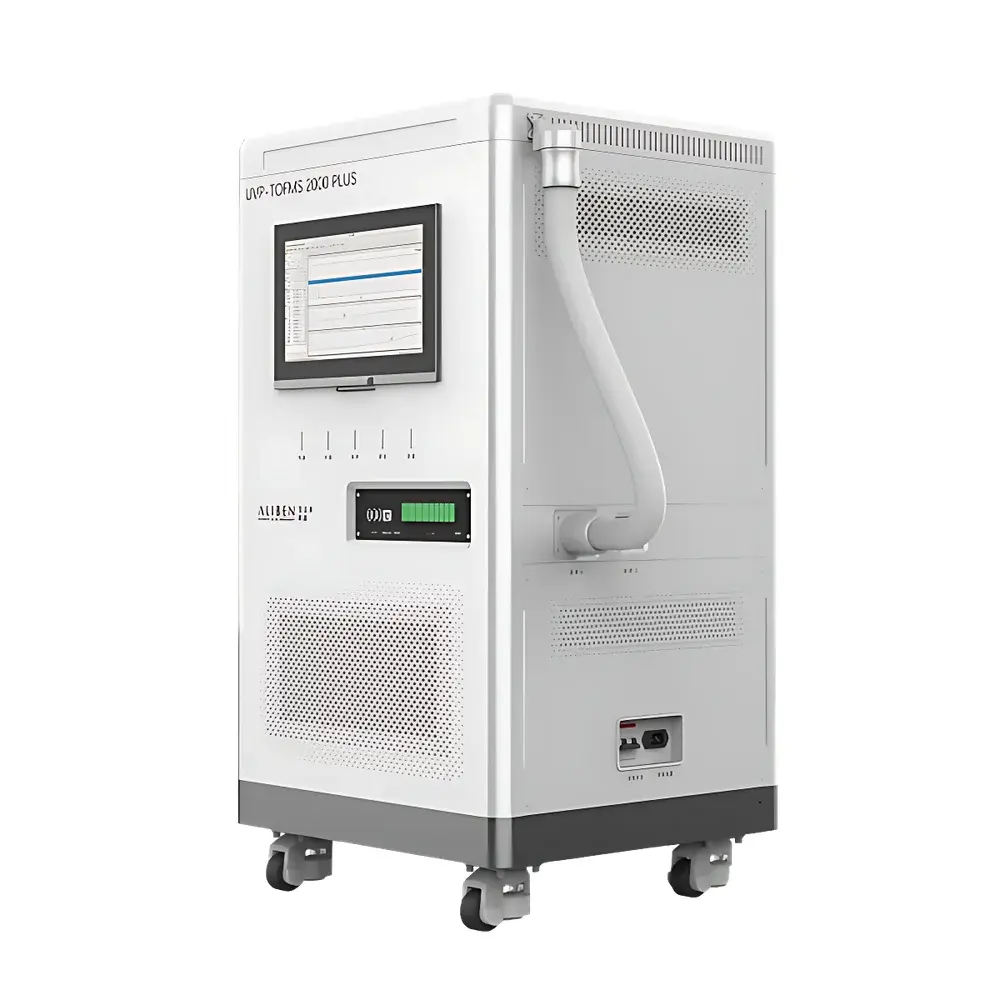
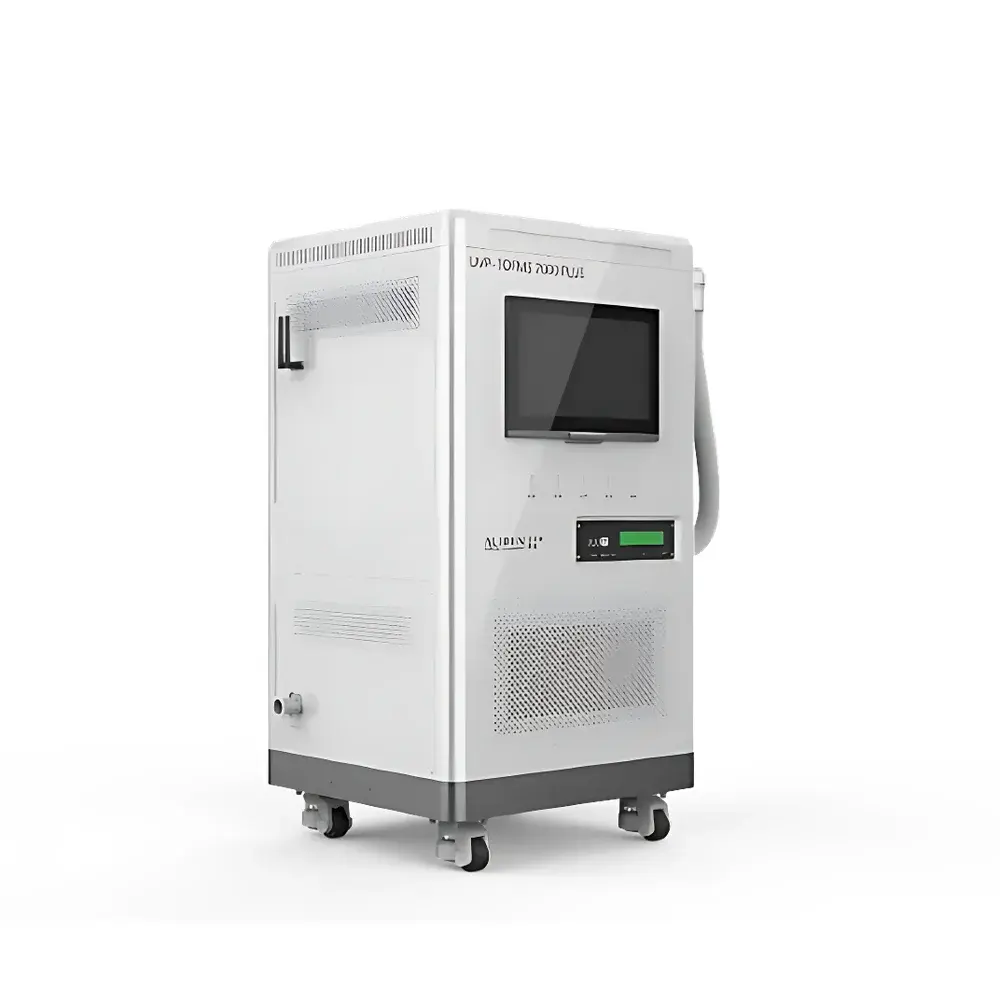
Aliben UVP-TOF MS 2000 PLUS Real-Time Online Time-of-Flight Mass Spectrometer for VOC Monitoring
| Brand | Aliben |
|---|---|
| Origin | Sichuan, China |
| Manufacturer Type | Original Equipment Manufacturer (OEM) |
| Origin Category | Domestic |
| Model | UVP-TOF MS 2000 PLUS |
| Detection Principle | Vacuum Ultraviolet Photoionization + Time-of-Flight Mass Spectrometry |
| Instrument Type | Online Analyzer |
| Configuration | Multi-Component VOC Monitor |
| Sampling Method | Direct Gas Inlet |
| Detection Range | 100 pptv – 1 ppmv |
| Mass Resolution (FWHM) | >2500 |
| Accuracy (RSD) | <3% |
| Response Time | <0.5 s |
Overview
The Aliben UVP-TOF MS 2000 PLUS is a real-time, online time-of-flight mass spectrometer engineered for continuous, untargeted volatile organic compound (VOC) monitoring in ambient air, industrial exhaust streams, and process gas environments. Unlike conventional GC-MS or PID-based systems, it employs vacuum ultraviolet (VUV) photoionization coupled with orthogonal acceleration time-of-flight (oa-TOF) mass analysis. This combination enables direct, soft ionization of gaseous VOCs without chromatographic separation—yielding full-spectrum acquisition at sub-second temporal resolution. The instrument operates on the principle that VUV photons (typically 10–12 eV) selectively ionize organic molecules with ionization energies below the photon energy threshold, while leaving major atmospheric constituents (N₂, O₂, CO₂, H₂O) largely unaffected. This inherent selectivity, combined with high mass resolving power and rapid duty cycling, supports quantitative tracking of dynamic VOC emissions across complex matrices—critical for fugitive emission detection, stack compliance verification, and mobile source profiling.
Key Features
- VUV photoionization source delivering soft, reproducible ionization with minimal fragmentation—ensuring dominant molecular ion signals for unambiguous identification.
- Orthogonal acceleration TOF mass analyzer with resolution >2500 (FWHM at m/z 100), enabling baseline separation of isobaric species (e.g., vinyl acetate vs. propanal at m/z 86).
- Direct gas inlet architecture eliminating membrane diffusion delays—achieving <0.5 s system response time from sample introduction to spectral output.
- Fully integrated platform: built-in turbomolecular pump, embedded industrial-grade computer, adjustable-angle capacitive touchscreen, and shock-isolated mechanical design optimized for vehicle-mounted mobile monitoring.
- Dynamic range exceeding 10⁴ enabled by high-speed 16-bit ADC digitization and real-time signal averaging algorithms.
- Low-power operation (<120 W typical), compatible with battery or vehicle DC power sources for extended field deployment.
Sample Compatibility & Compliance
The UVP-TOF MS 2000 PLUS is validated for direct analysis of undiluted ambient air, stack gases, and headspace vapors containing C₂–C₁₂ hydrocarbons, oxygenates, halocarbons, sulfur compounds, and aromatic VOCs. It complies with ISO 16000-6 for indoor air VOC measurement methodology and supports data acquisition protocols aligned with EPA Method TO-15 and EU EN 14662 for aromatic hydrocarbon quantification. While not certified as a Class I, Division 1 hazardous area device, its sealed ion source and non-sparking electronics meet IP54 environmental protection standards. Data integrity adheres to GLP/GMP-aligned audit trail requirements through timestamped raw spectra storage, user-access logs, and parameter change history—facilitating regulatory reporting under ISO/IEC 17025-accredited laboratories.
Software & Data Management
The proprietary UVP-TOF MS Control & Analysis Suite provides real-time spectral visualization, total ion current (TIC) and extracted ion current (XIC) plotting, automated mass calibration (using internal reference peaks or external calibrants), and quantitative analysis via external/internal standard calibration curves. All raw .raw files are stored in open HDF5 format with embedded metadata (instrument parameters, timestamps, pressure/temperature logs). Software supports batch processing, spectral deconvolution using constrained non-negative matrix factorization (cNMF), and export to CSV, mzML, or ChemStation-compatible formats. Remote monitoring and firmware updates are supported via secure TLS-enabled Ethernet or LTE module (optional). Audit trails comply with FDA 21 CFR Part 11 requirements when configured with role-based user authentication and electronic signature modules.
Applications
- Mobile emission mapping (fenceline monitoring, leak detection and repair—LDAR) using vehicle-mounted or drone-deployable configurations.
- Continuous stack emission monitoring (CEMS) for petrochemical refineries, chemical manufacturing plants, and pharmaceutical production facilities.
- Indoor air quality (IAQ) assessment in cleanrooms, hospitals, and office buildings—tracking formaldehyde, benzene, toluene, and terpenes in real time.
- Process analytical technology (PAT) applications: reactor off-gas monitoring, solvent recovery efficiency evaluation, and catalyst deactivation studies.
- Environmental research: atmospheric chemistry field campaigns, VOC speciation in urban plumes, and biogenic emission characterization.
FAQ
What ionization energy does the VUV lamp provide?
The integrated deuterium lamp emits photons centered at 10.6 eV (117 nm), enabling selective ionization of most VOCs (IE < 10.6 eV) while excluding N₂ (IE = 15.6 eV) and O₂ (IE = 12.1 eV).
Can the instrument quantify VOCs without calibration standards?
Semi-quantitative analysis is possible using relative ionization cross-sections; however, accurate quantification requires calibration with certified gas standards traceable to NIST SRMs.
Is the system compatible with existing CEMS infrastructure?
Yes—the instrument supports Modbus TCP and OPC UA protocols for integration into SCADA systems and DCS platforms used in industrial compliance monitoring.
How often is mass calibration required during continuous operation?
Automatic real-time mass axis stabilization occurs during each acquisition cycle; manual recalibration is recommended every 72 hours or after significant ambient temperature shifts (>5 °C).
Does the system support isotope ratio analysis?
While not optimized for high-precision isotopic abundance measurement, the >2500 resolution permits baseline separation of ¹³C/¹²C isotopologues for m/z ≤ 200, supporting qualitative isotopic pattern recognition.







