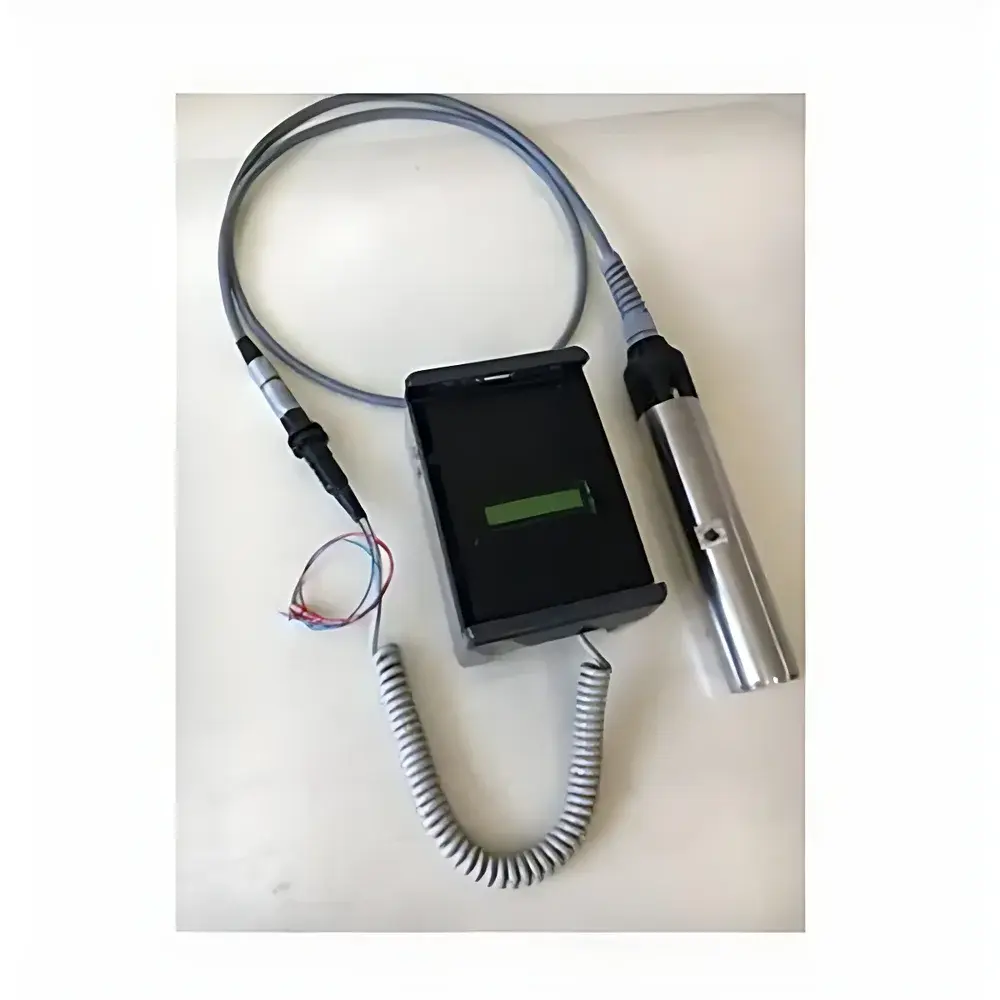
Alibillia GGUN-FL24ABS Portable Groundwater Fluorescence Tracer Detector
| Brand | Alibillia |
|---|---|
| Origin | Switzerland |
| Model | FL24ABS |
| Optical Channels | 4 (excitation–detection pairs) |
| Turbidity Range | 0.02–100 NTU |
| Fluorescein Sodium Detection Limit | 2 × 10⁻¹¹ g/mL |
| Sampling Interval Options | 8 programmable intervals (2 sec to 15 min for FL24 |
| Data Storage Capacity | 2–16 GB microSD card |
| Power Supply | 6–12 V DC |
| Battery | 12–24 Ah rechargeable (standard: 12 Ah LiFePO₄) |
| Current Draw | 1.5 mA (typical, active measurement mode) |
| A/D Resolution | 24-bit |
| Probe Cable Length | ≥30 m (custom lengths available) |
| Probe Weight | 1 kg per 10 m (ABS version: 80 g/m) |
| Probe Housing | Stainless steel (IP68 rated) |
| Integrated Thermistor Accuracy | ±0.01 °C |
| Probe Dimensions | Ø48 mm × 270 mm |
| Maximum Deployment Depth | 270 m (with standard 30 m cable + extension options) |
| Communication Interface | Digital RS-232 via USB-to-serial adapter (included) |
| Operating Environment | Submersible in boreholes ≥2 inches (5.08 cm) diameter |
Overview
The Alibillia GGUN-FL24ABS is a field-deployable, submersible fluorescence tracer detector engineered specifically for quantitative hydrogeological tracing in deep boreholes, karst conduits, and confined aquifer systems. It operates on the principle of synchronous dual-wavelength excitation and emission detection—utilizing four independent optical channels to simultaneously monitor turbidity (via 850 nm LED scatter detection) and up to three distinct fluorescent tracers (e.g., fluorescein, rhodamine WT, and eosin Y) with minimal spectral crosstalk. Unlike laboratory fluorometers or surface-mounted sensors, the FL24ABS integrates real-time signal digitization at the probe head, eliminating analog noise accumulation over long cable runs. Its architecture conforms to the physical constraints of 2-inch (50.8 mm) monitoring wells and supports autonomous operation for extended periods—enabling high-temporal-resolution breakthrough curve acquisition under low-flow or diffusion-dominated transport conditions.
Key Features
- Four-channel optical architecture: Independent excitation–emission pathways enable concurrent quantification of turbidity and three fluorescent dyes without sequential scanning delays.
- Submersible stainless-steel probe (IP68) with integrated high-stability thermistor (±0.01 °C accuracy), co-located with optical sensors to correct for temperature-induced fluorescence quenching.
- Low-power embedded data logger: Draws only 1.5 mA during active sampling; supports programmable intervals from 2 seconds to 20 minutes (ABS firmware variant), optimized for transient flow characterization.
- Digital signal transmission over shielded 4-conductor cable: All analog-to-digital conversion occurs at the probe—ensuring immunity to electromagnetic interference in electrically noisy field environments.
- Expandable storage: Accepts industrial-grade microSD cards (2–16 GB), enabling multi-week unattended logging of timestamped fluorescence intensity (mV), turbidity (NTU), and temperature (°C) at user-defined resolution.
- Borehole-optimized mechanical design: 48 mm diameter × 270 mm length probe fits standard 2-inch PVC or stainless-steel casings; maximum operational depth validated to 270 m with reinforced cable assembly.
Sample Compatibility & Compliance
The GGUN-FL24ABS is calibrated and validated for aqueous-phase detection of common environmental tracers including sodium fluorescein (detection limit: 2 × 10⁻¹¹ g/mL), rhodamine WT, and eosin Y. Its turbidity channel meets ISO 7027:2016 performance criteria for nephelometric measurement across the 0.02–100 NTU range. The device complies with IEC 60529 (IP68 ingress protection), EN 61000-6-2 (immunity to industrial electromagnetic disturbances), and RoHS 2011/65/EU material restrictions. While not certified for regulated GMP/GLP environments out-of-the-box, its deterministic sampling schedule, onboard clock traceability (RTC with <2 s/month drift), and immutable binary data logging support audit-ready workflows when paired with documented calibration procedures aligned with ASTM D5178 and USGS TWRI 3-A17 guidelines.
Software & Data Management
Data retrieval is performed via USB-connected serial interface using Alibillia’s cross-platform GGUN Control Suite (Windows/macOS/Linux). The software enables full configuration of sampling parameters, real-time telemetry visualization, and batch export to CSV or HDF5 formats with metadata embedding (probe ID, GPS-tagged deployment coordinates, calibration coefficients, and firmware revision). All logged datasets include hardware-timestamped entries with microsecond precision, supporting time-series alignment across distributed sensor networks. Raw fluorescence values are stored in engineering units (mV) prior to post-acquisition conversion using traceable calibration curves—preserving data integrity for reprocessing under updated analytical models. The system supports 21 CFR Part 11–compliant audit trails when deployed with optional password-protected user roles and electronic signature modules.
Applications
- Groundwater velocity and dispersion coefficient estimation in fractured bedrock and karst aquifers via controlled tracer injection and downhole detection.
- Wellfield interconnection studies—identifying preferential flow paths between production and observation wells.
- Contaminant plume migration tracking in monitored natural attenuation (MNA) assessments.
- Validation of numerical groundwater flow and transport models (e.g., MODFLOW-MT3DMS, PHT3D).
- Long-term ambient background fluorescence monitoring in protected aquifer recharge zones.
- Supporting ISO 10303-21 (STEP AP242)–compatible digital twin development for hydrogeological infrastructure.
FAQ
What tracer compounds are compatible with the FL24ABS?
Sodium fluorescein, rhodamine WT, and eosin Y are fully supported; custom excitation/emission filters can be installed for other UV–visible fluorophores upon request.
Can the probe operate continuously for more than 30 days?
Yes—using a 24 Ah battery and 15-minute sampling interval, theoretical runtime exceeds 45 days; actual duration depends on cable resistance, ambient temperature, and SD card write frequency.
Is the ABS variant physically different from the standard FL24?
The ABS designation refers to firmware-enhanced timing resolution and extended maximum sampling interval (20 min vs. 15 min), not mechanical redesign; all probes share identical housing, optics, and electrical interfaces.
How is calibration traceability maintained?
Each unit ships with NIST-traceable calibration certificates for fluorescence response and turbidity sensitivity; field recalibration kits (certified standards + portable cuvette holder) are available as optional accessories.
Does the system support remote telemetry via cellular or LoRaWAN?
Not natively—but the RS-232 output can be interfaced with third-party telemetry gateways (e.g., Campbell Scientific CR1000X or SensoLogic SL-GATE) for satellite or LPWAN integration.