
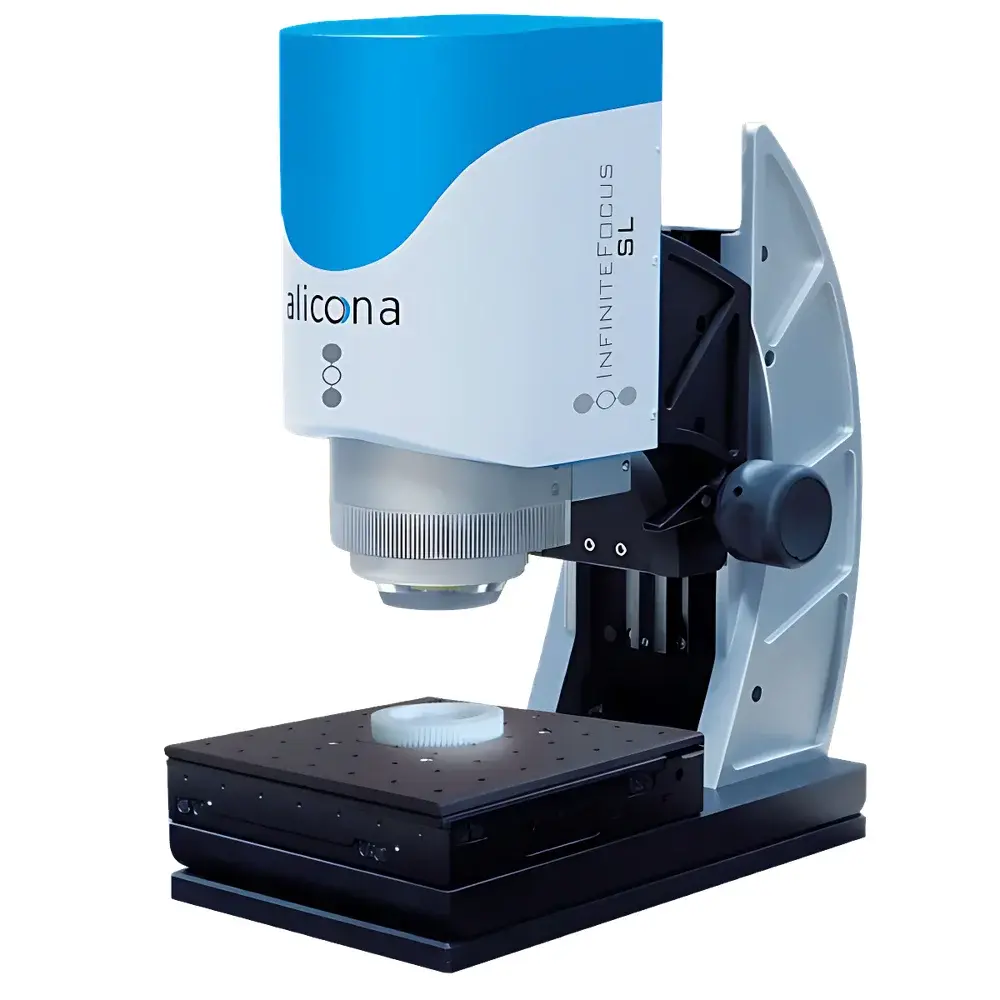
Alicona Infinite Focus SL 3D Optical Surface Metrology System
| Brand | Alicona |
|---|---|
| Origin | Austria |
| Model | Infinite Focus SL |
| Working Distance | 33 mm |
| Measurement Field | 50 × 50 mm |
| Imaging | True-color high-DOF surface imaging |
| Automation | Fully automated interface for inline integration |
| Measurement Speed | Sub-second to several seconds per scan (depending on resolution and area) |
| Optical Principle | Focus-Variation (patented confocal-like axial scanning with white-light LED illumination) |
Overview
The Alicona Infinite Focus SL is a high-performance, entry-tier 3D optical surface metrology system engineered for precision topographic characterization of technical surfaces. It operates on the principle of Focus-Variation—a proprietary optical method combining axial scanning with high-resolution digital image acquisition at multiple focal planes. Unlike conventional confocal or interferometric systems, Focus-Variation leverages depth-dependent contrast maximization across a stack of sharpness-optimized images, enabling robust, non-contact measurement of surfaces with steep flanks (up to 87°), multi-material interfaces, and varying reflectivity—without requiring coating or vacuum environments. Designed for both laboratory and production-integrated use, the Infinite Focus SL delivers traceable, ISO 25178-compliant surface texture parameters (Sa, Sq, Sz, Sdr, etc.) and full-field 3D topography data in a single acquisition cycle. Its modular architecture supports rapid deployment in QC labs, R&D centers, and automated manufacturing cells where repeatability, calibration traceability, and minimal operator intervention are critical.
Key Features
- Patented Focus-Variation optics with white-light LED illumination ensures stable, drift-free operation and immunity to ambient light interference.
- 33 mm extended working distance enables safe, unobstructed access to deep cavities, threaded components, and assembled subassemblies—ideal for aerospace, medical device, and mold & die inspection.
- 50 × 50 mm maximum field of view (at 2.5× objective) provides scalable measurement coverage without stage repositioning; optional motorized XY stage extends effective scan area.
- True-color surface imaging synchronized with topography acquisition delivers contextual visual documentation aligned pixel-for-pixel with height data—essential for defect localization and process correlation.
- Fully automated user interface compliant with industrial communication protocols (e.g., OPC UA, TCP/IP) supports seamless integration into factory MES/SCADA systems and robotic handling workflows.
- Integrated autofocus via coaxial laser assists rapid initial focusing and compensates for thermal drift or part-height variability during batch measurement sequences.
Sample Compatibility & Compliance
The Infinite Focus SL accommodates a broad spectrum of industrial materials—including hardened steel, sapphire, silicon wafers, polymers, ceramics, and additive-manufactured metal parts—without sample preparation. Its insensitivity to surface finish (matte, polished, anodized, or coated) eliminates reliance on conductive coatings required by SEM-based profiling. All measurements adhere to ISO 25178-2 (areal surface texture), ISO 25178-601 (calibration standards), and VDI/VDE 2634 Part 3 (optical 3D measuring systems). Calibration artifacts are NIST-traceable, and system verification follows manufacturer-defined periodic performance checks aligned with GLP and internal audit requirements. The platform supports audit trail generation and electronic signatures per FDA 21 CFR Part 11 when deployed with Alicona’s optional metrology software license.
Software & Data Management
Controlled by Alicona’s proprietary MountainsMap® SP software (v9.x or later), the Infinite Focus SL provides full metrological workflow management—from acquisition setup and parameter scripting to statistical process control (SPC) reporting and GD&T evaluation. Raw point-cloud and areal topography data are stored in vendor-neutral .sur or .xyz formats, ensuring long-term archival integrity. Batch processing scripts support standardized parameter extraction across hundreds of parts; results export directly to CSV, PDF, or XML for integration with LIMS or QMS platforms. Optional modules include automated defect detection (via height/threshold segmentation), cross-section analysis with ISO 4287 compliance, and comparative overlay of CAD nominal surfaces for deviation mapping (±1 µm alignment accuracy).
Applications
- Surface roughness and waviness quantification of cutting tools, injection molds, and turbine blades per ISO 13565 and ASME B46.1.
- Wear track analysis and coating thickness assessment on orthopedic implants and stents using multi-layer height difference algorithms.
- Dimensional verification of micro-structured surfaces (e.g., diffractive optics, microlens arrays) with lateral resolution down to 0.4 µm (dependent on objective).
- In-process validation of AM parts—measuring as-built surface fidelity, staircase effects, and support-removal artifacts prior to post-processing.
- Failure analysis labs: correlating corrosion pitting morphology, fatigue crack initiation zones, and EDM recast layer topography with mechanical test outcomes.
FAQ
What surface angles can the Infinite Focus SL measure reliably?
It measures surfaces with slopes up to 87° without shadowing or signal loss—enabling accurate profiling of gear teeth, thread flanks, and micro-milled channels.
Is the system suitable for in-line production environments?
Yes—its fully automated interface, vibration-insensitive design, and IP52-rated enclosure options support integration into cleanroom and shop-floor settings with minimal environmental conditioning.
Does it require periodic recalibration?
Calibration is performed using certified reference artifacts; Alicona recommends annual verification per ISO/IEC 17025 guidelines, with intermediate performance checks conducted daily or per shift using check standards.
Can it measure transparent or highly reflective surfaces?
Yes—Focus-Variation inherently handles low-contrast and specular surfaces better than confocal or fringe projection methods; optional polarization filters further suppress glare on mirror-finish metals.
How is measurement traceability ensured?
Each measurement includes embedded metadata: instrument ID, calibration certificate number, environmental conditions (optional sensor input), operator ID, and timestamp—all logged within MountainsMap® for full audit trail reconstruction.



