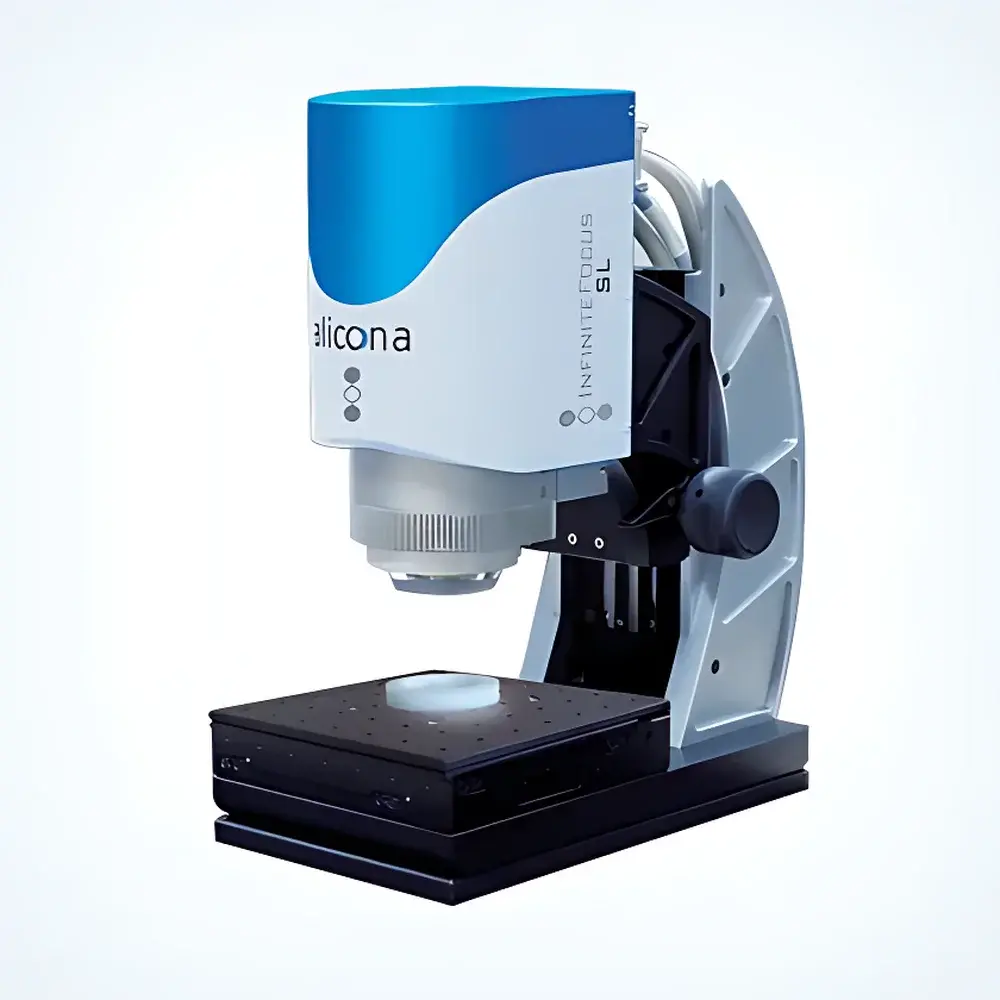
Alicona InfiniteFocus SL Optical 3D Surface Metrology System
| Brand | Alicona |
|---|---|
| Country of Origin | Austria |
| Model | InfiniteFocus SL |
| Product Type | Non-contact Optical Profilometer / Surface Roughness Tester |
| X/Y Travel Range | 50 mm × 50 mm (motorized) |
| Z Travel Range | 130 mm (26 mm motorized) |
| Best Vertical Resolution | 20 nm |
| Max. Scan Height | 25 mm |
| Working Distance | 17.5 mm (with 5× objective) |
| Max. Field of View Expansion | 2500 mm² |
| Max. Single-direction Measurement Range | 50 mm |
| Min. Measurable Radius | 2 µm |
| Min. Measurable Wedge Angle | 20° |
| Min. Measurable Roughness (Ra) | 80 nm |
| Min. Measurable Areal Roughness (Sa) | 50 nm |
Overview
The Alicona InfiniteFocus SL is a high-precision, non-contact optical 3D surface metrology system engineered for laboratory research and industrial quality control environments. It employs Focus-Variation technology—a robust optical measurement principle combining controlled vertical scanning with a shallow depth-of-field lens system. As light focuses sequentially across varying surface heights, the system captures high-contrast image stacks; surface topography is reconstructed pixel-by-pixel using focus evaluation algorithms. This method delivers true 3D areal data with sub-micrometer lateral resolution and nanometer-scale vertical repeatability—without requiring sample coating, vacuum, or stylus contact. Unlike interferometry or confocal microscopy, Focus-Variation maintains accuracy on steep flanks (>85°), multi-material surfaces, and optically heterogeneous features—including machined edges, coated tools, and textured functional surfaces—making it especially suited for geometrically complex manufactured parts.
Key Features
- Motorized XYZ stage with 50 mm × 50 mm automated X/Y travel and 130 mm total Z travel (26 mm motorized range), enabling flexible positioning and multi-region stitching.
- 20 nm best vertical resolution achieved via high-stability piezo-driven objective positioning and calibrated focus evaluation algorithms.
- 17.5 mm working distance (with 5× objective), accommodating bulky or mounted components without re-fixturing.
- Up to 2500 mm² extended field-of-view capability through automated tile-based stitching, preserving metrological traceability across large areas.
- Measurement of both form (e.g., curvature, flatness, step height) and micro-topography (e.g., Ra, Sa, Sq, Rz, Sdr) within a single acquisition—fully compliant with ISO 25178-2 and ISO 4287 standards.
- Integrated LED illumination with adjustable intensity and directional control ensures optimal contrast on reflective, matte, or layered surfaces—including PVD-coated cutting tools and EDM-finished molds.
Sample Compatibility & Compliance
The InfiniteFocus SL accommodates diverse industrial samples—from micro-machined inserts and turbine blade leading edges to injection molds and biomedical implants—without surface preparation. Its optical design tolerates surface slopes up to 85°, radiuses down to 2 µm, and wedge angles as low as 20°, supporting quantitative analysis of cutting edges, burrs, and micro-geometries. All measurements adhere to international metrological standards: vertical axis calibration is traceable to NIST/PTB references; roughness parameters follow ISO 25178-2 (areal) and ISO 4287 (profile); form deviations comply with ISO 1101 (geometrical product specifications). The system supports GLP/GMP-aligned workflows through optional audit trail logging, user access levels, and electronic signature capability per FDA 21 CFR Part 11 requirements.
Software & Data Management
Powered by Alicona’s proprietary MountainsMap® software (v9.x), the InfiniteFocus SL provides full metrology-grade analysis in a validated, intuitive interface. The software enables automatic feature recognition (e.g., edge detection, crater segmentation), GD&T evaluation (position, parallelism, cylindricity), and statistical process control (SPC) charting with Cp/Cpk calculation. Raw height maps are stored in standardized .sur format (ISO 25178-compliant), exportable to ASCII, CSV, or industry-standard exchange formats (STL, OBJ, DXF). Data integrity is ensured via embedded metadata (instrument ID, operator, timestamp, environmental conditions), version-controlled report templates, and encrypted database archiving. Optional integration with MES/QMS platforms (e.g., Siemens Opcenter, ETQ Reliance) supports automated data routing and compliance documentation.
Applications
The InfiniteFocus SL serves critical dimensional verification tasks across high-precision manufacturing sectors. In cutting tool production, it quantifies flank wear, rake angle deviation, and micro-chipping at sub-µm resolution—directly feeding into tool life prediction models. Automotive suppliers use it for cylinder bore cross-hatch analysis, piston ring surface texture, and injector nozzle orifice geometry. Aerospace manufacturers apply it to turbine vane cooling hole edge integrity, thermal barrier coating roughness, and additive-manufactured part porosity mapping. Mold and die shops rely on its ability to verify EDM sink-machined cavity textures and replication fidelity of micro-structured surfaces. Academic labs deploy it for tribology studies, biomaterial surface characterization, and validation of nanoimprint lithography processes.
FAQ
What surface materials can be measured without coating or preparation?
Metals (steel, TiAl6V4, Inconel), ceramics, polymers, composites, and coated surfaces—including PVD, CVD, and DLC layers—are directly measurable under standard illumination.
Is the system suitable for in-line or shop-floor deployment?
While designed for lab-grade stability, the InfiniteFocus SL’s rigid granite base, active vibration damping, and temperature-compensated optics support controlled production-floor environments when installed on isolation tables.
How does Focus-Variation compare to white-light interferometry (WLI) for steep-slope measurement?
Unlike WLI—which fails on slopes >10° due to coherence limitations—Focus-Variation maintains measurement continuity up to 85°, making it uniquely capable for cutting edge, gear tooth flank, and micro-milled cavity analysis.
Can roughness and form be evaluated simultaneously in one scan?
Yes. The system acquires a single 3D topography dataset from which both ISO 25178-2 areal roughness parameters (Sa, Sq, Sdr) and ISO 1101 geometric tolerances (flatness, roundness, position) are extracted without re-scanning.
Does the software support automated reporting for quality audits?
MountainsMap® includes customizable, password-protected report templates with embedded calibration certificates, uncertainty budgets, and digital signatures—fully aligned with ISO/IEC 17025 and IATF 16949 documentation requirements.