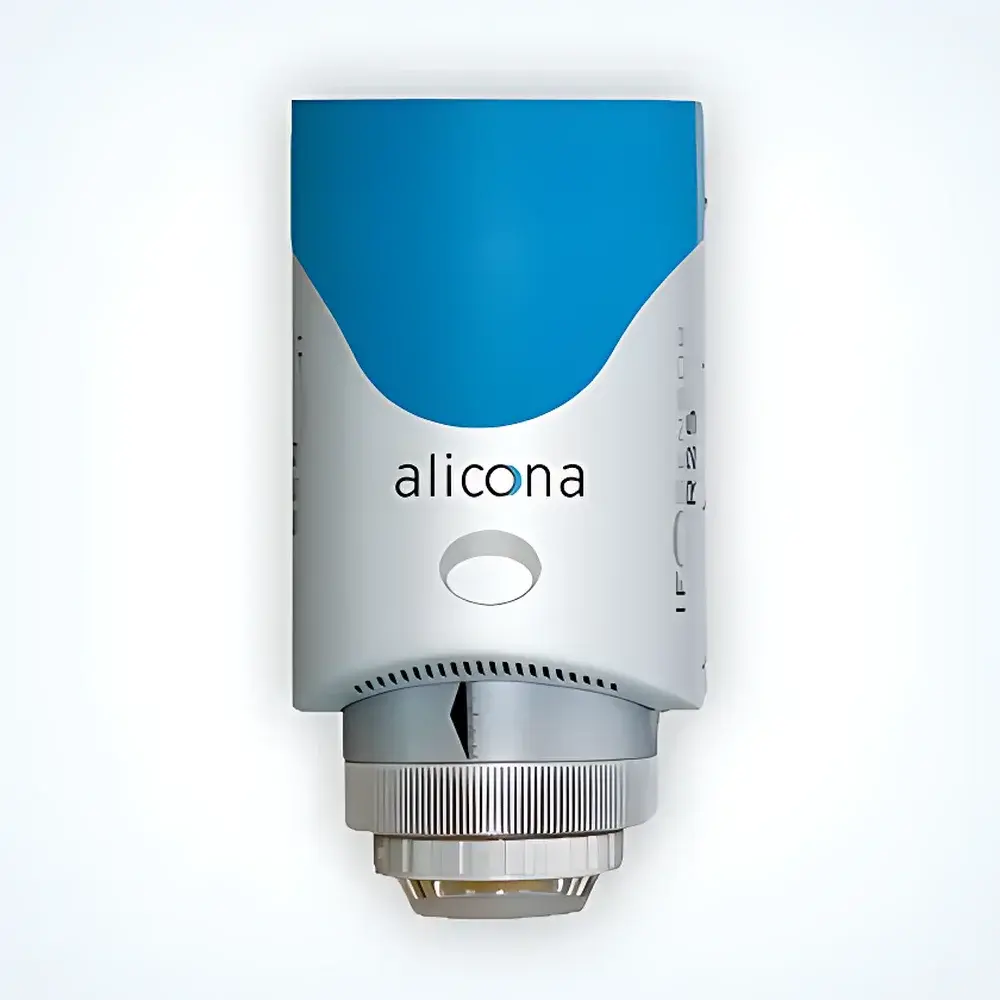
Alicona IF-Sensor R25 Focus-Variation 3D Surface Topography Sensor
| Brand | Alicona |
|---|---|
| Origin | Austria |
| Model | IF-Sensor R25 |
| Product Type | Non-contact Profilometer / Surface Roughness Analyzer |
| Z-Axis Travel | 26 mm (motorized) |
| Max. Scan Height | 25 mm |
| Best Vertical Resolution | 20 nm |
| Min. Measurable Radius | 2 µm |
| Min. Measurable Wedge Angle | 20° |
| Min. Measurable Ra | 80 nm |
| Min. Measurable Sa | 50 nm |
| Max. Tilt Angle Tolerance | 87° |
| Interface Standard | QDAS (Quality Data Acquisition Standard) |
Overview
The Alicona IF-Sensor R25 is a high-precision, non-contact 3D surface topography sensor engineered for integration into automated manufacturing environments. It employs focus-variation optical metrology—a robust, ISO 25178-compliant technique that combines axial scanning with high-magnification microscopy to capture true 3D surface geometry at micro- and sub-micrometer scales. Unlike conventional 2D profilometry or tactile stylus-based methods, the IF-Sensor R25 acquires full-field areal data without mechanical contact, eliminating probe wear, surface deformation, or measurement-induced artifacts. Its core architecture supports traceable, reproducible quantification of surface texture, form, and local geometry—making it suitable for both R&D validation and in-line process control where metrological continuity between lab and shop floor is critical.
Key Features
- Motorized Z-axis travel of 26 mm enables adaptive focusing across complex, high-relief surfaces up to 25 mm in total height.
- Vertical resolution down to 20 nm ensures reliable detection of fine-scale topographic features such as micro-machined textures, polished tooling marks, or thin-film interference patterns.
- Capable of measuring radii as small as 2 µm and wedge angles ≥20°, supporting characterization of sharp edges, micro-grooves, and precision-machined chamfers.
- Surface roughness parameters including Ra (80 nm min.) and Sa (50 nm min.) are computed directly from calibrated 3D point clouds, conforming to ISO 25178-2 and ASME B46.1 definitions.
- High tilt tolerance (up to 87°) allows stable acquisition on steep flanks, threaded surfaces, and freeform optics without repositioning or multi-angle stitching.
- QDAS (Quality Data Acquisition Standard)-compliant interface facilitates plug-and-play integration with MES, PLC, and SCADA systems—enabling real-time SPC, pass/fail logic, and automated report generation.
Sample Compatibility & Compliance
The IF-Sensor R25 accommodates a broad range of industrial materials—including hardened steels, carbides, ceramics, polymers, and coated substrates—without requiring conductive coating or vacuum conditions. Its optical design eliminates sensitivity to reflectivity variations across heterogeneous surfaces (e.g., mixed metal/plastic assemblies or textured composites). All measurements adhere to ISO/IEC 17025 requirements for calibration traceability, with optional NIST-traceable verification kits available. The system supports audit-ready documentation per FDA 21 CFR Part 11 when deployed in regulated manufacturing (e.g., medical device or aerospace component production), including electronic signatures, user access logs, and immutable measurement history.
Software & Data Management
Data acquisition and analysis are performed using Alicona’s proprietary InfiniteFocus Software (v7.x), which provides automated feature recognition, GD&T evaluation (per ISO 1101), and multi-sensor data fusion capabilities. Raw height maps are stored in standardized .ifp format, fully compatible with third-party metrology software (e.g., MountainsMap®, PolyWorks®, or MATLAB via API). Measurement workflows can be scripted and version-controlled, enabling repeatable operator-independent execution. Integrated reporting modules generate PDF/Excel outputs compliant with internal QA templates or external customer requirements (e.g., PPAP Level 3). Long-term data integrity is ensured through SHA-256 checksums and timestamped metadata embedding.
Applications
- Precision mold and die inspection: quantifying wear, polish degradation, and cavity fidelity on injection molds and forging dies.
- Medical implant surface verification: assessing osteoconductive topographies, grit-blasted roughness, and additive-manufactured lattice porosity.
- Optical component metrology: characterizing aspheric lens form error, diffractive element step heights, and anti-reflective coating uniformity.
- Micro-electromechanical systems (MEMS): measuring comb-drive gaps, cantilever thickness variation, and release etch uniformity.
- Automotive powertrain components: evaluating cylinder bore cross-hatch angles, piston ring land finish, and turbocharger blade surface integrity.
FAQ
Is the IF-Sensor R25 suitable for in-process measurement on CNC machine tools?
Yes—its compact sensor head (IP64-rated housing) and vibration-insensitive optical path support direct mounting on machining centers or robotic arms; synchronization with machine tool encoders is achievable via QDAS-triggered acquisition.
Does the system require periodic recalibration?
Calibration intervals follow ISO 10360-8 guidelines and are typically 12 months under stable environmental conditions; Alicona-certified service includes traceable verification against certified step-height and roughness standards.
Can it measure transparent or highly reflective surfaces?
Yes—the focus-variation principle is inherently insensitive to surface reflectivity; optional polarization filters and adjustable LED illumination intensity further enhance contrast on specular or translucent samples.
How is measurement uncertainty determined for custom applications?
Uncertainty budgets are generated per GUM (JCGM 100:2008) using Alicona’s validated uncertainty models, incorporating contributions from environmental stability, stage repeatability, optical aberration, and algorithmic interpolation—available upon request for critical aerospace or biomedical use cases.