
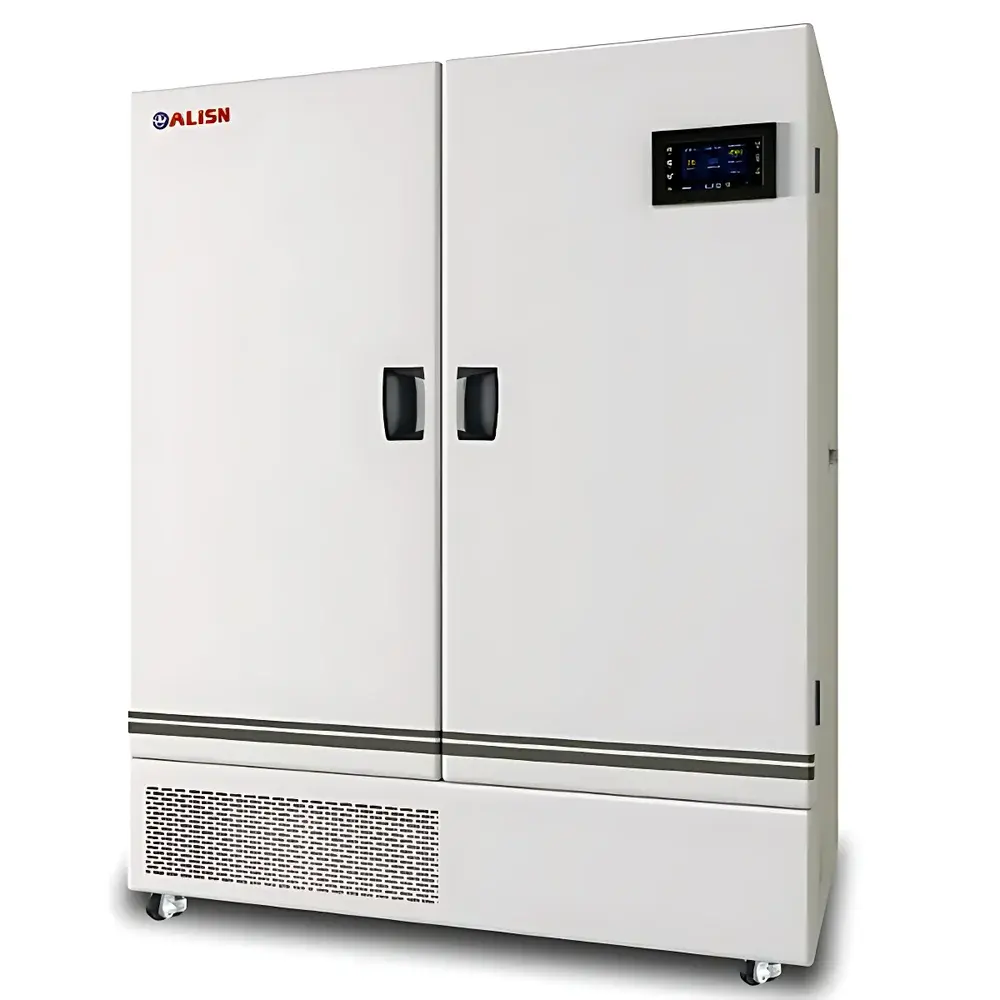
ALISN CNT 1000plus Low-Temperature Biochemical Incubator
| Brand | ALISN |
|---|---|
| Origin | Shanghai, China |
| Manufacturer Type | Authorized Distributor |
| Product Origin | Domestic (China) |
| Model | CNT 1000plus |
| Cooling Method | Compressor-based refrigeration |
| Air Circulation | Natural convection |
| Temperature Range | −10 °C to +90 °C |
| Temperature Accuracy | ±0.1 °C |
| Temperature Uniformity (at 37 °C, empty chamber) | ±0.1 °C |
| Chamber Volume | 1000 L |
| Display | 7-inch full-color TFT touch screen |
| Control System | PID + fuzzy logic algorithm |
| Data Logging Capacity | 10-year continuous temperature recording (non-editable, exportable via USB flash drive) |
| Audit Trail | 16,000 entries (user actions & alarms, non-modifiable, exportable) |
| User Management | Up to 5 configurable accounts with role-based permissions |
| Multi-point Temperature Calibration | Yes |
| Compressor | SECOP (Danfoss Group), Germany |
| Condenser Fan | EBM-Papst, Germany |
| Refrigerant | Environmentally compliant (R290/R600a blend) |
| Insulation | Monolithic polyurethane foam injection (≥80 mm thickness) |
| Power Supply | AC 220 V, 50/60 Hz |
| Heating Power | 3200 W |
| Operating Ambient | 5–35 °C (optimal: 23±2 °C) |
| Safety Features | Over-temperature alarm, door-open alert, compressor overpressure protection, leakage current protection, sensor fault detection, auto-restart after power failure |
Overview
The ALISN CNT 1000plus Low-Temperature Biochemical Incubator is an engineered environmental control system designed for precise, stable, and traceable thermal management in life science laboratories. It operates on a dual-mode thermoregulation principle—combining high-efficiency compressor-based refrigeration with PTC resistive heating—to maintain setpoints across a wide operational range of −10 °C to +90 °C. Unlike forced-air incubators, the CNT 1000plus employs natural convection to minimize shear stress on sensitive biological samples, making it especially suitable for low-turbulence applications such as vaccine stabilization, microbial culture at sub-ambient temperatures, plant tissue preservation, and long-term biochemical reaction monitoring. Its monolithic polyurethane insulation structure (≥80 mm wall thickness) delivers exceptional thermal inertia, reducing energy consumption by >40% compared to conventional air-jacketed units under identical ambient conditions (23 °C, 60% RH). The unit complies with IEC 61010-1:2010 safety standards for laboratory equipment and meets structural prerequisites for GLP-compliant environments.
Key Features
- High-stability temperature control: ±0.1 °C accuracy with real-time PID + fuzzy logic regulation; uniformity maintained at ±0.1 °C (measured at 37 °C, empty chamber, per ISO 15378 Annex A)
- Non-editable, time-stamped data logging: Continuous 10-year temperature history stored internally; exportable only via encrypted USB drive in .csv format
- Full audit trail capability: 16,000-event capacity (including user logins, parameter changes, alarm triggers); all entries immutable and timestamped to millisecond resolution
- Multi-tier permission architecture: Administrator-defined roles for up to five users—including operator, technician, and QA reviewer—with granular access to calibration, program editing, and data export functions
- Multi-point temperature offset correction: Independent compensation at up to six internal probe locations to eliminate spatial gradient effects across the 1000 L chamber
- Industrial-grade refrigeration subsystem: SECOP (Danfoss) variable-speed compressor paired with EBM-Papst EC condenser fans and low-GWP hydrocarbon refrigerant (R290/R600a blend)
- Dual-language UI: Seamless toggle between English and Chinese interface without firmware reset or configuration loss
- Standardized connectivity: RS232, RS485, and USB-B ports preconfigured for integration with LIMS, SCADA, or centralized facility monitoring systems
Sample Compatibility & Compliance
The CNT 1000plus accommodates diverse sample formats—including stacked Petri dishes, multi-well plates, serum bottles, and upright bioreactor vessels—within its 1300 × 1180 × 660 mm stainless-steel chamber. The double-door design features a tempered inner glass panel (5 mm thick, anti-fog coated) and a silicone-sealed 50 mm port for external sensor feedthroughs or gas line integration. All internal surfaces are electropolished AISI 304 stainless steel, passivated per ASTM A967, ensuring compatibility with ethanol, isopropanol, and hydrogen peroxide vapor decontamination cycles. The unit satisfies essential requirements for storage of WHO-prequalified vaccines (per WHO TRS No. 1016, Annex 9) and supports cold-chain validation per USP . Its hardware architecture and firmware design align with FDA 21 CFR Part 11 technical controls for electronic records and signatures when deployed with validated USB export workflows.
Software & Data Management
The embedded control system runs on a deterministic real-time OS with dedicated memory partitioning for process control, data logging, and user interface rendering. Temperature profiles support up to 32 programmable segments per cycle, with ramp rates adjustable from 0.1 to 10 °C/min. Logged data includes chamber setpoint, actual temperature (from HERAEUS Pt1000 sensor), compressor duty cycle, fan speed, and alarm status—all time-synchronized to an internal RTC traceable to UTC via NTP (when connected to network). Exported files include SHA-256 checksums and digital signature headers to verify integrity during regulatory submission. Optional ALISN LabLink™ software (sold separately) enables remote monitoring, automated report generation (PDF/Excel), and trend analysis against predefined acceptance criteria (e.g., ISO 8573-1 for stability thresholds).
Applications
- Low-temperature microbial cultivation (e.g., psychrophilic bacteria, lactic acid starters)
- Vaccine and monoclonal antibody intermediate storage (2–8 °C and −20 °C stability studies)
- Seed germination and plant phenotyping under controlled chilling stress
- Enzyme kinetics assays requiring extended incubation below ambient
- Long-duration biochemical degradation testing (e.g., polymer hydrolysis, protein aggregation)
- Reference standard storage for metrology labs conducting temperature-humidity correlation studies
FAQ
Does the CNT 1000plus support IQ/OQ/PQ documentation packages?
Yes—ALISN provides vendor-qualified IQ/OQ protocols (ASTM E2500-compliant) and PQ templates aligned with ISO/IEC 17025 for accredited calibration labs.
Can the unit operate continuously at −10 °C in a 35 °C ambient room?
Yes, but sustained operation at extreme ambient conditions requires optional condenser cooling assist (available as CNT-COOL add-on kit) to maintain compressor efficiency and lifespan.
Is the audit trail data export compliant with FDA 21 CFR Part 11?
The exported .csv files contain digitally signed metadata, user ID, timestamp, and hash verification—meeting Part 11’s “electronic record” definition when used within a validated procedural framework.
What is the mean time between failures (MTBF) for the SECOP compressor under continuous −10 °C operation?
Per SECOP MTBF certification (Document No. SECOP-MTBF-2023-ALISN), ≥35,000 hours at rated load, assuming ambient ≤30 °C and relative humidity ≤75% RH.
Are third-party calibration certificates available with NIST-traceable references?
Yes—ALISN partners with ISO/IEC 17025-accredited calibration providers; certificates include uncertainty budgets per GUM (JCGM 100:2008) and are issued with each commissioning.





