
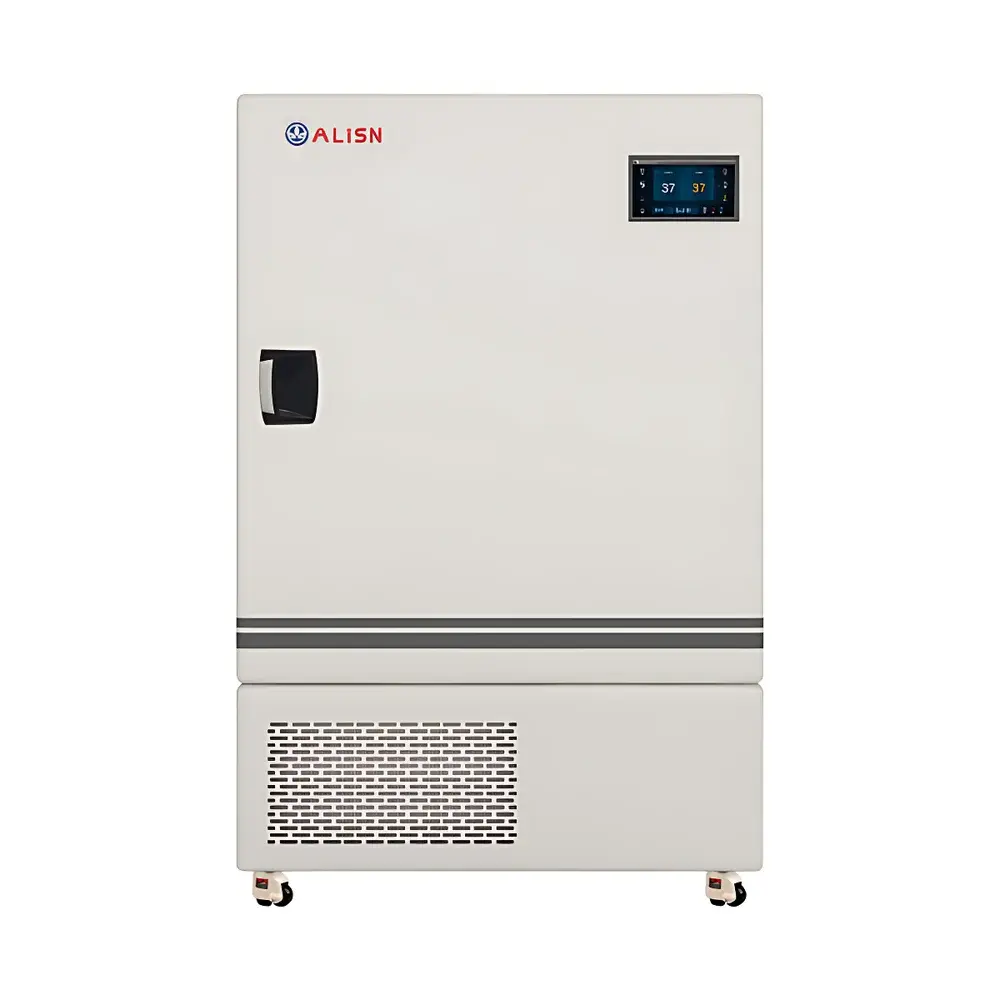
ALISN CNT-150 Low-Temperature Biochemical Incubator
| Brand | ALISN |
|---|---|
| Origin | Shanghai, China |
| Model | CNT-150 |
| Cooling Method | Compressor-based refrigeration |
| Air Circulation | Forced convection |
| Temperature Range | −10 °C to +85 °C |
| Temperature Control Accuracy | ±0.1 °C |
| Temperature Uniformity | ≤0.8 °C at 40 °C |
| Chamber Volume | 150 L |
| External Dimensions (W×H×D) | 780 × 1200 × 802 mm |
| Power Supply | AC 220 V, 50/60 Hz |
| Heating Power | 1000 W |
| Compressor | SECOP (Danfoss Group), Germany |
| Condenser Fan | EBM, Germany |
| Refrigerant | Eco-friendly R134a or equivalent |
| Temperature Sensor | HERAEUS platinum RTD (Pt100) |
| Insulation | Monolithic polyurethane foam (≥80 mm thickness) |
| Display | 4.3″ color TFT touchscreen |
| Data Logging | ≥3 years of timestamped temperature & alarm logs (U-disk export, write-protected) |
| Audit Trail | ≥16,000 entries (user actions, alarms, parameter changes) |
| User Management | 5 configurable roles with granular access control |
| Communication Ports | USB, RS-232, RS-485 |
| Language Interface | Switchable English/Chinese |
| Safety Features | Over-temperature cut-off, compressor high-pressure protection, door-open alarm, sensor fault detection, leakage current protection, auto-restart after power recovery |
Overview
The ALISN CNT-150 Low-Temperature Biochemical Incubator is an engineered environmental chamber designed for precise, stable, and traceable temperature control across extended operational ranges—from sub-zero conditions (−10 °C) to elevated thermal regimes (+85 °C). Built upon a dual-mode thermal architecture integrating high-efficiency compressor-based refrigeration and PID-regulated resistive heating, the unit maintains rigorous thermal fidelity under dynamic load conditions. Its core function is to provide a reproducible, contamination-minimized environment for biochemical reaction monitoring, microbial growth studies, enzymatic activity assays, BOD incubation, stability testing per ICH Q1 guidelines, and long-term sample conditioning in regulated laboratory settings. The chamber’s structural integrity, thermal insulation performance, and control system architecture comply with foundational design principles outlined in ISO 13485 (for medical device-related applications) and support alignment with GLP (Good Laboratory Practice) and GMP (Good Manufacturing Practice) documentation requirements.
Key Features
- High-fidelity temperature regulation: ±0.1 °C control accuracy and ≤0.8 °C uniformity at 40 °C—validated under no-load conditions per ISO 29182-2 (incubator performance testing).
- Dual-sensor redundancy architecture: Primary HERAEUS Pt100 RTD sensor integrated with secondary diagnostic thermistor for real-time fault detection and fail-safe alarm triggering.
- Energy-optimized thermal envelope: 80 mm monolithic polyurethane foam insulation achieves >40% lower energy consumption versus conventional air-jacketed incubators of comparable volume.
- Secure data governance: Write-protected internal flash memory stores ≥3 years of time-stamped temperature history and ≥16,000 audit trail entries—including user logins, setpoint modifications, alarm events, and door openings—exportable via encrypted USB drive.
- Regulatory-ready software framework: Supports role-based access control (five user tiers), electronic signature capability, and configurable alarm escalation protocols compliant with FDA 21 CFR Part 11 Annex 11 expectations.
- Robust mechanical design: Double-door configuration with tempered inner glass viewport; 50 mm silicone grommet port on right side wall for external probe feedthrough or gas line integration; stainless steel interior chamber (304 grade) with rounded corners for cleanability.
Sample Compatibility & Compliance
The CNT-150 accommodates standard microbiological vessels (e.g., Petri dishes, test tubes, flasks), multi-well plates, and custom bioreactor modules up to 600 mm height. Its −10 °C to +85 °C operating envelope supports diverse applications including cold-adapted enzyme characterization, psychrophilic culture propagation, accelerated stability studies (ICH Q1A–Q1E), and BOD5 incubation per ASTM D5210 and ISO 5815-1. All electrical components meet CE/EMC Directive 2014/30/EU standards; refrigerant selection complies with EU F-Gas Regulation (No. 517/2014) and EPA SNAP program criteria. The unit is compatible with ISO/IEC 17025-accredited laboratory quality management systems when deployed with documented IQ/OQ/PQ validation protocols.
Software & Data Management
The embedded firmware features a deterministic real-time OS with deterministic PID + fuzzy logic hybrid control algorithm—enabling rapid thermal recovery (<15 min from 25 °C to −5 °C post-door opening) and minimal overshoot during ramp-soak cycles. The 4.3″ capacitive touchscreen provides intuitive navigation through hierarchical menus supporting multi-segment programmable profiles (up to 32 steps), event-triggered logging, and real-time graphical trend display. Data export is restricted to FAT32-formatted USB drives; exported CSV files contain ISO 8601 timestamps, sensor IDs, and CRC-32 checksums to ensure data integrity. Internal non-volatile memory retains all logs during power loss. Optional RS-485 Modbus RTU interface enables integration into centralized SCADA or LIMS platforms.
Applications
- Pharmaceutical: Stability testing of APIs and finished dosage forms under ICH-defined storage conditions (e.g., “Refrigerated” and “Room Temperature” classifications).
- Food & Beverage: Aerobic plate count (APC), coliform enumeration, yeast/mold incubation per AOAC and ISO 4833-1 protocols.
- Environmental Testing: BOD5 analysis per Standard Methods 5210B; nitrification/denitrification process simulation.
- Academic Research: Low-temperature fermentation kinetics, cryotolerance screening, and psychrophile isolation workflows.
- Quality Control Labs: Routine calibration verification of reference thermometers and temperature-sensitive reagents.
FAQ
What is the validated temperature uniformity specification across the full chamber volume?
Uniformity is specified as ≤0.8 °C at 40 °C (per ISO 29182-2 Clause 6.3.2); actual performance at other setpoints may vary within ±0.3 °C under no-load conditions.
Does the unit support 21 CFR Part 11-compliant electronic records?
Yes—the system implements role-based authentication, immutable audit trails, and electronic signature capture for critical operations, satisfying core technical controls defined in Part 11 Subpart B.
Can external sensors be connected for independent validation?
Yes—via the dedicated 50 mm silicone port (with optional PT100 feedthrough kit) or via analog input mapping through the RS-485 interface using Modbus register addressing.
Is the refrigerant compliant with global environmental regulations?
Yes—the SECOP compressor uses R134a (GWP = 1430), classified as low-toxicity and non-ozone-depleting under Montreal Protocol Annex A, Group II, and approved under EPA SNAP Acceptable Substitutes List.
What validation documentation is supplied with the instrument?
Factory-assembled IQ/OQ documentation package is available upon request, including calibration certificates traceable to NIM (China National Institute of Metrology) and test reports per ISO/IEC 17025 accredited methods.






