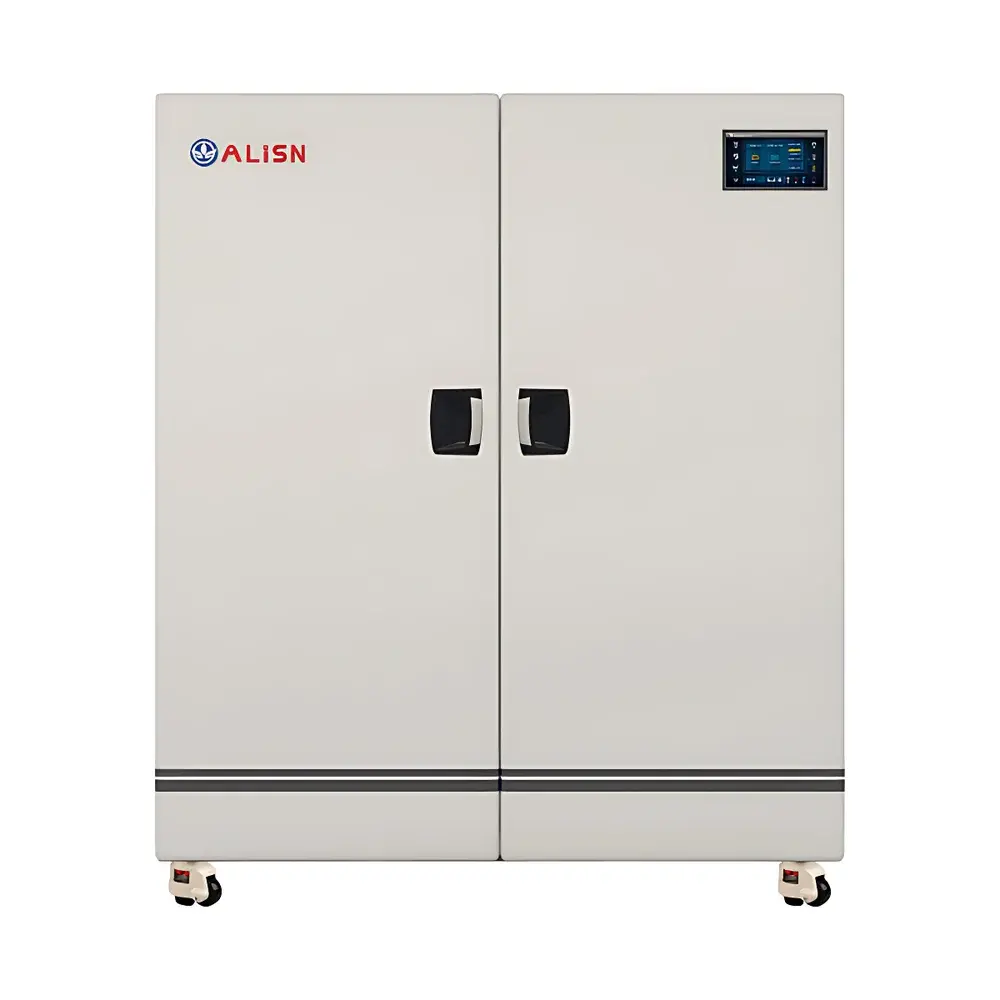
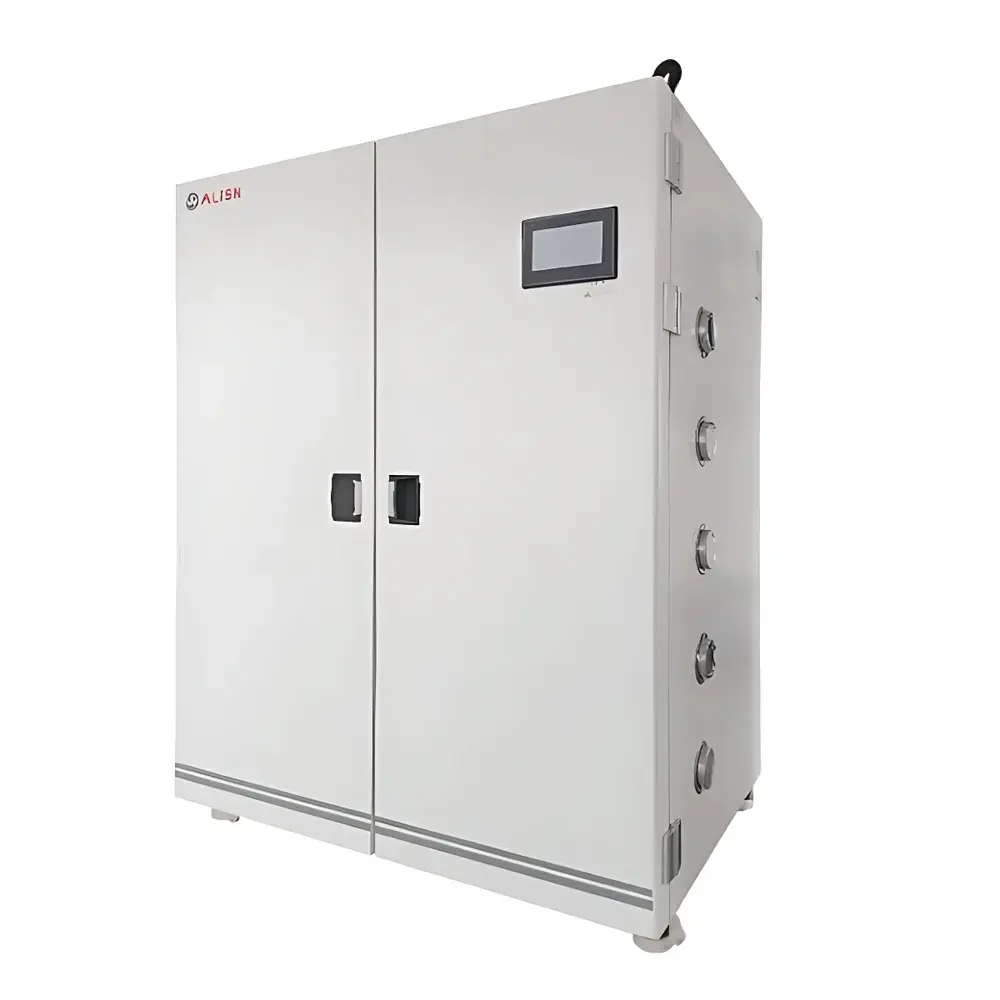
ALISN LDC 860 Battery Environmental Test Chamber
| Brand | ALISN |
|---|---|
| Origin | Shanghai, China |
| Model | LDC 860 |
| Temperature Control Range | –10 °C to 90 °C (–20 °C to 100 °C optional) |
| Temperature Uniformity (15–45 °C) | ±0.2–0.6 °C |
| Temperature Stability | ±0.1 °C |
| Internal Volume | 825 L |
| Interior Dimensions (W×H×D) | 1250×1600×450 mm |
| Exterior Dimensions (W×H×D) | 1590×1870×1050 mm |
| Weight | 295 kg |
| Heating Power | 2000 W |
| Compressor | SECOP (Danfoss), Condenser Fan: EBM |
| Refrigerant | Eco-friendly R134a/R404A |
| Insulation | Monolithic polyurethane foam |
| Temperature Sensor | PT100 (HERAEUS) |
| Display | 7-inch color TFT touch screen |
| Communication Interfaces | RS232, RS485, USB |
| Data Storage | ≥10 years of raw test data (immutable export via USB) |
| Audit Trail | 16,000+ timestamped operator and alarm logs (immutable USB export) |
| User Management | 5 configurable roles with granular permissions |
| Viewing Window | Tempered glass inner door |
| Cable Port | Φ50 mm silicone-sealed feedthrough |
| Compliance | Designed for ISO/IEC 17025-aligned battery testing workflows, supports GLP/GMP traceability requirements |
Overview
The ALISN LDC 860 Battery Environmental Test Chamber is an engineered platform for controlled-condition electrochemical performance evaluation of lithium-ion and other rechargeable battery cells, modules, and packs. It operates on a dual-mode thermal regulation principle—combining variable-speed compressor-driven refrigeration with PID-regulated resistive heating—to maintain precise, stable, and spatially uniform temperature environments across its 825 L internal chamber. Unlike general-purpose environmental chambers, the LDC 860 integrates hardware-level synchronization with external charge/discharge cyclers (via RS232/RS485 protocols), enabling time-correlated thermal profiling during dynamic current/voltage stress tests. Its design adheres to foundational thermal management requirements outlined in IEC 62660-1 (performance testing), UN 38.3 (transport safety), and GB/T 31485 (Chinese lithium battery safety standards), making it suitable for R&D validation, QC screening, and accelerated aging studies under defined thermal boundary conditions.
Key Features
- High-fidelity thermal control architecture: SECOP (Danfoss) hermetic compressor paired with EBM axial condenser fans and eco-refrigerants (R134a/R404A) ensures low-noise, high-efficiency operation with <±0.1 °C setpoint stability and rapid recovery (<15 min) after door opening.
- Monolithic polyurethane insulation (≥120 mm thickness) achieves >40% energy savings versus conventional chamber designs while minimizing thermal bridging and enhancing structural rigidity.
- True-color 7-inch TFT touchscreen interface with intuitive menu navigation, bilingual (English/Chinese) language toggle, and context-sensitive help prompts reduces operator training time and minimizes misconfiguration risk.
- Dual-layer door system: Outer insulated door + inner tempered glass viewport enables real-time visual monitoring without compromising thermal integrity or introducing condensation artifacts.
- Calibration-traceable PT100 sensors (HERAEUS) mounted at multiple chamber locations support multi-point temperature offset correction—critical for eliminating spatial non-uniformity in large-volume battery testing.
- Immutable data governance: All raw thermal logs, user actions, and system alarms are stored internally with cryptographic timestamps; export occurs exclusively via USB in read-only format compliant with FDA 21 CFR Part 11 audit trail requirements.
Sample Compatibility & Compliance
The LDC 860 accommodates battery formats from cylindrical (18650, 21700), prismatic, to pouch cells and modular assemblies up to 600 mm in height. A dedicated Φ50 mm silicone-sealed cable port (with optional Φ80/100/125 mm variants) permits safe, low-leakage integration with external cycler leads. The chamber’s thermal performance has been validated under no-load conditions per ISO 16750-4 (road vehicle environmental testing) and meets ambient operating constraints specified in UL 1642 (battery safety standard). Its audit-trail and permission architecture aligns with GLP (Good Laboratory Practice) documentation expectations for regulated battery qualification labs.
Software & Data Management
The embedded controller firmware implements deterministic real-time scheduling for temperature ramp/soak profiles and synchronizes event markers with external instrumentation triggers. Raw temperature/humidity logs (sampled at 1 Hz) are stored in CSV-compatible binary format with SHA-256 hash integrity verification. System-generated reports include calibration history, maintenance logs, and deviation alerts—all exportable via USB without modification capability. Optional Ethernet module (not included) enables remote status monitoring and scheduled firmware updates within segregated lab networks.
Applications
- Thermal runaway propagation studies under controlled ambient ramping (e.g., 1 °C/min from 25 °C to 120 °C).
- Calendar and cycle life testing per ISO 12405-2, with concurrent thermal profiling during constant-current/constant-voltage charge-discharge sequences.
- Low-temperature performance characterization (–20 °C operation optional) for EV battery pack validation.
- Humidity-inclusive storage stability testing (optional humidity add-on available) for electrolyte decomposition analysis.
- Pre-conditioning of battery samples prior to mechanical abuse testing (crush, nail penetration) per UN 38.3 Section 38.3.4.
FAQ
Does the LDC 860 support humidity control?
Standard configuration provides temperature-only control. Humidity control (10–95% RH, ±2% RH accuracy) is available as a factory-installed option requiring modified insulation and steam generator integration.
Can the chamber be integrated with third-party battery cyclers?
Yes—native RS232 and RS485 interfaces support Modbus RTU protocol for bidirectional command exchange (e.g., trigger temperature hold upon current cutoff, log chamber temp at voltage inflection points). Custom API drivers available upon request.
What is the validation procedure for temperature uniformity?
Uniformity mapping is performed using NIST-traceable Class A PT100 probes at 9 predefined locations (per IEC 60068-3-5). A full validation report—including uncertainty budget and probe calibration certificates—is provided with each unit.
Is remote monitoring supported out-of-the-box?
No. Remote access requires optional Ethernet module installation and configuration within a secured VLAN. Web-based dashboard functionality is limited to status telemetry (no control commands) to preserve system integrity.
How is firmware updated and verified?
Updates are delivered as signed .bin files via USB. The controller performs signature verification and CRC32 checksum validation before committing to flash memory—rollback capability is retained for critical revisions.