
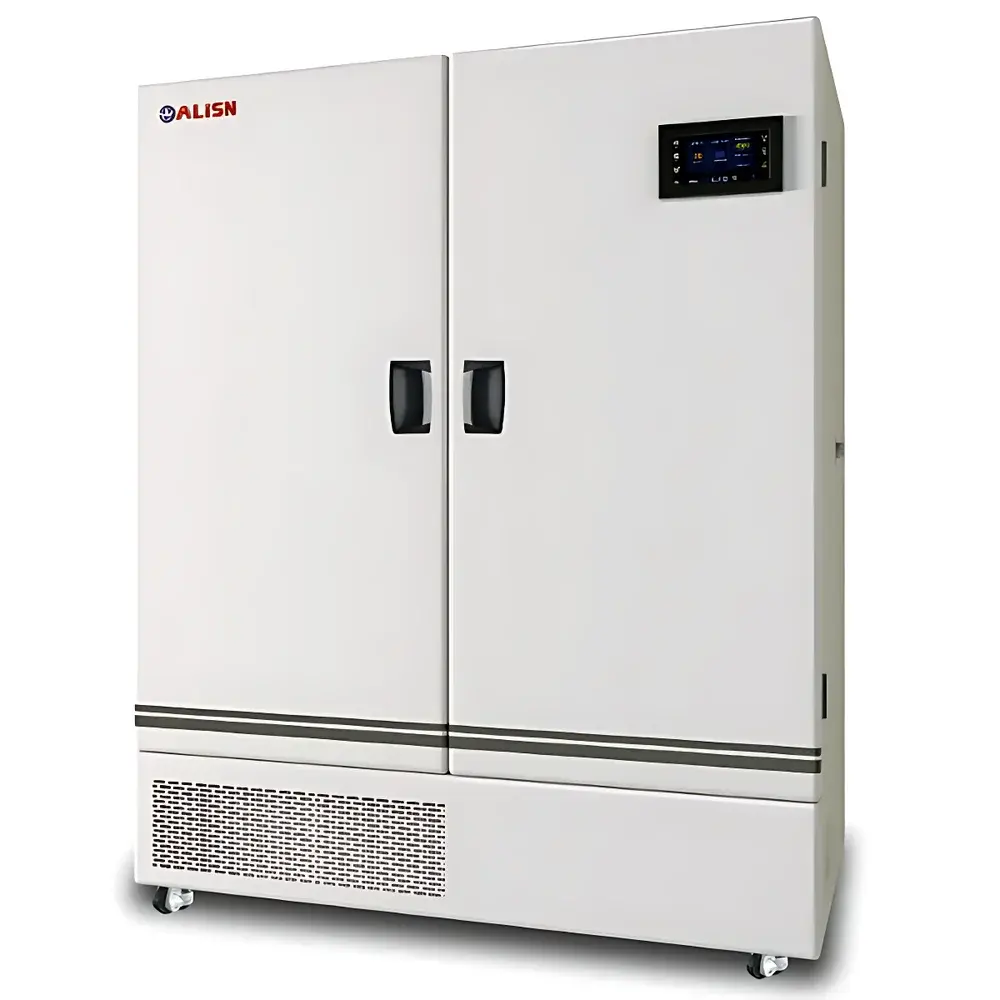
ALISN STC 760 Drug Stability Testing Chamber
| Brand | ALISN |
|---|---|
| Origin | Shanghai, China |
| Manufacturer Type | Authorized Distributor |
| Country of Origin | China |
| Model | STC 760 |
| Price | USD 19,800 (FOB Shanghai) |
| Control System | PID + Fuzzy Logic |
| Display | 7-inch Color TFT Touchscreen |
| Temperature Range (Dark) | −10°C to +85°C |
| Temperature Range (Illuminated) | +10°C to +65°C |
| Humidity Range (Dark) | 15–95% RH ±1.5% RH |
| Humidity Range (Illuminated) | 20–95% RH ±1.5% RH |
| Temperature Uniformity (at 25°C, dark) | ±0.3°C |
| Temperature Stability | ±0.1°C |
| Humidity Stability | ±1.5% RH |
| Illumination | ICH-compliant D65 daylight simulator (0–8000 lux, 6-step adjustable |
| UV Spectrum | 320–400 nm (UVA) |
| Internal Volume | 767 L |
| Interior Dimensions (W×H×D) | 1300 × 1180 × 500 mm |
| External Dimensions (W×H×D) | 1490 × 1790 × 887 mm |
| Net Weight | 295 kg |
| Refrigeration | Inverter-driven SECOP (Danfoss) compressor + EBM condenser fan |
| Refrigerant | Eco-friendly R134a/R600a blend |
| Insulation | Monolithic polyurethane foam (≥120 mm thickness) |
| Humidity Sensor | E+E Electronics capacitive RH sensor |
| Temperature Sensor | Heraeus Pt100 Class A |
| Data Logging | ≥10 years of uneditable timestamped data (internal flash + USB export) |
| Audit Trail | 16,000 entries (user actions, alarms, parameter changes) |
| User Management | 5 configurable roles with granular permissions |
| Communication Ports | RS232, RS485, USB host/device |
| Compliance | Designed to support ICH Q1A(R2), Q1B, Q5C |
Overview
The ALISN STC 760 Drug Stability Testing Chamber is a precision-engineered environmental simulation system designed explicitly for long-term stability studies in accordance with International Council for Harmonisation (ICH) guidelines—particularly Q1A(R2), Q1B (photostability), and Q5C (biotechnological product stability). It operates on a dual-mode control architecture combining PID regulation with adaptive fuzzy logic algorithms to maintain rigorous thermal and hygrometric conditions across extended test durations (up to 72 months). The chamber employs a closed-loop inverter-driven refrigeration system featuring a SECOP (Danfoss) hermetic compressor and EBM axial condenser fan, enabling stable temperature recovery within ≤12 minutes after a 30-second door opening event under standard load conditions. Its illumination subsystem integrates ICH-specified D65 daylight simulators with calibrated spectral output (300–800 nm), including UVA-emitting fluorescent tubes (320–400 nm), all traceable to NIST-certified photometric standards. The unit is constructed for GLP/GMP-aligned laboratory environments, supporting full data integrity workflows required for regulatory submissions to the FDA, EMA, PMDA, and NMPA.
Key Features
- True-color 7-inch TFT capacitive touchscreen interface with intuitive icon-based navigation and bilingual (English/Chinese) menu switching—no language firmware reload required.
- Monolithic polyurethane insulation (≥120 mm wall thickness) applied via high-pressure one-shot foaming, achieving thermal conductivity ≤0.018 W/m·K and reducing energy consumption by >40% versus conventional chambers.
- Capacitive humidity sensing using E+E Electronics EE190 series transducers—zero-drift design, no periodic recalibration needed, certified to ISO 9001 calibration traceability.
- Dual-door structure: outer door with magnetic seal and inner tempered glass door for real-time visual monitoring without compromising internal environment integrity.
- Multi-point temperature offset correction algorithm—enables independent compensation at up to six spatial locations to ensure uniformity compliance per ICH Q1A Annex 3 (±0.5°C max deviation across working volume).
- Integrated audit trail system storing 16,000 chronological entries—including user logins, setpoint modifications, alarm events, and door openings—with immutable USB-exportable binary logs compliant with 21 CFR Part 11 §11.10(d).
- Programmable illumination profile: six-level lux adjustment (0–8000 lux), with optional upgrade path to 12,000 lux; spectral power distribution validated against CIE Publication No. 15:2018.
Sample Compatibility & Compliance
The STC 760 accommodates diverse pharmaceutical dosage forms—including tablets, capsules, injectables in vials, lyophilized powders, topical creams, and biologics in primary containers—within its 767 L working volume. Its stainless-steel interior (AISI 304, 2B finish) and smooth-radius corners meet USP analytical instrument qualification requirements for cleanliness and extractables profiling. All environmental parameters are continuously monitored and recorded in alignment with ICH Q5C section 4.2.3 (stability protocol documentation) and WHO Technical Report Series No. 992 Annex 6 (good manufacturing practices for stability testing). The system supports IQ/OQ/PQ documentation packages, and its embedded firmware includes configurable alarm thresholds per ICH Q1A section 2.2.2 (failure mode identification). Electrical safety conforms to IEC 61010-1:2010 Ed.3; EMC compliance per EN 61326-1:2013.
Software & Data Management
Data acquisition occurs at 10-second intervals by default, with user-selectable logging resolution down to 1 second. All raw sensor values—temperature (Pt100), relative humidity (capacitive), irradiance (calibrated photodiode array), and door status—are timestamped with microsecond precision using an onboard RTC synchronized to UTC via NTP upon network connection. Internal storage retains ≥10 years of compressed time-series data (lossless LZ4 encoding); export is restricted to encrypted .CSV or .PDF formats via USB 2.0 host port. The audit trail database enforces write-once-read-many (WORM) logic: once committed, no record may be altered or deleted—even by administrator accounts. Role-based access control (RBAC) implements five predefined permission tiers (Viewer, Operator, Supervisor, QA Reviewer, Administrator), each assignable to unique login credentials with password complexity enforcement and 90-day expiry policies. Optional Ethernet module enables remote monitoring via HTTPS-secured REST API (JSON payload), compatible with LabVantage LIMS and Oracle Clinical One.
Applications
- I CH Q1A(R2) long-term (25°C/60% RH) and accelerated (40°C/75% RH) stability protocols for small-molecule APIs and finished products.
- Photostability testing per ICH Q1B: near-UV (320–400 nm) and visible light (D65) exposure under controlled temperature/humidity.
- Bracketing and matrixing study designs for multi-strength or multi-package configurations.
- Forced degradation studies requiring precise thermal ramping (e.g., 5°C/h from 25°C to 60°C) with concurrent humidity hold.
- Stability-indicating method development support, including reference standard storage under defined conditions prior to HPLC/UPLC analysis.
- Biologics shelf-life assessment per ICH Q5C, including freeze-thaw cycle simulation when integrated with external cryo-control modules.
FAQ
Does the STC 760 comply with FDA 21 CFR Part 11 for electronic records and signatures?
Yes—the system implements role-based electronic signatures, audit-trail immutability, and secure user authentication in full alignment with Part 11 Subpart B requirements.
Can humidity be maintained independently of temperature during illuminated cycles?
Yes—dual-loop control decouples humidification and refrigeration actuators, enabling stable RH hold (±1.5% RH) even during active photostability testing at 40°C.
What validation documentation is provided with the chamber?
Each unit ships with Factory Acceptance Test (FAT) report, calibration certificates for all sensors (traceable to NIST), IQ/OQ templates, and a complete 21 CFR Part 11 readiness assessment checklist.
Is remote software update capability available?
Firmware updates require authenticated USB media; no over-the-air (OTA) functionality is implemented to preserve regulatory-controlled configuration integrity.
How is temperature uniformity verified across the working chamber volume?
Uniformity mapping follows ASTM E2876-21 Annex A1 methodology using nine calibrated Pt100 probes placed at standardized ICH grid positions; final report includes k=2 expanded uncertainty budgets.






