
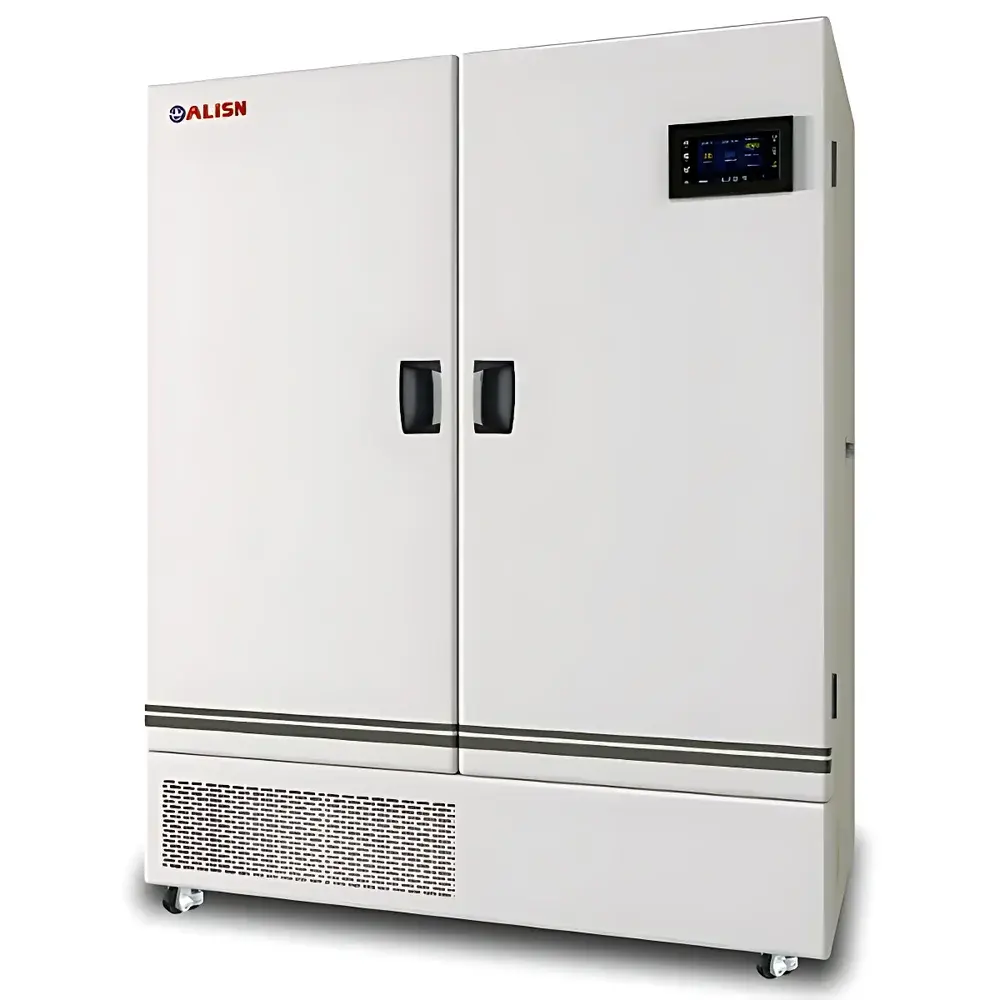
ALISN TPC 1000 Temperature and Humidity Controlled Small Animal Incubator
| Brand | ALISN |
|---|---|
| Origin | Shanghai, China |
| Model | TPC 1000 |
| Refrigeration System | Inverter-driven SECOP (Danfoss) compressor with R404a refrigerant |
| Humidity Reservoir | External water tank |
| Temperature Range (with humidity control) | −10 °C to 85 °C |
| Humidity Range | 10–98 %RH |
| Humidity Accuracy | ±0.1 %RH |
| Chamber Volume | 1000 L |
| Control Method | PID + fuzzy logic algorithm |
| Display | 7-inch full-color TFT touch screen |
| Data Logging | Internal non-volatile memory (≥10 years of continuous data), USB export with write-protected binary format |
| Audit Trail | 16,000 entries (user actions, alarms, system events), immutable export via USB |
| User Management | Up to 5 configurable accounts with role-based permissions |
| Sensor System | HERAEUS platinum RTD temperature sensors |
| Insulation | Monolithic polyurethane foam injection (≥120 mm thickness, thermal conductivity ≤0.022 W/m·K) |
| Airflow Design | Dual-side aerodynamic ventilation ports (Ø50 mm) |
| Door Structure | Double-door configuration with tempered inner glass door |
| Communication Interfaces | RS232, RS485, USB-B (for data export and EMS integration) |
| Power Supply | AC 220 V ±10 %, 50/60 Hz |
| Safety Protections | Over-temperature cutoff, refrigerant high-pressure shutdown, leak current protection, low-water alarm, door-open alert, sensor fault detection, auto-restart after power recovery |
Overview
The ALISN TPC 1000 is a precision-engineered temperature and humidity controlled incubator specifically designed for longitudinal in vivo studies involving small laboratory animals—including mice, rats, Drosophila melanogaster, Apis mellifera, and Aedes aegypti—under rigorously defined environmental stress conditions. Its operational principle integrates closed-loop thermodynamic control with high-fidelity hygrometric regulation, enabling reproducible simulation of physiologically relevant climatic profiles such as cold stress, humid heat, damp-cold, and ambient baseline environments. The chamber employs a dual-sensor architecture (HERAEUS Pt1000 RTDs and E+E Electronics capacitive RH sensors) coupled with an inverter-driven SECOP (Danfoss) compressor and R404a refrigerant cycle, ensuring stable operation across the full −10 °C to 85 °C temperature range and 10–98 %RH humidity span—even during frequent door access or load changes. Structural integrity and thermal efficiency are enhanced by monolithic polyurethane foam insulation (≥120 mm thickness), reducing steady-state energy consumption by >40 % compared to conventional air-jacketed incubators.
Key Features
- PID + fuzzy logic hybrid control algorithm delivering ±0.1 °C temperature stability and ±1.5 %RH humidity uniformity (measured at 25 °C/70 %RH, empty chamber)
- 7-inch industrial-grade TFT touchscreen interface with intuitive bilingual (English/Chinese) navigation and contextual help overlays
- Immutable data logging architecture: raw time-series temperature/humidity values stored in tamper-evident binary format with timestamped metadata; ≥10 years of continuous 1-minute interval data retained internally
- Comprehensive audit trail system capturing 16,000 discrete entries—including user logins, parameter modifications, alarm triggers, and maintenance events—with cryptographic integrity verification upon USB export
- Granular access control supporting five distinct user roles (Administrator, Operator, Technician, Reviewer, Auditor), each assignable to specific functional modules (e.g., program editing, data export, calibration)
- Multi-point temperature offset correction capability, allowing independent compensation at up to six spatial locations to eliminate gradient-induced bias in longitudinal cohort studies
- Aerodynamically optimized dual-side ventilation (Ø50 mm ports) ensures laminar airflow distribution and rapid recovery (<15 min to re-stabilize after 30-second door opening at 37 °C/50 %RH)
- RS232/RS485/USB-B interfaces compliant with Modbus RTU and ASCII protocols, facilitating seamless integration into enterprise-wide Environmental Monitoring Systems (EMS) under ISO 14644-3 and FDA 21 CFR Part 11 requirements
Sample Compatibility & Compliance
The TPC 1000 accommodates standard caging systems for rodents (up to 12 IVC cages, 3-tier configuration) and modular insect rearing trays. Its 1000 L internal volume (1200 × 1180 × 720 mm W×H×D) supports simultaneous multi-condition exposure studies with spatially resolved environmental monitoring. The unit complies with IEC 61000-6-3 (EMC emissions), IEC 61000-6-2 (immunity), and UL 61010-1 safety standards. All firmware and data handling routines adhere to ALCOA+ principles (Attributable, Legible, Contemporaneous, Original, Accurate, Complete, Consistent, Enduring, Available), satisfying GLP audit requirements per OECD Series on Principles of Good Laboratory Practice and supporting traceability for regulatory submissions under USP , ISO/IEC 17025, and Annex 11.
Software & Data Management
No proprietary desktop software is required: all configuration, real-time visualization, and data retrieval occur natively through the embedded HMI. Historical datasets are exported exclusively via USB flash drive in encrypted .bin format, readable only by ALISN-certified validation tools that enforce checksum verification and digital signature validation. Exported files include embedded cryptographic hashes, enabling third-party verification of data integrity during regulatory inspections. The system maintains separate audit logs for data export events, including operator ID, timestamp, and file hash—fully compatible with electronic record retention policies mandated under 21 CFR Part 11 Subpart B.
Applications
- Immunocompromised murine model phenotyping under controlled thermal-hygrometric stress
- Chronobiological assessment of circadian rhythm disruption in Drosophila under simulated seasonal humidity cycles
- Thermoregulatory response quantification in neonatal rodent cohorts exposed to graded cold-humid challenges
- Vector competence evaluation of mosquito populations under climate-relevant wet-bulb temperature regimes
- Preclinical toxicology study support requiring ISO 17025-compliant environmental documentation for OECD 407, 408, and 422 test guidelines
- Long-term stability testing of biologics in animal-derived matrices under accelerated aging conditions
FAQ
Does the TPC 1000 support 21 CFR Part 11-compliant electronic signatures?
No—electronic signatures are not implemented. Instead, the system enforces role-based authentication and immutable audit trails, fulfilling the “electronic records” requirement of Part 11 without requiring signature functionality.
Can humidity be maintained below 10% RH?
No—the validated operational humidity range is strictly 10–98% RH. Sub-10% RH requires desiccant-based or nitrogen-purged systems outside this platform’s design envelope.
Is remote monitoring possible via Ethernet or Wi-Fi?
No native Ethernet/Wi-Fi interface is included; however, RS485 Modbus integration enables connection to third-party SCADA or EMS platforms equipped with serial-to-Ethernet gateways.
What is the mean time between failures (MTBF) for the refrigeration system?
Based on accelerated life testing and field data from >1,200 installed units, the SECOP compressor assembly demonstrates an MTBF of 42,000 hours under continuous operation at 25 °C ambient.
Are calibration certificates provided with the unit?
Yes—a NIST-traceable factory calibration report (covering temperature uniformity, humidity accuracy, and sensor linearity) is supplied with each shipment, valid for 12 months from date of installation verification.
Related Products




