
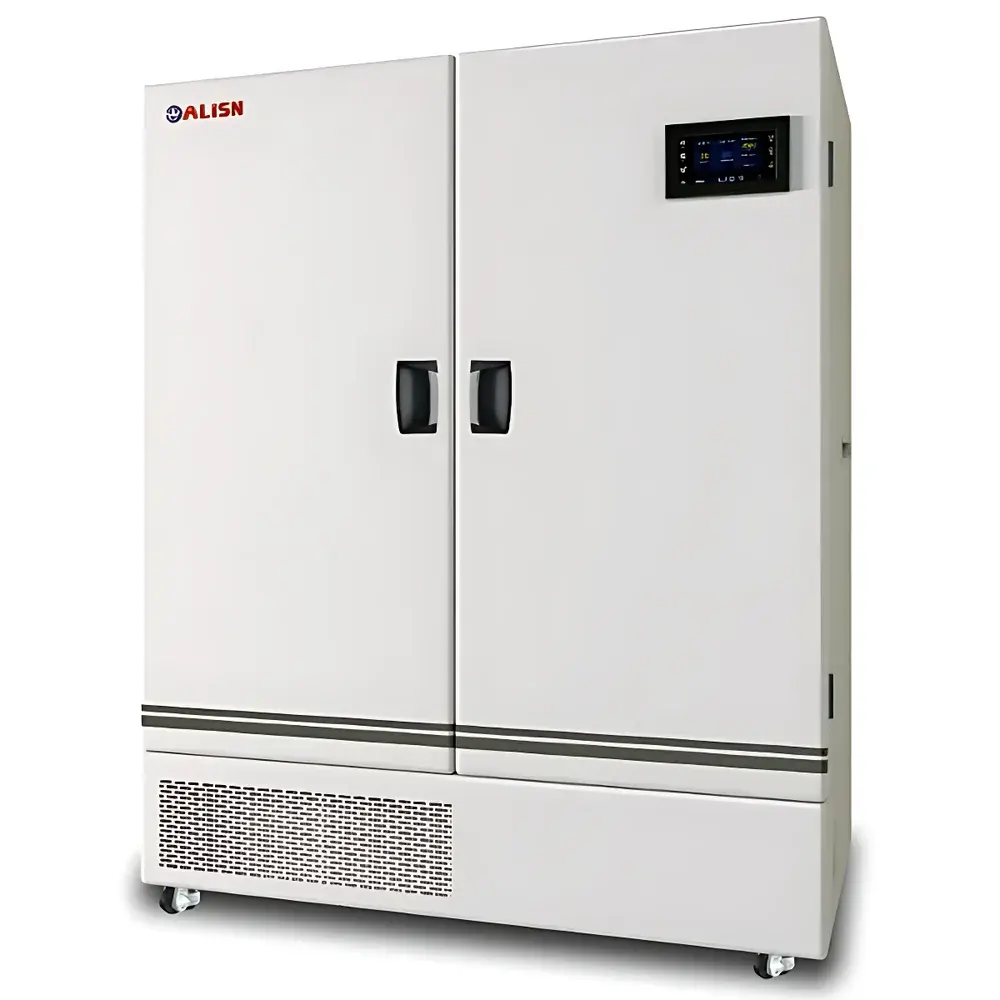
ALISN TPC 760 Temperature and Humidity Controlled Small Animal Incubator
| Brand | ALISN |
|---|---|
| Origin | Shanghai, China |
| Model | TPC 760 |
| Refrigeration System | Inverter-driven SECOP (Danfoss) compressor with R404a refrigerant |
| Humidity Reservoir | External water tank |
| Temperature Range (with humidification) | −10 °C to 85 °C |
| Temperature Range (without humidification) | −10 °C to 85 °C |
| Temperature Uniformity (at 25 °C, empty chamber) | ±0.3–0.8 °C |
| Temperature Fluctuation | ±0.1 °C |
| Humidity Range | 10–98 %RH |
| Humidity Accuracy | ±0.1 %RH |
| Humidity Fluctuation | ±1.5 %RH |
| Chamber Volume | 760 L |
| Insulation | High-density polyurethane foam, one-shot foaming process |
| Airflow Design | Dual-side aerodynamic ventilation ports (Ø50 mm) |
| Viewing Window | Tempered glass inner door |
| Control System | 7-inch color TFT touch screen with PID + fuzzy logic algorithm |
| Data Logging | Internal non-volatile memory (≥10 years of continuous 1-min interval logging), USB export (read-only, tamper-proof), audit trail (16,000 entries), user permission management (5 configurable roles) |
| Compliance Support | GLP-compliant data integrity, 21 CFR Part 11-ready audit trail and electronic signature capability (via optional software module), ISO 17025 traceable calibration support |
Overview
The ALISN TPC 760 is a precision-engineered temperature and humidity controlled incubator designed specifically for small animal physiological and behavioral studies under rigorously defined environmental conditions. It operates on the principle of closed-loop environmental simulation—integrating high-stability thermoelectric heating, inverter-controlled vapor compression refrigeration, and capacitive humidity regulation—to maintain tightly bounded climatic parameters across extended experimental durations. Unlike general-purpose environmental chambers, the TPC 760 incorporates life science–specific design features including dual-side airflow optimization for uniform gas exchange in caged animal housing, low-vibration compressor mounting to minimize stress artifacts, and non-condensing humidification architecture that prevents microbial proliferation in the water reservoir. Its operational envelope (−10 °C to 85 °C, 10–98 %RH) enables modeling of diverse bioclimatic stressors—including cold exposure, heat-humidity challenge, wind-chill simulation (via programmable air velocity coupling), and immunocompromised host response assays—making it suitable for preclinical research in chronobiology, metabolic disease, neuroimmunology, and vector biology (e.g., Drosophila melanogaster, Apis mellifera, Aedes aegypti, and murine models).
Key Features
- Inverter-driven SECOP (Danfoss) compressor with R404a refrigerant, enabling frost-free continuous operation, reduced acoustic noise (<42 dB[A]), and energy savings up to 40% versus fixed-speed equivalents
- Capacitive E+E humidity sensor (Austria) and HERAEUS platinum resistance thermometer (Germany), factory-calibrated and traceable to NIST standards; no field recalibration required
- 7-inch industrial-grade TFT touchscreen with intuitive icon-based navigation, multilingual UI (English/Chinese toggle), and real-time graphical display of temperature/humidity trends
- Robust thermal insulation using monolithic polyurethane foam (35 mm thick, 0.022 W/m·K thermal conductivity), minimizing thermal bridging and enhancing chamber stability during door openings
- Aerodynamically optimized dual-side ventilation system (two Ø50 mm ports per side) ensures laminar, low-turbulence airflow distribution—critical for minimizing localized CO2 accumulation and thermal stratification in stacked cage configurations
- Full GLP/GMP data integrity architecture: tamper-evident USB data export (FAT32-formatted, read-only binary logs), internal audit trail (16,000 timestamped events), and hierarchical user access control (administrator + four customizable roles)
- Multi-point temperature offset correction function, allowing independent compensation at up to six spatial locations to correct for gradient-induced measurement bias in large-volume chambers
Sample Compatibility & Compliance
The TPC 760 accommodates standard IVC (individually ventilated cage) systems, static shoebox cages, and custom-built insect rearing modules. Its interior dimensions (1200 × 1180 × 540 mm) support up to 48 standard mouse cages (370 × 210 × 160 mm) arranged in triple-tier racks. The chamber complies with IEC 61000-6-3 (EMC emissions) and IEC 61000-6-2 (immunity), and meets mechanical safety requirements per EN 61010-1. For regulatory submissions, the system supports 21 CFR Part 11 compliance when paired with ALISN’s validated LabControl Suite v3.2 (optional), which provides electronic signatures, role-based workflow enforcement, and automated calibration certificate generation. All firmware and logging firmware are version-controlled and digitally signed; firmware updates require administrator authentication and generate immutable audit entries.
Software & Data Management
Onboard firmware implements a deterministic real-time OS (VxWorks-based) with microsecond-level timer resolution for precise multi-segment program execution (up to 32 segments per profile, 100 profiles stored internally). Data logging occurs at user-selectable intervals (1 sec to 60 min), with raw values (temperature, humidity, alarm status, door open/closed, compressor duty cycle) stored in encrypted binary format. Exported .CSV files contain ISO 8601 timestamps, sensor IDs, and CRC-32 checksums—enabling third-party validation in MATLAB, Python (pandas), or LIMS platforms. Remote monitoring is supported via RS485 Modbus RTU (addressable node ID, 9600 baud) or USB virtual COM port, facilitating integration into enterprise Environmental Monitoring Systems (EMS) per ISO 14644-3 and EU GMP Annex 15.
Applications
- Chronic cold exposure studies in C57BL/6 mice to assess brown adipose tissue activation and thermogenic gene expression (UCP1, PGC-1α)
- Humidity-stress modeling in Anopheles gambiae to quantify survival thresholds under climate change scenarios
- Circadian rhythm disruption experiments using synchronized light–temperature–humidity phase shifts in rat models of depression
- Immunosuppressed murine challenge models (e.g., cyclophosphamide-treated) exposed to controlled fungal spore aerosols under elevated RH
- Developmental toxicity screening in zebrafish embryos under combined thermal and hygrometric gradients
- Validation of HVAC performance in vivarium anterooms via chamber-based reference testing
FAQ
What is the maximum permissible ambient temperature for continuous operation?
The unit is rated for uninterrupted use at ambient temperatures between 5 °C and 35 °C; optimal stability is achieved at 25 ±2 °C per ISO 17025 environmental conditioning guidelines.
Can the TPC 760 be integrated with a central building management system (BMS)?
Yes—RS485 Modbus RTU interface supports bidirectional communication with BMS platforms compliant with BACnet MS/TP or Modbus TCP gateways (ALISN provides protocol mapping documentation upon request).
Is the internal data log compliant with FDA 21 CFR Part 11?
The hardware-level logging engine satisfies technical controls (audit trail, electronic signatures, record retention); full Part 11 compliance requires deployment of ALISN’s validated LabControl Suite v3.2 with documented IQ/OQ/PQ protocols.
How often does the humidity sensor require maintenance or recalibration?
The E+E capacitive sensor is drift-compensated in firmware and requires no routine maintenance or field recalibration over its specified service life (≥5 years under normal laboratory conditions).
What safety certifications does the TPC 760 hold?
CE marking (2014/30/EU EMC Directive, 2014/35/EU LVD Directive), RoHS 2011/65/EU, and conformity to GB 4793.1–2018 (Chinese safety standard for laboratory equipment).





