
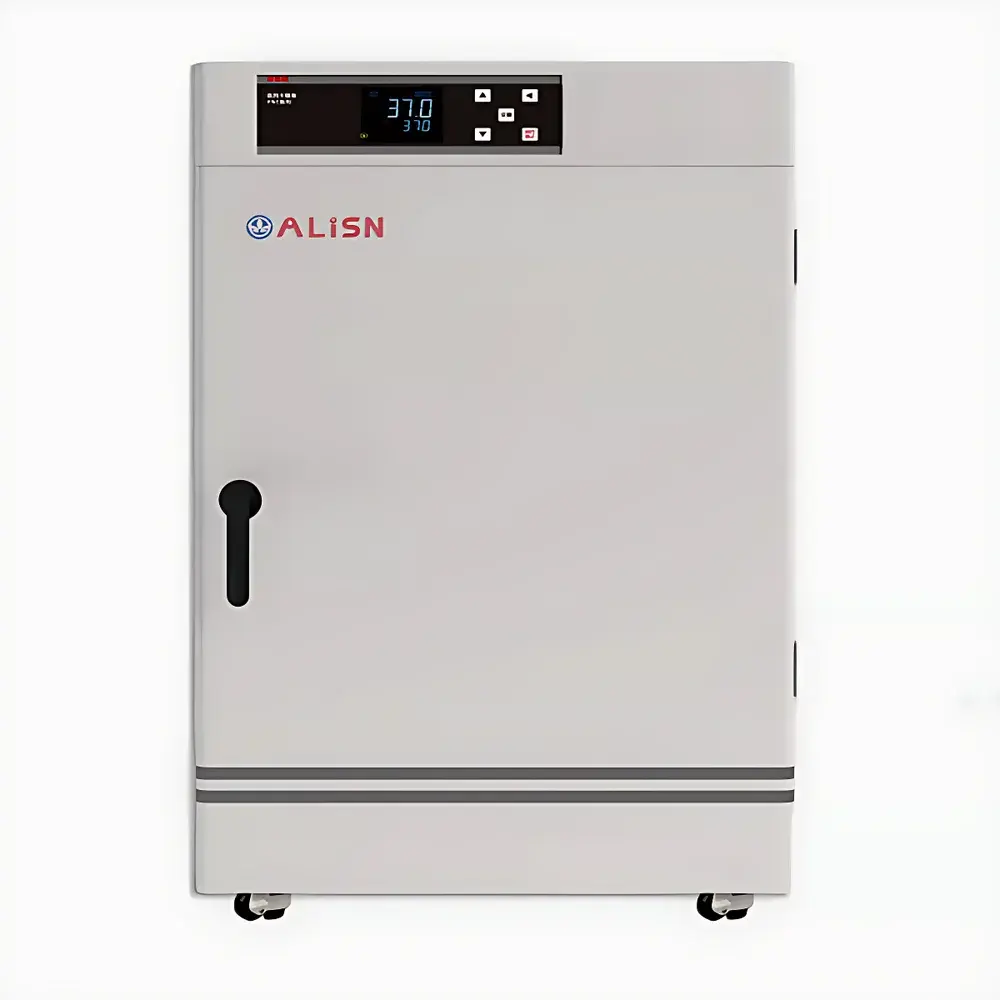
ALISON PNC 250 Precision Forced-Air Drying Oven
| Brand | ALISON |
|---|---|
| Origin | Shanghai, China |
| Model | PNC 250 |
| Instrument Type | Precision Drying Oven |
| Temperature Range | Ambient +5°C to 250°C |
| Temperature Fluctuation | ±0.5°C |
| External Dimensions (W×H×D) | 820×1070×720 mm |
| Internal Chamber Dimensions (W×H×D) | 700×760×470 mm |
| Internal Volume | 250 L |
| Chamber Material | SUS304 Stainless Steel |
| Heating Method | Forced-Air Convection |
| Temperature Uniformity (at 150°C) | ±1.5°C |
| Control Resolution | 0.1°C |
| Heating Power | 2500 W |
| Net Weight | 115 kg |
| Air Inlet/Outlet | Two bottom inlets, one top exhaust |
| Safety Features | Leakage protection, over-temperature cutoff, door-open alarm, sensor fault detection |
| Shelf Configuration | Three removable SUS304 shelves |
| Insulation | High-density mineral fiber (≥100 mm thickness) |
| Control System | PID + Fuzzy Logic, dual-mode (constant-setpoint & multi-segment programmable) |
Overview
The ALISON PNC 250 Precision Forced-Air Drying Oven is an engineered thermal processing system designed for reproducible, stable, and uniform heat treatment of laboratory and industrial samples. It operates on the principle of forced convection—using a high-efficiency centrifugal blower to circulate heated air uniformly throughout the insulated chamber—ensuring minimal thermal stratification and rapid temperature recovery after door opening. With a maximum operating temperature of 250°C and a tight temperature fluctuation of ±0.5°C under steady-state conditions, the PNC 250 meets the thermal stability requirements for drying, baking, sterilization, moisture loss analysis, polymer curing, and pre-conditioning of materials prior to mechanical or analytical testing. Its robust architecture—including a 100 mm-thick high-density mineral fiber insulation layer and seamless SUS304 stainless steel inner chamber—minimizes thermal bridging and energy loss, supporting energy-efficient operation across extended duty cycles.
Key Features
- Triple-layer thermal insulation with ≥100 mm mineral wool ensures low surface temperature rise and high thermal retention, reducing power consumption by up to 22% compared to standard ovens.
- SUS304 stainless steel interior (1.2 mm thickness) resists oxidation and warping at sustained temperatures up to 250°C; four-radius corner design eliminates crevices and facilitates cleaning and residue removal.
- Programmable PID + fuzzy logic controller supports up to 30 segments per program, enabling complex thermal profiles (e.g., ramp-hold-cool sequences) required for ASTM D792, ISO 293, and USP material conditioning protocols.
- Three-tier removable stainless steel shelves with reinforced edge rails accommodate varied sample configurations; shelf spacing is adjustable without tools.
- Integrated fresh-air inlet system (dual bottom ports) and top-mounted exhaust vent allow controlled atmosphere exchange—critical for solvent evaporation, volatile residue removal, and oxygen-sensitive drying applications.
- Comprehensive safety architecture includes independent over-temperature cut-off (mechanical backup), real-time door-open detection with audible/visual alert, leakage current protection (≤30 mA), and automatic sensor fault diagnosis with display warning.
Sample Compatibility & Compliance
The PNC 250 accommodates a broad range of sample types—including glassware, metal parts, ceramic substrates, pharmaceutical excipients, polymer pellets, soil specimens, and biological culture plates—without risk of cross-contamination or surface degradation. Its chamber geometry (700 × 760 × 470 mm) and 250 L volume support batch processing of multiple ASTM E145-compliant test specimens or ICH Q5C stability study trays. The oven complies with IEC 61010-1:2010 for laboratory electrical equipment safety and incorporates design elements aligned with GLP and GMP environmental control expectations—such as audit-ready event logging (via optional RS485 interface), non-volatile parameter storage, and traceable calibration point access. While not certified for Class II biological safety or explosion-proof use, it is suitable for non-hazardous, low-volatility applications within ISO 17025-accredited laboratories.
Software & Data Management
The built-in LCD interface provides real-time display of setpoint, actual chamber temperature, elapsed time, and active program segment. Optional RS485 serial communication enables integration with LabVIEW, SCADA, or LIMS platforms for remote monitoring, automated data capture, and electronic record retention. When configured with ALISON’s optional Data Logger Module (sold separately), the system records temperature values at user-defined intervals (1–600 sec), stores ≥30 days of continuous data internally, and exports CSV-formatted logs via USB. All logged events—including door openings, power interruptions, alarms, and mode transitions—are timestamped and retained with device ID and operator tag fields, satisfying FDA 21 CFR Part 11 requirements for electronic signatures and audit trails when paired with validated software.
Applications
- Drying of moisture-sensitive powders (e.g., APIs, catalysts) under controlled airflow to prevent agglomeration.
- Baking of printed circuit board (PCB) substrates and solder paste stencils per IPC-7711/7721 guidelines.
- Pre-drying of gravimetric filters and crucibles prior to ash content determination (AOAC 920.115).
- Thermal aging of elastomers and composites per ASTM D573 and ISO 188 accelerated life testing protocols.
- Residual solvent removal from coated films and thin-film photovoltaic precursors.
- Moisture equilibration of reference standards used in Karl Fischer titration and dynamic vapor sorption (DVS) instrumentation.
FAQ
What is the recommended calibration interval for the PNC 250?
ALISON recommends annual calibration using NIST-traceable reference thermometers at three chamber locations (center, top rear, bottom front) per ISO/IEC 17025 Clause 6.6. Calibration certificates are issued with DAkkS or CNAS accreditation upon request.
Can the PNC 250 be used for sterilization of medical devices?
No. While it achieves temperatures sufficient for dry-heat sterilization (160–180°C for 2 hours), the PNC 250 lacks the validation documentation, chamber pressure control, and bioburden monitoring interfaces required for ISO 17665-compliant sterilization processes.
Is the oven compatible with external ventilation ducting?
Yes—the top-mounted exhaust port (Φ60 mm) and dual bottom inlets support connection to lab fume hood manifolds or dedicated exhaust systems using flexible stainless steel ducting (max. 3 m length recommended).
Does the unit include a factory calibration report?
Yes—each PNC 250 ships with a signed factory verification report confirming temperature uniformity (±1.5°C at 150°C), fluctuation (±0.5°C), and controller accuracy (±0.3°C) across five load conditions.
What maintenance is required for long-term reliability?
Monthly inspection of air filter (located behind front grille), quarterly cleaning of blower impeller and heating element surfaces with non-abrasive stainless steel cleaner, and annual verification of door gasket compression force and thermal seal integrity.



