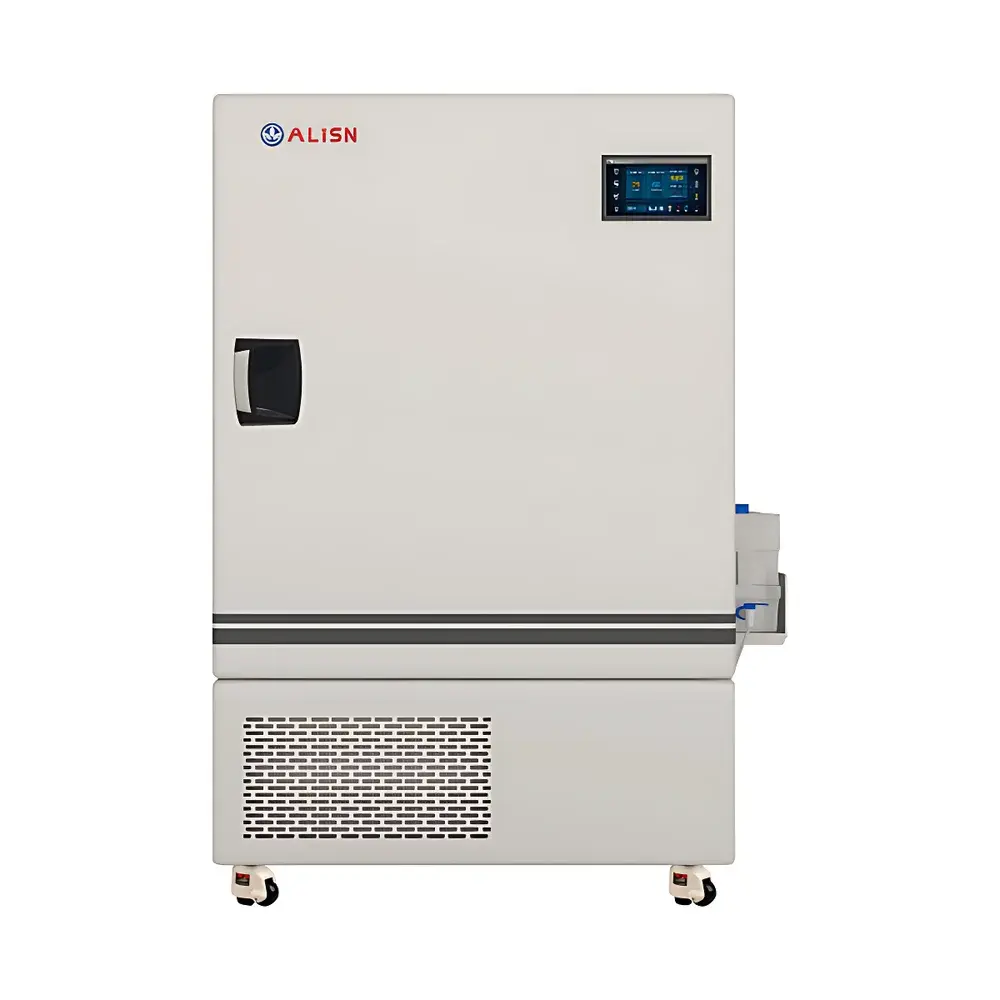
Alison TPC-250 Temperature and Humidity Controlled Small Animal Incubator
| Brand | Alison (ALISN) |
|---|---|
| Origin | Shanghai, China |
| Model | TPC-250 |
| Refrigeration System | Inverter-driven Danfoss (SECOP) compressor with R134a refrigerant |
| Humidity Reservoir | External water tank |
| Temperature Range (with humidification) | 10–85 °C |
| Temperature Range (dry operation) | −10–85 °C |
| Temperature Uniformity (15–45 °C) | ±0.2–0.5 °C |
| Temperature Fluctuation | ±0.1 °C |
| Humidity Range | 10–98 %RH |
| Humidity Accuracy | ±0.1 %RH |
| Humidity Fluctuation | ±1.5 %RH |
| Internal Volume | 250 L |
| Insulation | High-density polyurethane foam, one-shot foaming process |
| Display | 7-inch full-color TFT touch screen |
| Control Algorithm | PID + fuzzy logic hybrid control |
| Data Logging | 3-year capacity (1-min interval), stored internally and exportable via USB (read-only, tamper-proof) |
| Audit Trail | 16,000 entries (user actions, alarms, system events), non-erasable, USB-exportable |
| User Management | Up to 5 configurable accounts with role-based permissions |
| Sensor System | HERAEUS platinum RTD temperature sensors |
| Airflow Design | Dual-side aerodynamic 50-mm diameter ventilation ports |
| Door Structure | Double-door system with inner tempered glass door |
| Communication Interfaces | USB, RS-232, RS-485 (EMS integration ready) |
| Power Supply | AC 220 V, 50/60 Hz |
| Heating & Humidification Power | 2200 W |
| Compressor Power | 250 W |
| Safety Features | Over-temperature alarm, low-water alarm, door-open alarm, sensor fault detection, compressor high-pressure protection, earth-leakage protection, auto-restart after power recovery |
Overview
The Alison TPC-250 is a precision-engineered temperature and humidity controlled incubator designed specifically for small animal housing and environmental simulation studies in preclinical research. It operates on a dual-parameter control architecture—simultaneous, independent regulation of air temperature and relative humidity—enabling reproducible replication of physiologically relevant microclimates. Its core thermal management relies on an inverter-driven Danfoss SECOP compressor paired with R134a refrigerant, delivering stable cooling across the full operational range (−10 °C to 85 °C), while maintaining sub-0.1 °C temperature fluctuation under steady-state conditions. The humidity subsystem employs a capacitive E+E Electronics sensor and external water reservoir, ensuring long-term stability and calibration traceability within ±0.1 %RH accuracy. The unit’s structural integrity is reinforced by monolithic polyurethane insulation—foamed-in-place at high density—which achieves >40% energy reduction versus conventional insulated enclosures and eliminates cold bridging. Designed for GLP-compliant animal phenotyping, immunocompromised model studies, and entomological research (e.g., Drosophila, mosquitoes, honeybees), the TPC-250 meets the environmental fidelity requirements of ISO 554 (standard atmospheres), ASTM E145 (specifications for gravity-convection and forced-air ovens), and ICH Q5C (stability testing of biotechnological products).
Key Features
- Inverter-controlled refrigeration system ensures continuous frost-free operation, rapid post-door-opening recovery (<6 min to re-stabilize at 25 °C/50 %RH), and reduced acoustic noise (<42 dB(A))
- Hybrid PID-fuzzy logic control algorithm dynamically adjusts heating, cooling, and humidification outputs to minimize overshoot and hysteresis
- 7-inch industrial-grade TFT touchscreen with intuitive icon-driven interface, supporting seamless English/Chinese language switching
- Triple-layer stainless-steel shelving (standard), adjustable in height and load-rated to 15 kg per shelf
- Aerodynamically optimized dual-side ventilation (50 mm Ø ports) promotes uniform laminar airflow and eliminates stagnant zones
- Double-door architecture: outer insulated door + inner tempered glass door, enabling real-time visual monitoring without thermal disturbance
- Comprehensive safety suite including compressor overpressure cutoff, PT100 sensor redundancy, earth-leakage circuit interruption, and programmable alarm escalation
Sample Compatibility & Compliance
The TPC-250 accommodates standard rodent caging systems (e.g., Allentown, Tecniplast), insect rearing trays, and multi-well environmental exposure chambers. Its internal dimensions (670 × 912 × 410 mm) support up to four standard mouse cages (IVC size) or twelve 250-mL Drosophila vial racks. The chamber complies with IEC 61000-6-2 (immunity) and IEC 61000-6-4 (emission) for electromagnetic compatibility. All firmware operations—including parameter modification, data export, and user privilege assignment—are governed by a deterministic state machine architecture that enforces write-once-read-many (WORM) data integrity per FDA 21 CFR Part 11 Annex 11 principles. Audit trail records include timestamp, operator ID, action type, and pre-/post-value states—retained for ≥16,000 entries without rollover.
Software & Data Management
Onboard firmware implements a secure embedded Linux kernel with real-time scheduling (PREEMPT_RT patchset). Temperature and humidity are logged at 1-minute intervals into a cyclic, encrypted SQLite database. Raw binary logs (CSV-compatible format) are exportable only via physically inserted USB 2.0 flash drives—no network upload capability exists, eliminating remote data tampering risk. Historical trend visualization includes 10-hour real-time overlay curves and multi-day comparative plots (exportable as PNG/SVG). The system supports Modbus RTU over RS-485 for integration into centralized Environmental Monitoring Systems (EMS) compliant with EU GMP Annex 15 and USP . All configuration changes trigger automatic audit log entries with cryptographic hash verification.
Applications
- Immunophenotyping of murine models under controlled thermal stress (e.g., cold challenge at 10 °C, heat stress at 35 °C)
- Humidity-dependent behavioral assays in Anopheles and Aedes mosquito colonies
- Developmental staging of Drosophila melanogaster across hygrothermal gradients (10–98 %RH, 18–28 °C)
- Preclinical evaluation of thermoregulatory drugs in hypothermic or hyperthermic rodent models
- Standardized acclimatization protocols prior to metabolic cage studies (indirect calorimetry)
- Long-term colony maintenance of sensitive strains (e.g., NSG mice) requiring strict RH stability
FAQ
Does the TPC-250 support remote monitoring via Ethernet or Wi-Fi?
No. To ensure data integrity and regulatory compliance, the TPC-250 excludes wireless or TCP/IP connectivity. Integration with enterprise systems occurs exclusively through isolated RS-485/RS-232 serial links.
Can the internal data logger be extended beyond three years?
No. The onboard storage is fixed-capacity (8 GB NAND flash) and configured for exactly three years of 1-minute logging. Export and archival are the user’s responsibility.
Is the humidity sensor factory-calibrated and field-serviceable?
Yes. Each E+E EE190-HS sensor ships with NIST-traceable calibration certificate (±0.1 %RH @ 23 °C, 50 %RH). Field recalibration requires proprietary E+E software and reference dew-point generator—not supported by Alison.
What is the maximum allowable ambient temperature for continuous operation?
35 °C. For optimal performance and compressor longevity, ambient temperature should be maintained at 25 ± 2 °C per ICH Q1A(R3) guidance.
Are third-party validation protocols (IQ/OQ/PQ) available?
Yes. Alison provides a complete URS-aligned qualification package—including test scripts, acceptance criteria, and blank execution records—for GxP environments. Installation Qualification (IQ) covers mechanical and electrical verification; Operational Qualification (OQ) validates control loop response, uniformity mapping, and alarm functionality.