
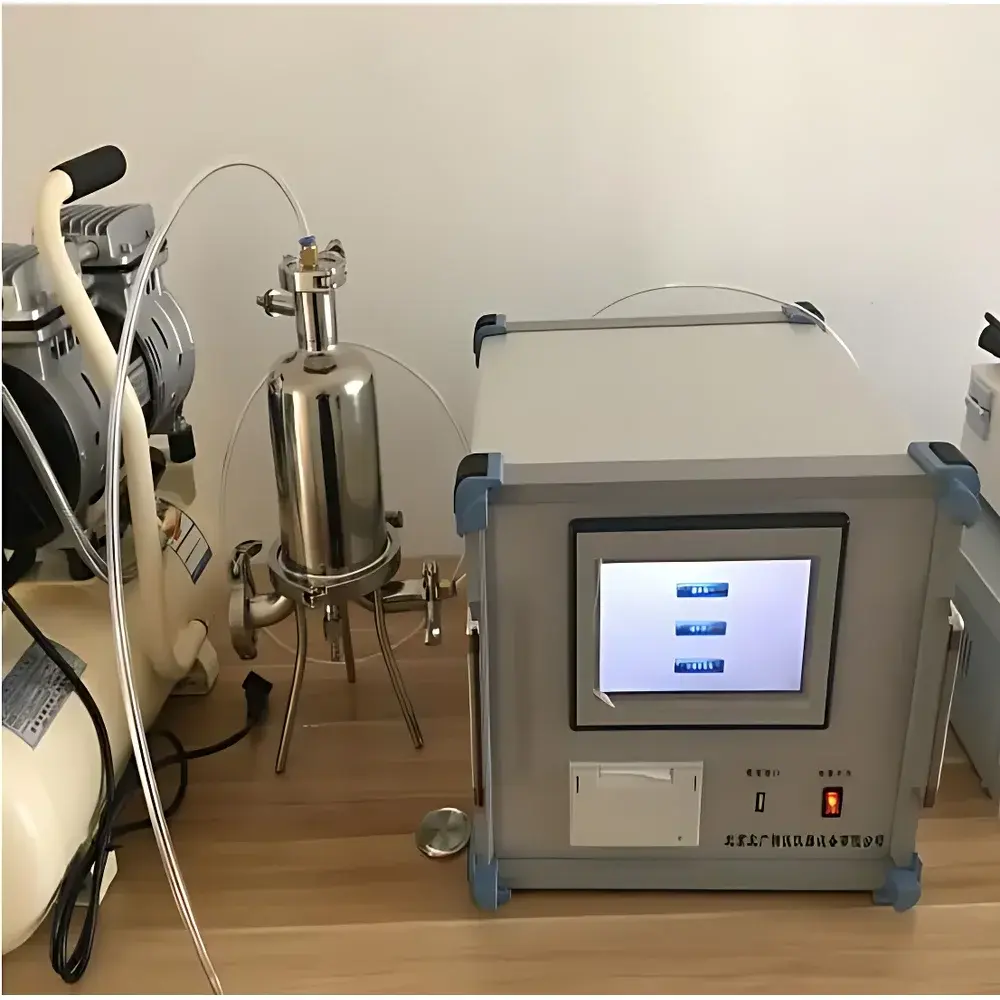
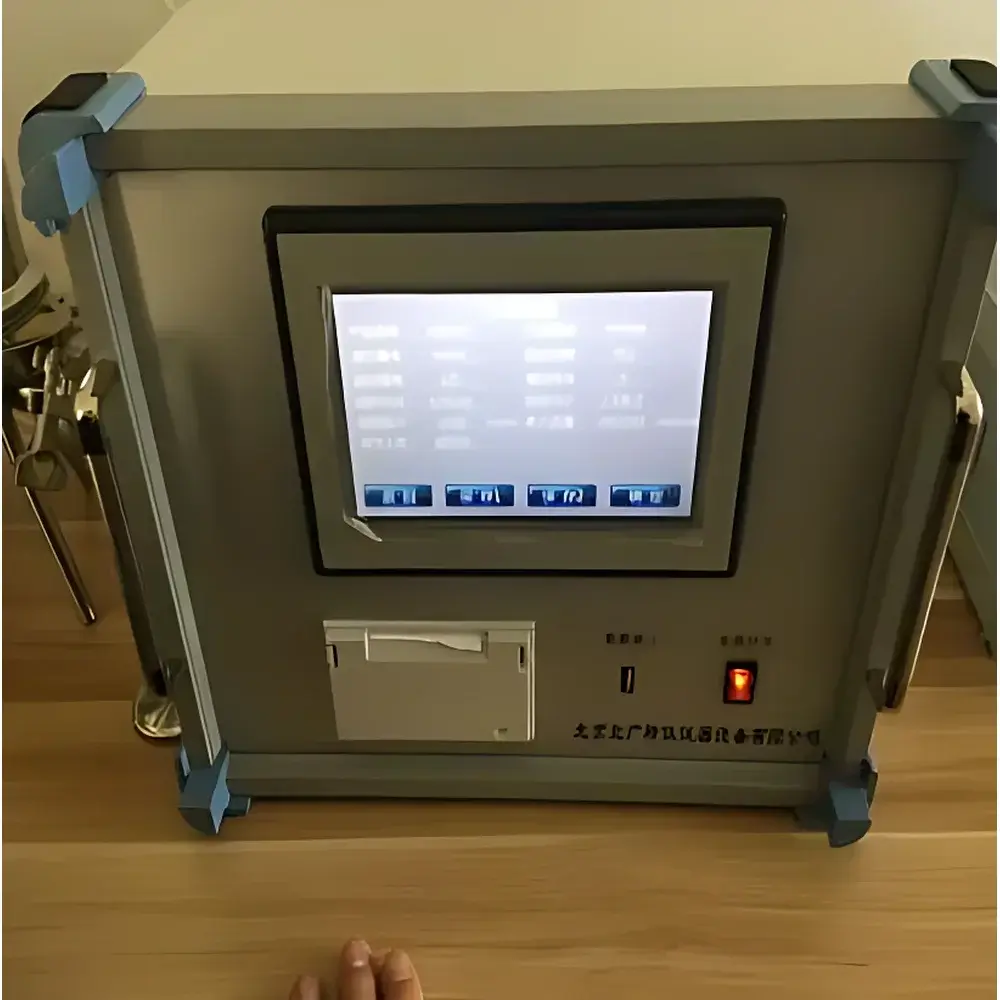
All Precision Instrument BP-19 Portable Bubble Point Integrity Tester
| Brand | All Precision Instrument |
|---|---|
| Origin | Beijing, China |
| Manufacturer Type | Manufacturer |
| Model | BP-19 |
| Power Supply | 170–240 V AC, 50/60 Hz, 100 W |
| Max Operating Pressure | 7999 mbar |
| Minimum Inlet Pressure | 3000 mbar |
| Test Pressure Range | 500–6900 mbar |
| Pressure Sensitivity | ±1.0 mbar |
| Bubble Point Accuracy | ±60 mbar |
| Dimensions (L×W×H) | 500 × 200 × 180 mm |
| Display | 5.7-inch 32-bit touchscreen |
| Language Options | English / Chinese |
| Data Storage | 32 GB (≥1 million test records) |
| Print Output | Bilingual (English/Chinese), including test parameters, results, and pressure decay curves |
| Environmental Operating Conditions | 0–50 °C, 10–80% RH |
| Test Duration | Bubble point: 2 ± 2 min |
| Diffusion flow | 7 ± 2 min |
| Water intrusion | 7 ± 2 min |
| System leak check | 3 ± 1 min |
| Communication Interface | RS232/USB for PC connectivity and remote supervision via proprietary software |
| Compliance Support | Fully compatible with FDA 21 CFR Part 11 audit trail requirements, EU Annex 1, USP <1207>, ISO 13408-2, and GMP Annex 15 integrity testing protocols |
Overview
The All Precision Instrument BP-19 Portable Bubble Point Integrity Tester is a CE-compliant, GMP-aligned benchtop instrument engineered for deterministic, non-destructive integrity verification of hydrophilic and hydrophobic membrane filters used in pharmaceutical, biotechnology, and sterile manufacturing processes. It operates on the fundamental principle of capillary flow physics: when a filter membrane is fully wetted with a suitable liquid (e.g., water, isopropyl alcohol, or ethanol), gas pressure applied upstream forces the wetting liquid out of the largest pores at a characteristic pressure—the bubble point (BP). This pressure is inversely proportional to the pore diameter and directly dependent on the liquid’s surface tension and contact angle with the membrane material. The BP-19 precisely measures this critical pressure threshold, enabling objective pass/fail assessment per regulatory benchmarks defined in USP <1207>, ISO 13408-2, and EU GMP Annex 1. Unlike destructive methods, bubble point testing preserves filter functionality while delivering quantitative evidence of pore size distribution consistency—essential for validating sterilizing-grade filtration (0.22 µm or 0.1 µm) prior to use in aseptic processing.
Key Features
- Digital pneumatic control architecture eliminates mechanical flow regulators—ensuring stable, repeatable gas delivery across variable supply pressures (3000–7999 mbar), eliminating operator-induced variability.
- Automated pass-exit protocol terminates pressurization immediately upon confirmation of compliance, minimizing unnecessary stress on filter media and extending service life.
- Bilingual (English/Chinese) 5.7-inch capacitive touchscreen with contextual on-screen prompts and “one-touch retest” functionality—retains last-used parameters for identical filter configurations.
- Integrated audit-ready data management: 32 GB onboard storage retains ≥1 million complete test records—including raw pressure decay curves, environmental metadata, operator ID, timestamp, and pass/fail logic—with optional export to secure network drives.
- Multi-method validation support: bubble point, diffusion flow, and water intrusion (WI) testing—all compliant with USP <1207> Method I (BP), Method II (Diffusion), and Method III (WI) for hydrophobic filters.
- Real-time system self-diagnostic routine: continuous pressure monitoring during standby ensures automatic venting if residual pressure exceeds 50 mbar—preventing accidental pressurized handling and meeting ISO 13857 safety clearance requirements.
- RS232 and USB interfaces enable bidirectional communication with validated LIMS or MES platforms; includes FDA 21 CFR Part 11–compliant PC software for remote operation, centralized fleet monitoring, and electronic signature capture.
Sample Compatibility & Compliance
The BP-19 accommodates a full spectrum of single-use and reusable filtration assemblies without adapter modification: disc membranes (Φ25 mm to Φ300 mm), standard cartridges (2.5″ to 40″, 1–9 core), capsule filters, mini-cartridges, and vent filters. Its high-resolution pressure transduction system maintains measurement fidelity across large-area systems (>1000 cm²), ensuring low-coefficient-of-variation results even for multi-core PES or PVDF filters. Regulatory alignment is embedded at the firmware level: all test logs include immutable timestamps, user authentication tokens, and change history—fully satisfying FDA 21 CFR Part 11, EU Annex 11, and PIC/S GMP Annex 15 requirements for electronic records and signatures. The instrument supports configurable user roles (Operator, Supervisor, Administrator) with password-protected parameter editing rights—enabling segregation of duties per ALCOA+ principles.
Software & Data Management
The BP-19 ships with All Precision Instrument’s IntegritySuite™ v4.0—a validated Windows-based application supporting remote test initiation, live pressure curve visualization, batch report generation (PDF/CSV), and automated backup to networked repositories. Each test record contains full traceability: instrument serial number, calibration certificate ID, wetting fluid type and lot number, ambient temperature/humidity, operator ID, and digital signature. Audit trails are write-once, read-many (WORM), with cryptographic hashing to prevent tampering. Historical data can be queried by date range, filter type, operator, or result status—facilitating CAPA investigations and annual product review submissions. Optional integration with Siemens Desigo CC or Rockwell FactoryTalk enables real-time integrity status feeds into facility SCADA systems.
Applications
This instrument serves as the primary integrity verification tool in regulated environments where filter failure carries direct patient safety risk. Typical use cases include pre-use integrity testing of sterilizing-grade filters in bioreactor harvest lines; post-use testing of viral removal filters in monoclonal antibody purification; validation of breathing filters on lyophilizer chambers; and release testing of final-fill sterilizing filters in aseptic filling suites. It is routinely deployed in QC laboratories performing method qualification per ICH Q2(R2), in engineering teams executing filter train qualification per ASTM F838-22, and in manufacturing operations executing daily pre-use/post-sterilization checks under cGMP §211.67. Its portability (≤8.2 kg) allows deployment in cleanroom classified areas (ISO 5–8) without permanent utility hookups.
FAQ
What wetting fluids are supported for bubble point testing?
Water, isopropyl alcohol (IPA), ethanol, and surfactant solutions (e.g., Tween 80) are validated. Surface tension and contact angle values must be entered manually or selected from the built-in database.
Can the BP-19 perform water intrusion testing on hydrophobic filters?
Yes—equipped with dual-pressure sensors and programmable hold phases, it executes USP <1207> Method III per specified upstream water volume and pressure ramp profiles.
Is calibration traceable to NIST standards?
Yes—factory calibration uses Fluke 754 Documenting Process Calibrators traceable to NIST, with certificate provided. Field recalibration is supported via USB-connected reference manometers.
How does the instrument handle pressure drift during diffusion flow tests?
It applies real-time temperature-compensated pressure decay correction using integrated Pt100 sensor feedback—reducing thermal artifact error to <±0.3 mbar over 7-minute test windows.
Does the system support electronic signatures per 21 CFR Part 11?
Yes—IntegritySuite™ enforces role-based access, biometric or token-based login, and digitally signed PDF reports with embedded hash verification.






