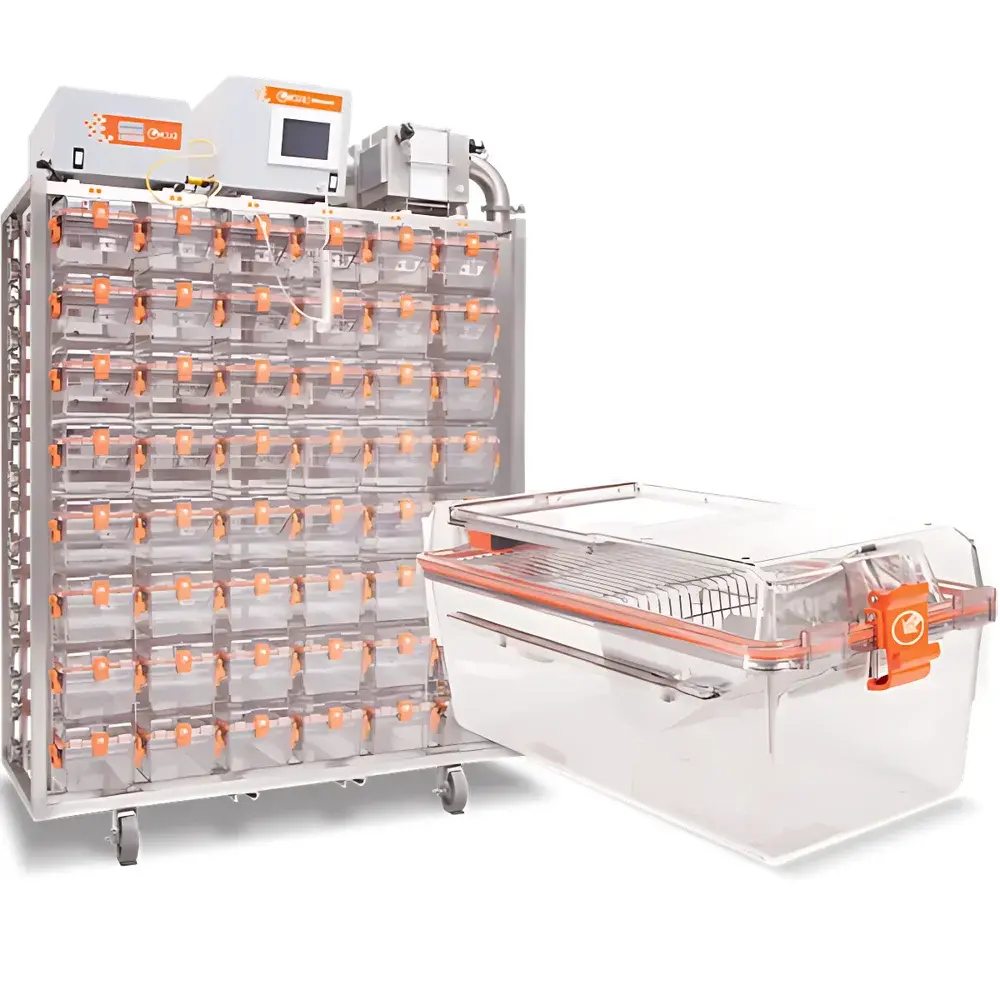
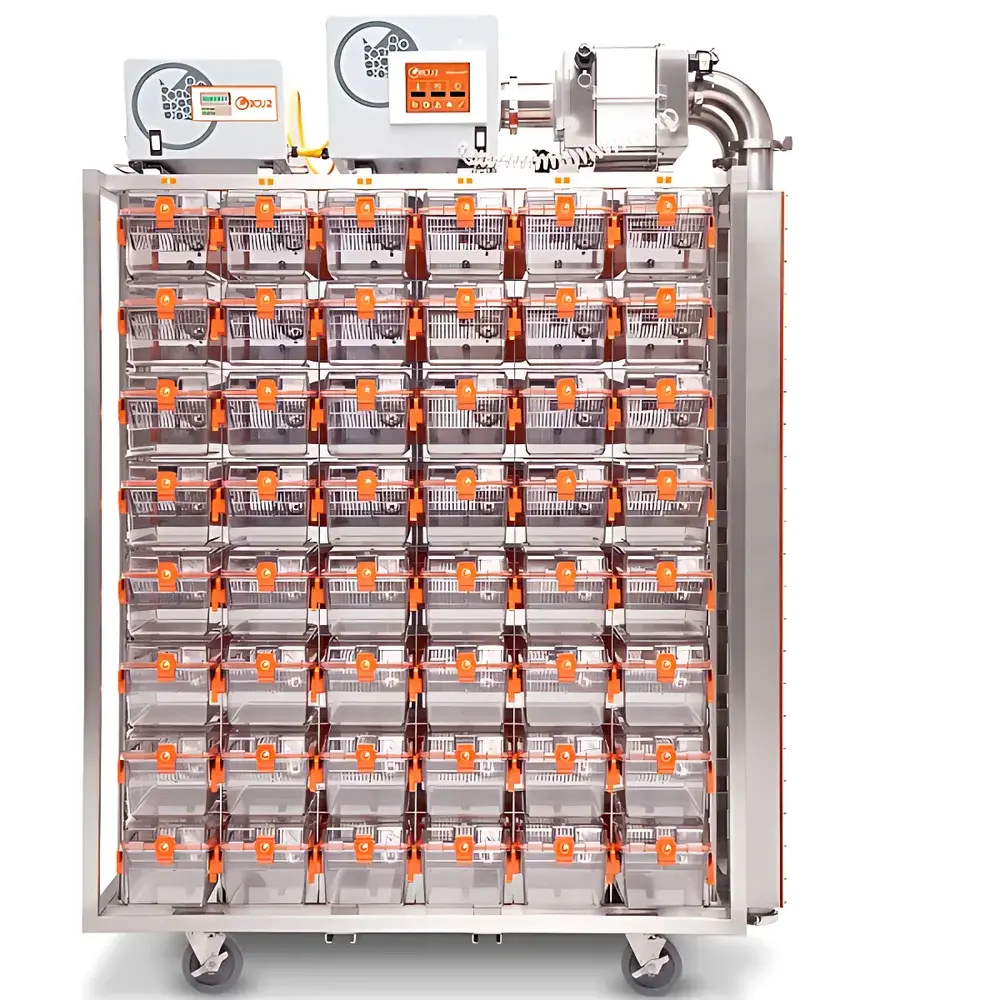
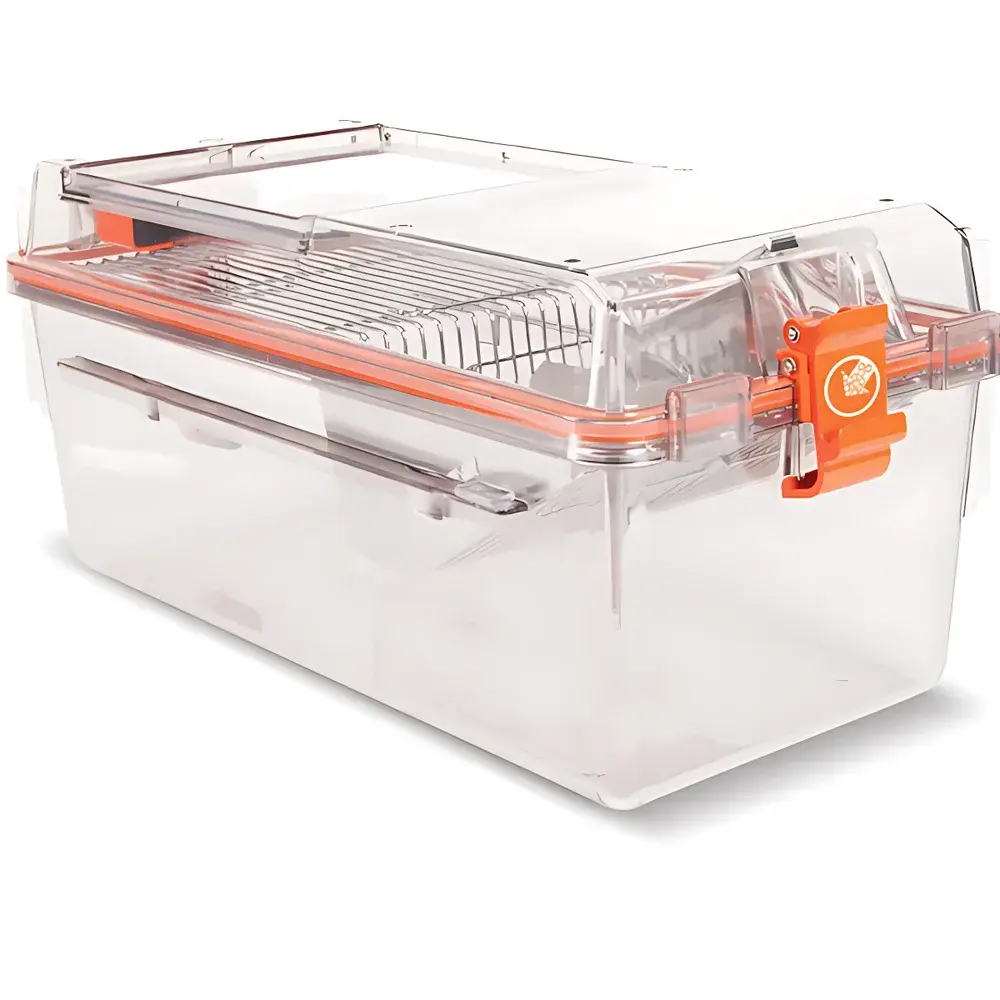
Allentown BCU-2 Mouse Sealed Negative-Pressure IVC System for BSL-3 Compliance
| Brand | Allentown |
|---|---|
| Origin | USA |
| Model | BCU-2 |
| Cage Capacity | 48 (6 × 8) |
| Frame Material | 304 Stainless Steel |
| Cage Material | Polysulfone (PSU) |
| HEPA Class | H14 (Filtration Efficiency ≥99.995% @ 0.1 µm) |
| Operating Pressure | Stable Negative Pressure (Controlled via Feedback Loop) |
| Sterilization | Autoclavable at 134°C |
| Backup Power | ≥10 h (at 50% airflow) |
| Dimensions (W×D×H) | 1466 × 651 × 1995 mm (incl. casters) |
| Weight | 148 kg (empty), 237 kg (fully loaded) |
Overview
The Allentown BCU-2 Mouse is a sealed, negative-pressure Independent Ventilation Cage (IVC) system engineered for high-containment rodent housing in biosafety level 3 (BSL-3)–compliant environments. Designed specifically for murine models in infectious disease research, vaccine development, and immunology, the BCU-2 integrates principles of aerodynamic containment, pressure-differential integrity, and fail-safe mechanical sealing to prevent aerosol escape during routine husbandry. Its operational foundation lies in a dynamically regulated negative-pressure environment—maintained across all cages via closed-loop airflow control—ensuring that air flows unidirectionally from clean supply through the animal microenvironment and out through validated H14 HEPA filtration. This architecture satisfies core requirements of NIH Guide for the Care and Use of Laboratory Animals, CDC/NIH Biosafety in Microbiological and Biomedical Laboratories (BMBL), and ISO 14644-1 Class 5 (ISO Class 5) cleanroom-equivalent air quality within each cage.
Key Features
- Patented Four-Point Sealing System (U.S. Patent No. 6,308,660): Simultaneously seals both the cage and rack interface upon removal, eliminating aerosol release and cross-contamination during cage changes.
- SmartDock™ Mechanical Interlock: Prevents misalignment during cage insertion; tactile and visual indicators confirm proper docking and seal engagement with single-finger operation.
- Constant Airflow Regulation: Maintains consistent volumetric flow per cage (±5% tolerance) regardless of filter loading or transition to battery backup mode, using real-time differential pressure feedback.
- Dual-Mode Power Architecture: Integrated rechargeable battery supports ≥10 hours of operation at 50% nominal airflow during utility failure; automatic switchover ensures uninterrupted containment.
- Comprehensive Alarm Suite: Dry-contact outputs for fan failure, filter clogging, power loss, and pressure deviation; configurable thresholds align with institutional biosafety protocols.
- Full-Autoclave Compatibility: Entire rack structure—including PSU cages, stainless steel frame, and integrated ducting—is validated for repeated sterilization at 134°C, 3 bar, supporting GLP-compliant decontamination cycles.
Sample Compatibility & Compliance
The BCU-2 accommodates standard mouse cages (up to 48 units in a 6 × 8 configuration) with options for cage-level inlet and exhaust HEPA filtration, enabling dual-filter configurations for enhanced pathogen retention. Cage lids feature molded polysulfone gaskets ensuring long-term seal integrity under cyclic thermal and mechanical stress. The system complies with ASTM E2996–22 (Standard Practice for Performance Testing of Rodent IVC Systems), meets ISO 14644-1:2015 Class 5 particulate limits inside cages, and supports validation documentation required for FDA 21 CFR Part 11–aligned facilities. Rack-level H14 HEPA filters are certified per EN 1822-1:2019, with on-site challenge testing enabled via quick-disconnect ports for filter integrity verification (e.g., DOP/PAO testing) and duct decontamination.
Software & Data Management
While the base BCU-2 operates via embedded hardware controls, optional integration with WWarium Plus™ enables centralized monitoring via tablet-based interface. This platform logs time-stamped records of airflow rates, static pressure differentials, battery status, and alarm events—data exportable in CSV format for audit trail generation. All logged parameters comply with ALCOA+ principles (Attributable, Legible, Contemporaneous, Original, Accurate, Complete, Consistent, Enduring, Available) and support retrospective review during GLP or GMP audits. Optional dry-contact alarm outputs interface with building management systems (BMS) for facility-wide alert escalation.
Applications
The BCU-2 is deployed in BSL-2+ and BSL-3 laboratories conducting research with select agents (e.g., SARS-CoV-2, Mycobacterium tuberculosis, Francisella tularensis), genetically modified organisms (GMOs), and oncogenic viral vectors. It serves as a scalable alternative to rigid isolators—offering equivalent containment performance while permitting frequent handling, automated watering (Hydropac® compatible), and modular expansion. Its design supports longitudinal studies requiring repeated sampling, imaging, or behavioral assessment without compromising containment integrity. Institutions use the BCU-2 in core vivaria supporting NIH-funded infectious disease consortia, BARDA medical countermeasure programs, and contract research organizations performing preclinical safety assessments under OECD GLP guidelines.
FAQ
Is the BCU-2 certified for BSL-3 use?
Yes—the system’s sealed architecture, H14 HEPA filtration, negative-pressure maintenance, and validated decontamination protocol meet the engineering control requirements outlined in BMBL 6th Edition for BSL-3 rodent housing.
Can the entire rack be autoclaved without disassembly?
Yes—both the stainless steel rack structure and polysulfone cages are rated for full-cycle autoclaving at 134°C, 3 bar, without degradation of structural or sealing performance.
What is the maximum allowable filter resistance before alarm activation?
The system triggers a filter clog alarm when static pressure drop across the supply HEPA exceeds 850 Pa, corresponding to end-of-service life per EN 779:2012 recommendations.
Does the BCU-2 support integration with institutional LIMS or animal welfare databases?
Via WWarium Plus™, event logs and operational metadata can be exported programmatically; custom API integration is available under NDA for enterprise-level data federation.
What warranty coverage applies to cage components versus rack electronics?
Cages and structural components carry a 36-month limited warranty; rack-mounted controllers, fans, and sensors are covered for 12 months from commissioning date, consistent with ISO 9001:2015 service agreements.
Related Products