
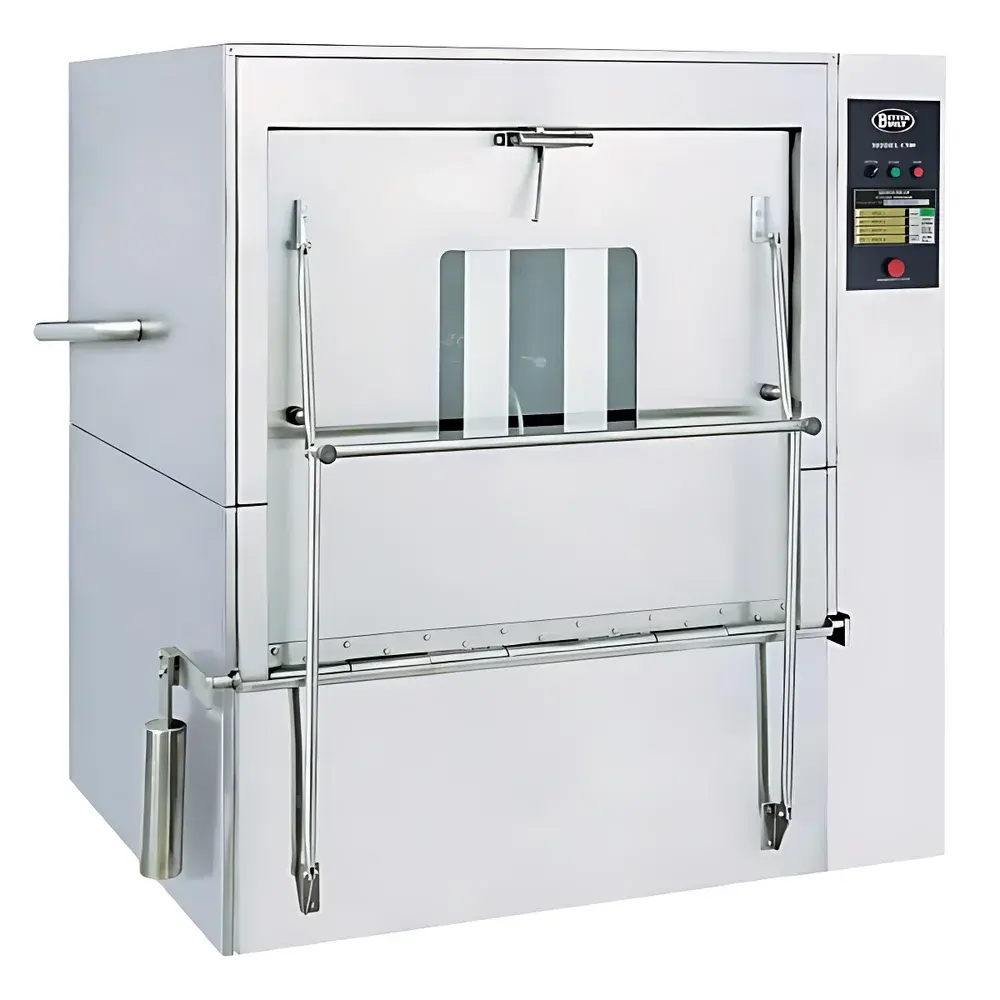
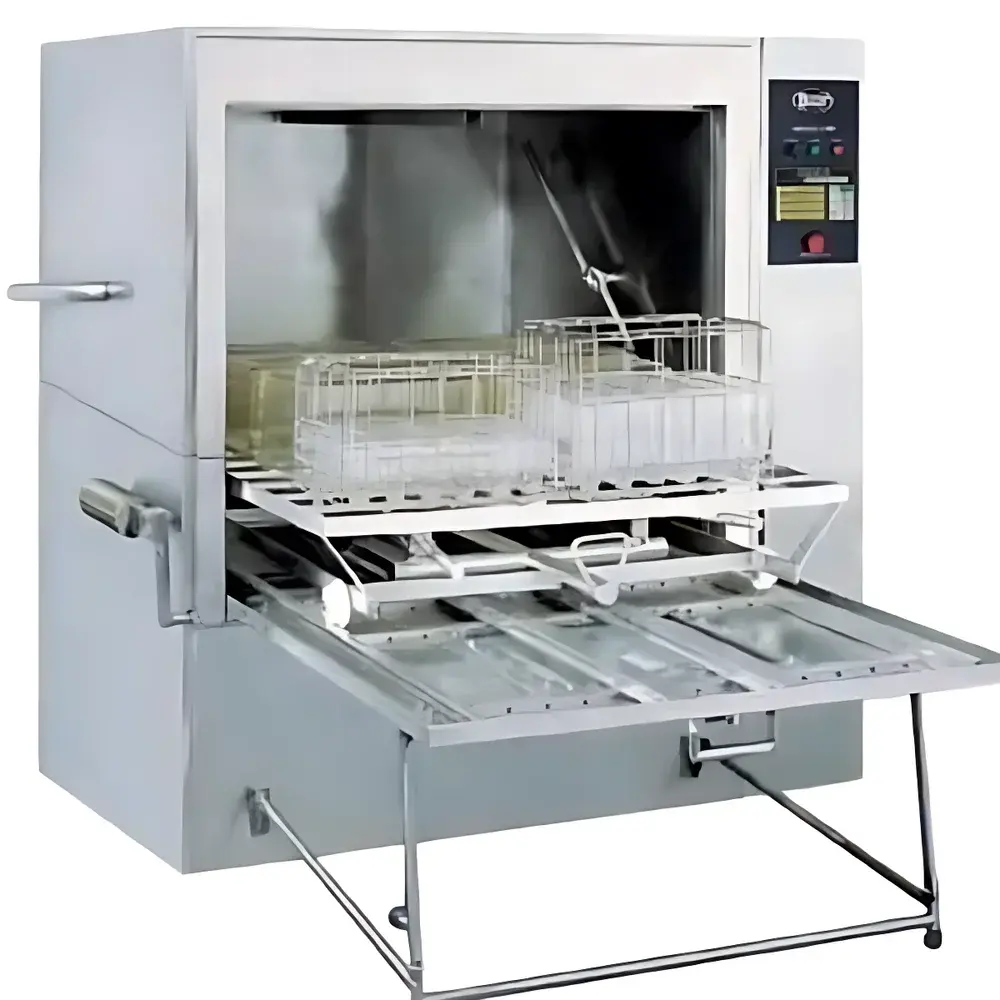
Allentown C500 Series Cabinet-Style Cage and Bottle Washer
| Brand | Allentown |
|---|---|
| Origin | Canada |
| Model | C500 |
| Type | Cabinet-style, microprocessor-controlled laboratory cage and bottle washer |
| Construction | Fully welded 316 stainless steel chamber and door with satin finish |
| Spray system | Three hydraulically driven rotating spray arms (left/right/top) |
| Temperature control | Programmable multi-stage heating (wash, rinse, final rinse) with ±1°C stability |
| User interface | 7-inch TFT color touchscreen with 8 pre-programmed cycles |
| Data logging | Optional CF card or Ethernet connectivity for full cycle traceability |
| Safety | Emergency stop button, door interlock, <80 dB(A) operational noise |
| Compliance | Designed to support GLP/GMP workflows |
| Loading capacity | C520 — up to 48 standard mouse cages or 6 rat cages |
| Optional accessories | Bottle washing cart (BWC), VHSS high-capacity rack system, pH neutralization unit, ActivView remote monitoring integration, thermal printer, RS485 interface, factory diagnostic port |
Overview
The Allentown C500 Series Cabinet-Style Cage and Bottle Washer is an engineered solution for research facilities requiring industrial-grade cleaning performance within constrained spatial footprints. Unlike conventional undercounter or compact washers, the C500 integrates the mechanical robustness and thermal precision of floor-standing cage washers into a fully enclosed, space-optimized cabinet architecture. It operates on a validated thermodynamic cleaning principle—combining precisely controlled temperature staging, high-velocity rotating spray dynamics, and chemical compatibility—to achieve reproducible removal of organic residues, biofilms, and particulate contaminants from animal housing systems and associated consumables. Designed for compliance-critical environments—including AAALAC-accredited vivaria, contract research organizations (CROs), and academic core facilities—the C500 supports end-to-end process accountability through integrated data capture and user-accessible audit trails.
Key Features
- Fully welded 316 stainless steel construction throughout chamber, door, pump housing, piping, and fittings—eliminating elastomeric seals and plastic conduits that degrade under alkaline or acidic detergent exposure.
- Three hydraulically actuated rotating spray arms (two lateral, one overhead) delivering uniform 360° coverage at pressures exceeding 3.5 bar, ensuring consistent impingement force across all surfaces—even interior cage grates and bottle threads.
- Microprocessor-controlled multi-stage thermal profile: independent setpoints for pre-wash, main wash, intermediate rinse, and final high-temperature rinse (up to 93°C), with real-time feedback regulation maintaining ±1°C accuracy per stage.
- 7-inch TFT color touchscreen interface supporting eight factory-validated cycles—configurable for cage type (mouse/rat), material (polycarbonate/stainless), and load density—with dynamic display of current temperature, elapsed time, and remaining duration.
- Multi-tiered security architecture: 11-level PIN code access control restricting parameter modification, cycle deletion, or firmware updates to authorized personnel only.
- Acoustic optimization yielding <80 dB(A) sound pressure level during operation—meeting OSHA 29 CFR 1910.95 occupational noise exposure thresholds for continuous 8-hour shifts.
Sample Compatibility & Compliance
The C500 accommodates standard IVC caging systems (e.g., Allentown Micro-Isolator®, Tecniplast Sealsafe®), polycarbonate and polysulfone cages, stainless steel transport carriers, and glass or PETG water bottles. Its chamber geometry and rack configurations comply with ANSI/NSF 50 and ISO 15883-1 requirements for washer-disinfectors used in biomedical settings. While not a sterilizer per ISO 17665, the final rinse stage meets AAMI ST34-defined thermal disinfection criteria (≥90°C for ≥1 minute). The system’s deterministic cycle execution, combined with optional CF card or Ethernet logging, enables alignment with FDA 21 CFR Part 11 electronic record integrity standards when paired with validated software configuration.
Software & Data Management
Cycle execution is governed by embedded firmware compliant with IEC 62304 Class B medical device software safety standards. All operational parameters—including temperatures, durations, pump duty cycles, and door status—are timestamped and stored in non-volatile memory. Optional CF card logging captures full-cycle metadata (start/stop times, operator ID, cycle name, deviation flags) in CSV format for import into LIMS or quality management systems. Ethernet-enabled units support Modbus TCP protocol for integration with building automation or centralized equipment monitoring platforms such as ActivView Lite. Remote diagnostics via factory-provisioned secure modem or Ethernet interface allow certified technicians to perform real-time fault analysis without on-site visits—reducing mean time to repair (MTTR).
Applications
The C500 serves as a primary cleaning platform in barrier facilities performing daily decontamination of rodent housing systems prior to autoclaving or reuse. It is routinely deployed in toxicology studies where residue carryover must be minimized between dosing cohorts; in transgenic breeding colonies where pathogen exclusion is critical; and in biologics manufacturing support labs where single-use bottle cleaning must meet stringent particulate and endotoxin limits. Its programmable thermal profiles also support detergent validation protocols (e.g., AOAC 966.04), cleaning verification studies per PDA Technical Report No. 29, and routine maintenance of reusable IV fluid containers in preclinical pharmacokinetic labs.
FAQ
Does the C500 meet regulatory requirements for GxP environments?
Yes—when configured with data logging and user access controls, it supports ALCOA+ data integrity principles and facilitates adherence to FDA 21 CFR Part 11, EU Annex 11, and WHO TRS 986 Annex 5 expectations for automated cleaning equipment.
Can the C500 clean both cages and bottles simultaneously?
Yes—using optional dual-purpose racks or the Bottle Washing Cart (BWC), the system accommodates mixed loads without cross-contamination risk due to fixed-zone spray targeting and thermal segregation between stages.
What maintenance intervals are recommended?
Preventive maintenance is scheduled every 6 months or 500 cycles, whichever occurs first; includes pump seal inspection, spray arm rotation verification, temperature sensor calibration, and drain filter cleaning—all using non-proprietary components available from local industrial suppliers.
Is third-party validation support available?
Allentown provides IQ/OQ documentation templates, installation checklists, and on-site qualification assistance through authorized service partners—aligned with ASTM E2500 and ISPE Baseline Guide Vol. 5 methodologies.
How does the C550 differ from the C520 beyond capacity?
The C550 features a taller chamber height (813 mm vs. 660 mm), reinforced VHSS rack system, and enhanced pump flow rate (120 L/min vs. 95 L/min) to maintain dwell time consistency at higher load densities.



