
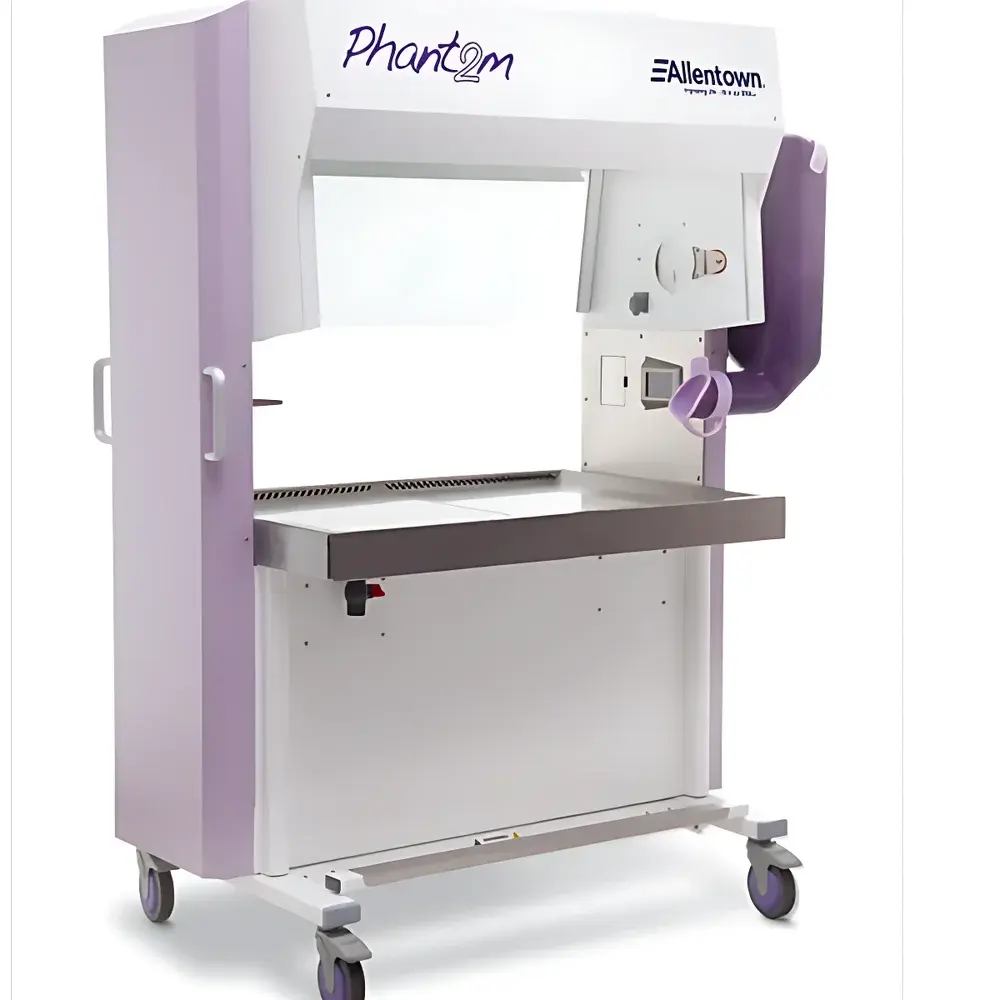
Allentown Phantom2 Animal Transfer Station (ATS)
| Brand | Allentown |
|---|---|
| Origin | Canada |
| Model | Phantom2 |
| Certification | ISO 14644-1 Class 3 Verified |
| Filtration | Dual-stage HEPA (≥99.995% @ 0.3 µm) |
| Airflow System | Unidirectional laminar flow with Active Barrier Control (ABC) |
| Work Area Opening Height | Up to 406 mm |
| Height Adjustment | Motorized, 305 mm travel with 4 programmable memory positions |
| Lighting | Adjustable-intensity LED (6000K white + red-light mode) |
| Display | Full-color touchscreen interface (8 languages) |
| Construction | Tempered safety glass (6 mm), polycarbonate rear panel (6 mm), IP-rated USB 2.0 ports |
| Motor | Energy-efficient ECM fan with ±1% airflow stability under variable filter load |
| Cabinet Temperature Rise | <1 °C during operation |
| Mobility | 127 mm polyurethane casters with brakes |
| Compliance | Designed for GLP/GMP-aligned animal facilities |
Overview
The Allentown Phantom2 Animal Transfer Station (ATS) is an ISO 14644-1 Class 3 certified, unidirectional laminar flow workstation engineered specifically for high-integrity animal handling in barrier-controlled vivaria and preclinical research environments. Unlike conventional clean benches or biosafety cabinets, the Phantom2 operates as a true animal transfer station—designed not only to protect the operator and environment but, critically, to preserve the microbiological integrity of immunocompromised, gnotobiotic, and germ-free animal models during cage changes and procedural interventions. Its core architecture employs a vertically oriented, top-exhaust laminar airflow system that maintains positive pressure within the work chamber while actively excluding ambient particulates through a dynamically stabilized air curtain at the front aperture. This dual-defense strategy—passive filtration via dual-stage HEPA media and active barrier control (ABC)—ensures sustained particle removal efficiency down to 0.3 µm with ≥99.995% retention, meeting the most stringent requirements for SPF, GF, and humanized mouse colony maintenance.
Key Features
- ISO 14644-1 Class 3 verified performance: Delivers 10× lower particle concentration than standard ISO Class 4 clean benches, validated by independent third-party testing.
- Active Barrier Control (ABC) system: Projects a precisely directed laminar air curtain beyond the sash plane, forming a dynamic seal against room-air infiltration at the work opening.
- Motorized height adjustment: 305 mm vertical travel range with four user-programmable memory positions for ergonomic adaptation across personnel heights and procedural workflows.
- Dual-spectrum LED lighting: Independently adjustable white light (6000 K CCT) and red-light mode minimize circadian disruption during nocturnal animal handling.
- Full-color touchscreen interface: Supports eight language options—including English, German, French, Japanese, and Chinese—with intuitive navigation for airflow setpoints, lighting profiles, and maintenance alerts.
- ECM-driven laminar flow system: Single energy-efficient electronically commutated motor maintains airflow stability within ±1% of nominal velocity—even under increasing HEPA filter resistance—ensuring long-term reproducibility.
- Thermally neutral cabinet design: Internal temperature rise remains below 1 °C during continuous operation, supporting thermoregulatory welfare of temperature-sensitive models.
Sample Compatibility & Compliance
The Phantom2 is validated for use with all standard IVC (individually ventilated cage) systems, including Tecniplast GreenLine, Allentown Avertin, and Lab Products caging platforms. Its large 406 mm vertical sash opening accommodates multi-cage transfers and integrated feed dispensing accessories without compromising containment integrity. The unit complies with ISO 14644-1:2015 (Class 3), adheres to principles outlined in the Guide for the Care and Use of Laboratory Animals (NRC, 2011), and supports facility alignment with AAALAC International accreditation standards. While not classified as a biological safety cabinet per NSF/ANSI 49, its design intent—animal model protection over operator protection—positions it as a purpose-built solution for GLP- and GMP-aligned preclinical operations where data fidelity depends on consistent microbial status.
Software & Data Management
The Phantom2’s embedded control firmware logs operational parameters—including runtime hours, filter differential pressure, motor speed, and lighting configuration—for internal review and export via USB. Though not FDA 21 CFR Part 11 compliant out-of-the-box, the system supports audit-ready documentation when integrated into institutional electronic lab notebook (ELN) or facility management platforms. Optional motion-sensor activation enables automatic power-state transitions (e.g., dimming lights and reducing fan speed during idle periods), with event timestamps recorded for energy-use tracking. All firmware updates are delivered via encrypted USB key to maintain version control and traceability in regulated environments.
Applications
- Maintenance of immunodeficient strains (e.g., NSG, NOG, BRGS mice) requiring strict pathogen exclusion.
- Germ-free and gnotobiotic animal derivation, weaning, and longitudinal monitoring.
- Cell line implantation, tumor engraftment, and other sterile procedures performed directly in the animal housing suite.
- High-value transgenic colony expansion where genetic drift or microbial contamination would invalidate experimental endpoints.
- Integration into modular vivarium designs where decentralized, point-of-use containment reduces reliance on centralized HVAC-based pressure cascades.
FAQ
Is the Phantom2 suitable for use with non-human primates or larger rodents?
The Phantom2 is optimized for murine and small rodent handling (up to ~500 g). For larger species, Allentown offers custom-engineered ATS variants with expanded footprint and reinforced structural support.
Does the Phantom2 require external ducting or hard exhaust?
No. It operates as a recirculating system with top-mounted exhaust; no building modifications or dedicated ductwork are required.
Can the ABC air curtain be disabled or adjusted manually?
The ABC system is fully integrated and cannot be disabled; its velocity and geometry are factory-calibrated to maintain ISO Class 3 performance across the full sash range.
What maintenance intervals are recommended for HEPA filters?
Dual-stage HEPA filters should be replaced every 18–24 months under typical usage, or sooner if differential pressure exceeds 250 Pa—monitored continuously via the onboard sensor suite.
Is remote monitoring or integration with BMS (Building Management Systems) supported?
Standard Phantom2 units do not include BACnet or Modbus interfaces; however, Allentown provides OEM integration support for facility-wide telemetry upon request.
Related Products



