Allentown Sentry SPP Sealed Positive Pressure IVC System for Mice and Rats
| Brand | Allentown |
|---|---|
| Origin | Canada |
| Model | Sentry SPP |
| Construction | 304 Stainless Steel Frame |
| Filtration | Dual Certified HEPA (Supply & Exhaust, Optional) |
| Sterilization | Autoclavable at 134°C |
| Power Backup | ≥10-hour Battery Redundancy |
| Cage Sizes | Mouse (537 cm² floor area), Rat (916 cm² floor area) |
| Sealing System | Patented 4-Point Automatic Seal (US Patent 6,308,660) |
| Docking Interface | SmartDock® Visual Alignment System |
| Compliance | Meets NIH Guide, AAALAC International standards, supports GLP/GMP-aligned animal facility operations |
Overview
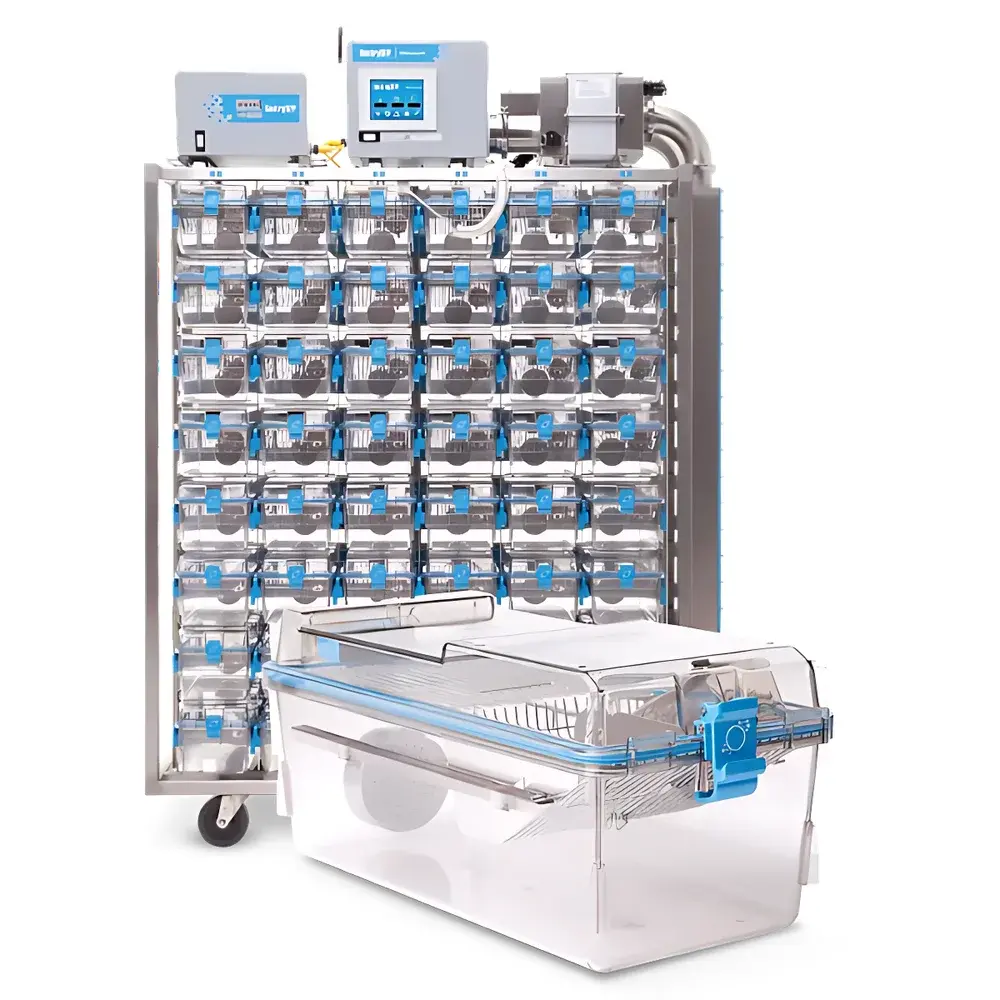
The Allentown Sentry SPP (Sealed Positive Pressure) Independent Ventilated Cage (IVC) System is an engineered solution for high-integrity rodent housing in biosafety-critical research environments. Unlike conventional IVC systems that rely on differential pressure gradients alone, the Sentry SPP employs a rigorously sealed, actively pressurized architecture—functionally equivalent to a mobile isolator—while retaining the spatial efficiency, ergonomic access, and modular scalability of standard IVC infrastructure. Its core operating principle is continuous positive pressure maintenance (≥30 Pa relative to ambient lab air) across both cage and rack interfaces, enforced by redundant blowers and validated HEPA filtration. This ensures unidirectional airflow from clean supply through the animal microenvironment and into exhaust—preventing ingress of environmental particulates, pathogens, or aerosolized contaminants. Designed explicitly for germ-free (GF), gnotobiotic, immunocompromised, genetically engineered, or high-value preclinical models, the Sentry SPP bridges the operational gap between isolator-grade containment and routine vivarium workflow.
Key Features
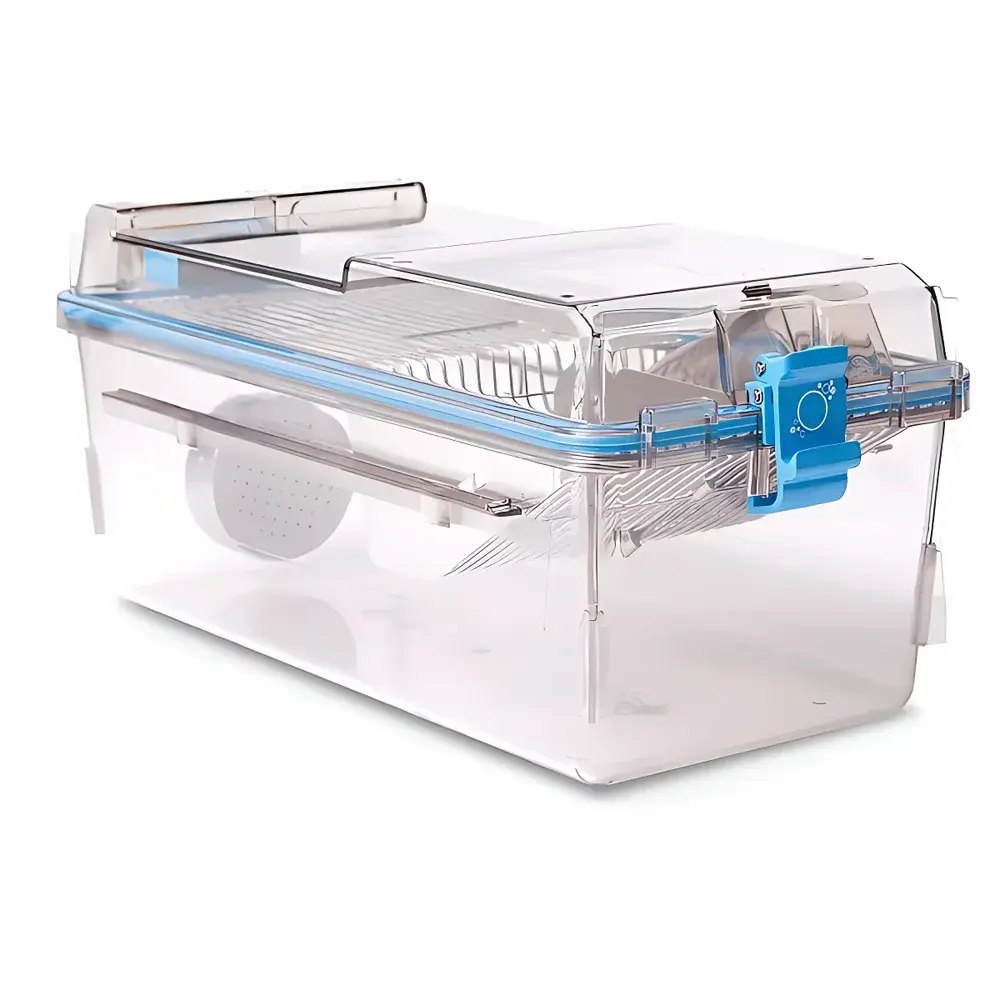
- Patented 4-Point Automatic Sealing Mechanism (US Patent 6,308,660): Upon cage removal from the rack, both cage lid and rack interface seal simultaneously—eliminating exposure risk during transport or handling.
- SmartDock® Visual Docking Guidance: Integrated LED indicators confirm correct mechanical and pneumatic engagement, preventing misalignment-induced airflow failure or pressure loss.
- Dual-Level HEPA Filtration: Certified Class H14 HEPA filters (≥99.995% @ 0.3 µm) installed at both rack inlet (supply) and optional cage exhaust outlet—ensuring sterile air delivery and contained effluent treatment.
- Autoclavable Architecture: Entire rack structure and all cage components withstand repeated sterilization cycles at 134°C / 273°F for ≥18 minutes, fully compliant with ISO 17665-1 for steam sterilization validation.
- Redundant Critical Systems: Dual independent blowers with automatic failover and integrated backup battery sustaining ≥10 hours of uninterrupted pressure and airflow during mains power interruption.
- Ergonomic Human Factors Design: Single-finger latch actuation, low-lift cage insertion, and optimized rack height reduce operator fatigue and repetitive strain injury risk during daily husbandry.
Sample Compatibility & Compliance
The Sentry SPP accommodates standard NIH-compliant mouse cages (537 cm² floor area) and rat cages (916 cm² floor area), supporting group housing up to IACUC-defined density limits. All cage materials—including polycarbonate-free polyphenylsulfone (PPSU) for optical clarity and thermal/chemical resistance—are USP Class VI certified and compatible with peracetic acid, hydrogen peroxide vapor (HPV), and chlorine-based disinfectants. The system conforms to AAALAC International accreditation requirements for barrier integrity verification, including annual leak testing per ASTM E2877-13 (Standard Practice for Leak Testing of Isolators). It supports facility-level compliance with NIH Guide for Care and Use of Laboratory Animals, EU Directive 2010/63/EU Annex III, and FDA expectations for animal model integrity in IND-enabling toxicology studies.
Software & Data Management
The Sentry SPP integrates with Allentown’s Wivarium Plus™ platform—a secure, tablet-based monitoring system enabling remote real-time visualization of rack-level parameters: static pressure differential, supply/exhaust airflow rates, HEPA filter delta-P, blower RPM, and battery status. All system events—including door openings, seal actuation, alarm triggers, and manual overrides—are time-stamped and logged with user ID attribution, satisfying audit trail requirements under 21 CFR Part 11 for regulated preclinical studies. Data export is supported via Ethernet (Modbus TCP/IP) or USB for integration into institutional LIMS or electronic vivarium management systems. Optional SNMP-enabled network alerts allow centralized IT infrastructure monitoring without compromising vivarium network segmentation policies.
Applications
This system is deployed where biological containment fidelity directly impacts data validity: infectious disease challenge models requiring ABSL-2/3 equivalence; immuno-oncology studies using humanized or NSG mice; microbiome research involving defined-flora colonization; CRISPR/Cas9-generated transgenic lines with compromised immune surveillance; and longitudinal pharmacology studies where inter-cage contamination could confound endpoint biomarkers. Its pressure-stability profile (<±2 Pa variation over 24 h under nominal load) also supports behavioral phenotyping protocols sensitive to olfactory or airborne cue interference.
FAQ
How does Sentry SPP differ from traditional IVC systems in terms of biocontainment?
It provides isolator-equivalent barrier protection via active sealing and sustained positive pressure—whereas standard IVCs depend solely on airflow velocity and pressure differentials without physical isolation upon cage removal.
Can Sentry SPP cages be used outside the rack without compromising containment?
Yes—the patented 4-point seal maintains internal positive pressure for ≥15 minutes post-removal, enabling safe transport to procedure rooms or imaging suites without auxiliary enclosures.
Is the system compatible with automated watering or feeding systems?
Rack-level integration ports support third-party automated hydration systems meeting ISO 5667-3 water quality standards; feed hopper compatibility requires custom bracketing per cage size.
What validation documentation is provided for regulatory submissions?
Allentown supplies Factory Acceptance Test (FAT) reports, HEPA filter certification (EN 1822-1), pressure decay test protocols, and autoclave cycle validation templates aligned with ISO 13485 and GxP expectations.
Does the system support integration with building management systems (BMS)?
Yes—via dry-contact alarm outputs and Modbus TCP/IP interface for HVAC interlock, emergency shutdown sequencing, and environmental parameter logging.
Related Products