
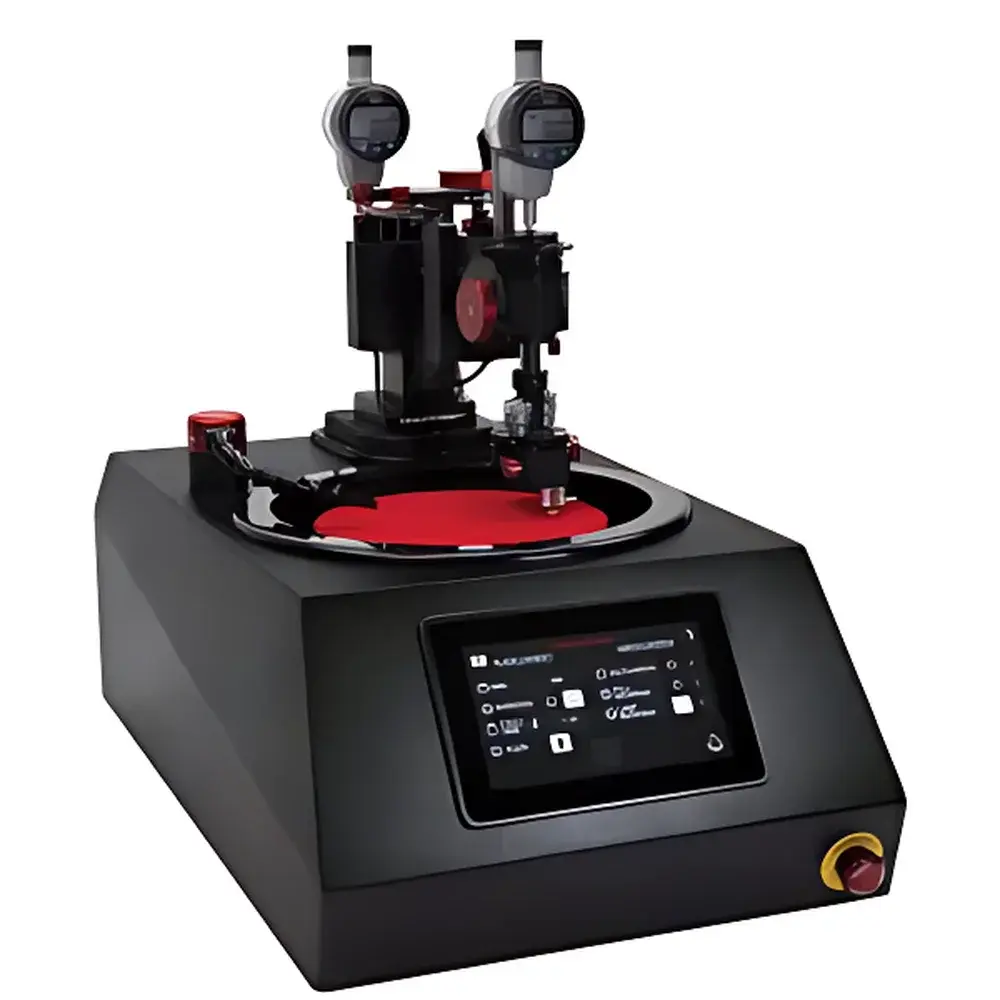
Allied MultiPrep™ Precision Grinding and Polishing System
| Brand | Allied |
|---|---|
| Origin | USA |
| Model | MultiPrep™ |
| Sample Type | Cryogenic-compatible |
| Output Particle Size | ≥0.5 mm |
| Drive Motor | 0.5 HP (375 W) |
| Grinding Disk Speed | 5–350 RPM (5-RPM increments) |
| Z-axis Resolution | 1 µm |
| Tilt & Swing Adjustment Range | +10° / –2.5° (0.02° increment) |
| Sample Load Capacity | 0–600 g (100 g increments) |
| Dimensions (Standard) | 381 × 660 × 508 mm (W×D×H) |
| Weight (Standard) | 43 kg |
| Compliance | CE, ISO 9001-aligned design, GLP-ready architecture |
| Power Supply | 100–240 V, 50/60 Hz, single-phase |
Overview
The Allied MultiPrep™ Precision Grinding and Polishing System is an engineered solution for reproducible, geometry-controlled sample preparation in advanced materials characterization laboratories. Designed specifically for high-resolution microstructural analysis, the system operates on a dual-axis kinematic principle—combining precision Z-axis vertical displacement control with independent tilt (±10°) and swing (±2.5°) adjustments—enabling deterministic material removal while preserving critical sample geometry. Unlike conventional manual or semi-automated grinders, the MultiPrep™ eliminates operator-dependent variability by mechanically constraining all motion to calibrated axes, ensuring that only the specimen surface contacts the abrasive medium. Its core architecture integrates a high-torque 0.5 HP motor, rigid RIM-cast aluminum and stainless-steel frame, and a thermally stable base—features essential for maintaining sub-micron positional fidelity during extended polishing cycles required for TEM lamella thinning, SEM cross-sectioning, or AFM substrate planarization.
Key Features
- 7-inch LCD touchscreen interface with full keyboard input for intuitive parameter configuration, real-time monitoring, and recipe-based automation
- Dual digital micrometers for independent, high-resolution adjustment of sample tilt and swing angles (0.02° increments within ±10° / ±2.5° range)
- Z-axis vertical position indicator with 1 µm resolution and zero-reset functionality—critical for quantifying cumulative material removal depth
- Programmable rotational speed (5–350 RPM, 5-RPM steps) and oscillatory motion (6× and 8× variable-speed gear-driven sample rotation) to maximize abrasive utilization and minimize edge rounding
- Electronically regulated coolant delivery via optional AD-5™ fluid dispenser with adjustable flow valve and temperature-stable delivery path
- Cam-lock clamping mechanism enabling rapid, tool-free reconfiguration of fixtures without compromising alignment repeatability
- Load compensation system supporting 0–600 g sample mass (in 100 g increments), accommodating both fragile cryo-mounted specimens and robust encapsulated samples
Sample Compatibility & Compliance
The MultiPrep™ accommodates a broad spectrum of specimen types—including brittle ceramics, polymer composites, metallurgical alloys, semiconductor wafers, and frozen-hydrated biological tissues—without requiring manual intervention during grinding or polishing stages. Its cryo-compatible stage design permits direct integration with liquid nitrogen cooling accessories (sold separately), making it suitable for low-temperature sectioning where thermal degradation must be avoided. All mechanical and electrical subsystems comply with CE marking requirements for safety and electromagnetic compatibility. The system’s deterministic motion control, traceable calibration paths, and non-volatile parameter logging support adherence to GLP and GMP documentation standards. While not FDA 21 CFR Part 11 certified out-of-the-box, its audit-trail-capable software architecture allows integration into validated workflows when paired with compliant LIMS or ELN platforms.
Software & Data Management
Operation is managed through an embedded real-time OS running on the integrated touchscreen controller. Each process sequence—including speed profiles, dwell times, load settings, and coolant activation thresholds—is stored as a named protocol with timestamped execution logs. Digital indicators record cumulative Z-axis displacement, rotational cycles, and total elapsed time per step, enabling post-process correlation between geometric parameters and analytical outcomes (e.g., TEM foil thickness vs. polishing duration). Exportable CSV logs include full axis-position histories at user-defined sampling intervals (default: 100 ms). Optional RS-232 or USB-C connectivity supports external data acquisition systems for synchronized environmental monitoring (e.g., humidity, ambient temperature) during long-duration polishing runs.
Applications
The MultiPrep™ serves as a foundational platform for preparing specimens destined for electron microscopy, surface metrology, and failure analysis. Key use cases include: parallel-plane polishing of metallographic mounts for quantitative grain analysis; wedge-angle polishing of semiconductor interconnect layers for circuit-level tomography; cross-sectional preparation of multilayer thin-film stacks for EDS line-scan validation; TEM lamella thinning using FIB-compatible fixtures (e.g., #15-1013, #15-1014); and AFM substrate flattening for nanoscale topographic mapping. Its ability to maintain consistent normal-force distribution across heterogeneous surfaces ensures uniform removal rates in composite or graded materials—reducing artifact generation common in hand-polished samples.
FAQ
What sample sizes can the MultiPrep™ accommodate?
Standard fixtures support specimens ranging from 1.0 mm × 0.4 mm × 0.45 mm (miniature bag-type clamps) up to 100 mm diameter parallel-polish mounts. Custom fixture integration is supported via standardized mounting interfaces.
Is the system compatible with diamond suspension or colloidal silica slurries?
Yes—the AD-5™ fluid dispenser and corrosion-resistant stainless-steel fluid path are rated for aqueous and organic-based polishing media, including pH-stable colloidal silica (pH 9–11) and ethanol-based diamond suspensions.
Can I perform angle-specific polishing for crystallographic analysis?
Absolutely—the dual-axis micrometer system enables precise angular orientation relative to the grinding disk plane, allowing controlled preparation of crystallographically defined surfaces for EBSD or Laue diffraction.
Does the system support unattended overnight operation?
Yes—timed sequences with auto-shutdown, overload detection, and coolant-flow monitoring allow fully autonomous multi-hour protocols, provided ambient temperature remains within 15–30°C and humidity <70% RH.
Are calibration certificates included with purchase?
Each unit ships with NIST-traceable dimensional verification documentation for Z-axis encoder linearity and rotational speed accuracy. Full ISO/IEC 17025 calibration services are available through Allied-certified service centers.



