
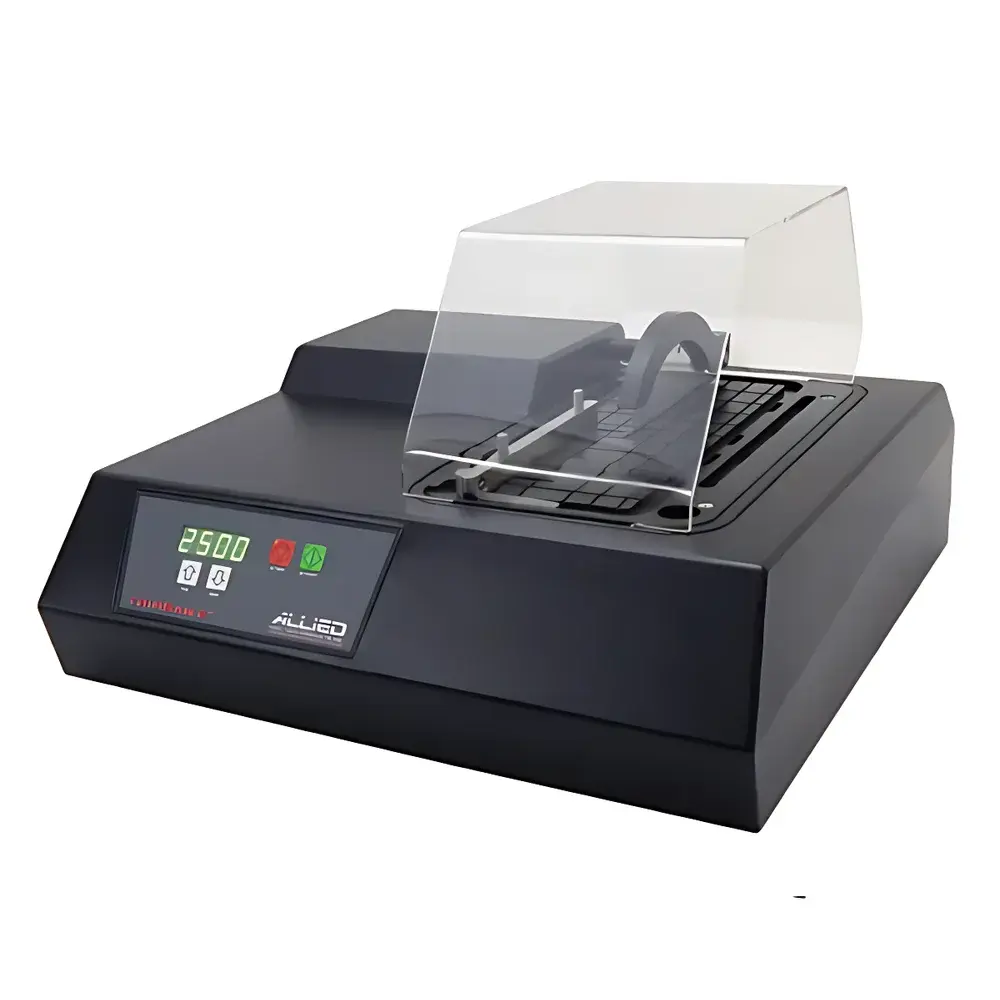
Allied TrimSaw 2™ Precision Low-Speed Diamond Saw
| Brand | Allied |
|---|---|
| Model | TrimSaw 2™ |
| Motor Power | 190 W (0.25 HP) |
| Rotational Speed Range | 500–3000 rpm (in 100 rpm increments) |
| Blade Diameter | 150 mm (6") |
| Max Cutting Depth | 41 mm (1.6") |
| Worktable Dimensions | 171 mm × 318 mm (6.75" × 12.5") |
| Coolant Reservoir Capacity | 3.8 L (1 gal) |
| Overall Dimensions | 457 mm × 508 mm × 279 mm (18" × 20" × 11") |
| Net Weight | 15.9 kg (35 lb) |
| Blade Compatibility | 102–152 mm (4"–6") |
| Construction | Aluminum and stainless steel frame with chemical-resistant polycarbonate safety shield |
| Optional accessories | Linear guide (Part #5-3005), Universal fixture (Part #5-3010) |
Overview
The Allied TrimSaw 2™ is a precision-engineered low-speed diamond saw designed specifically for controlled sectioning of electronic components, semiconductor packages, PCBs, encapsulated devices, and other delicate or heterogeneous materials requiring minimal thermal and mechanical disturbance. Unlike high-speed abrasive cutters, the TrimSaw 2™ operates on the principle of controlled diamond abrasion under continuous coolant flow—enabling clean, planar cuts with negligible kerf loss, minimized microcracking, and preserved interfacial integrity. Its variable-speed DC motor (500–3000 rpm) allows optimization of cutting parameters for diverse material classes—from brittle ceramics and sintered metals to polymer-encapsulated ICs and multilayer laminates—while maintaining dimensional repeatability critical for failure analysis, cross-sectional metrology, and metallurgical preparation.
Key Features
- 190 W brushless DC motor delivering consistent torque across the full speed range (500–3000 rpm in 100 rpm steps), enabling precise matching of rotational velocity to material hardness and diamond grit size.
- Chemically resistant polycarbonate safety shield with integrated splash guard, fully enclosing the cutting zone while permitting unobstructed operator visibility and safe access during setup.
- Adjustable blade mounting assembly accommodating 102–152 mm (4″–6″) diamond blades, with fine-tuned lateral and angular alignment capability to ensure perpendicularity and minimize runout.
- Removable stainless steel worktable (171 mm × 318 mm) featuring calibrated T-slots, adjustable reference stops, and integrated coolant drainage channels—designed for rapid reconfiguration between sample types and efficient maintenance.
- Integrated 3.8 L polyethylene coolant reservoir with submersible pump, flow control valve, and recirculation filtration—compatible with water-soluble coolants, glycol-based fluids, or deionized water for sensitive electronic substrates.
- Rugged aluminum and stainless steel chassis engineered for long-term stability in cleanroom-adjacent labs, ESD-safe environments, and QA/QC laboratories performing IPC-A-610 or JEDEC-compliant sample preparation.
Sample Compatibility & Compliance
The TrimSaw 2™ supports sectioning of packaged semiconductors (QFN, BGA, SOIC), ceramic substrates, metal matrix composites, solder joints, wire bonds, and conformally coated assemblies—without delamination or localized heating-induced phase transformation. Its low-speed operation conforms to ASTM F2794 (Standard Practice for Cross-Sectioning Electronic Components) and supports preparation workflows aligned with IPC-TM-650 Test Methods Manual (2.1.1, 2.2.1). The unit’s electrical design meets IEC 61000-6-2 (immunity) and IEC 61000-6-4 (emission) requirements; CE marking is applicable per Machinery Directive 2006/42/EC. Optional accessories—including the linear 90° guide (P/N 5-3005) and universal fixture (P/N 5-3010)—enable repeatable orthogonal cuts and multi-axis fixturing for serial sectioning protocols required in FA labs and reliability testing centers.
Software & Data Management
The TrimSaw 2™ is a standalone electromechanical instrument with no embedded firmware or digital interface. All operational parameters are manually set via front-panel rotary encoder and LED display. However, its mechanical reproducibility—combined with standardized blade geometry, coolant flow rate, feed rate, and depth-of-cut settings—enables full traceability within GLP/GMP-compliant documentation systems. Users may integrate operational logs, maintenance records, and calibration certificates into LIMS or ELN platforms using standard SOP templates. While no proprietary software is bundled, the device’s deterministic behavior supports audit-ready validation protocols per ISO/IEC 17025 and FDA 21 CFR Part 11 when paired with controlled documentation practices.
Applications
- Cross-sectional analysis of flip-chip interconnects and underfill interfaces in advanced packaging.
- Preparation of TEM/SEM specimens from power modules and SiC/GaN devices without beam-sensitive artifact generation.
- Controlled sectioning of conformal coatings and potting compounds for adhesion assessment per MIL-STD-883 Method 2005.
- Dimensional verification of solder paste deposits and stencil-applied features prior to reflow.
- Failure analysis of cracked die attach layers, voided thermal interface materials, and fractured substrate vias.
- Metallurgical sample preparation for grain structure evaluation in leadframe alloys and bond wire metallurgy.
FAQ
Is the TrimSaw 2™ suitable for cutting silicon wafers?
Yes—when equipped with a resin-bonded diamond blade (e.g., 15 µm grit) and operated at ≤1000 rpm with DI water coolant, it produces low-stress sections suitable for subsequent polishing and SEM inspection.
Can the machine be used in a Class 100 cleanroom environment?
The unit itself is not ISO Class 5 certified, but its non-shedding construction, absence of internal lubricants, and compatibility with IPA-rinsed coolant systems allow deployment in adjacent buffer zones with appropriate environmental controls.
What blade types are recommended for cutting FR-4 PCBs?
A 125 mm, 10–15 µm metal-bonded diamond blade with segmented rim geometry is optimal for minimizing delamination and copper pull-out during through-board sectioning.
Does Allied provide validation documentation for IQ/OQ protocols?
Yes—Allied supplies Factory Acceptance Test (FAT) reports, mechanical calibration certificates, and user-installable verification checklists compatible with GxP-regulated environments.
Is the coolant reservoir compatible with biocidal additives?
Polyethylene construction is chemically stable with common biocides (e.g., isothiazolinones); however, concentration must remain below 0.5% v/v to prevent long-term seal degradation.



