
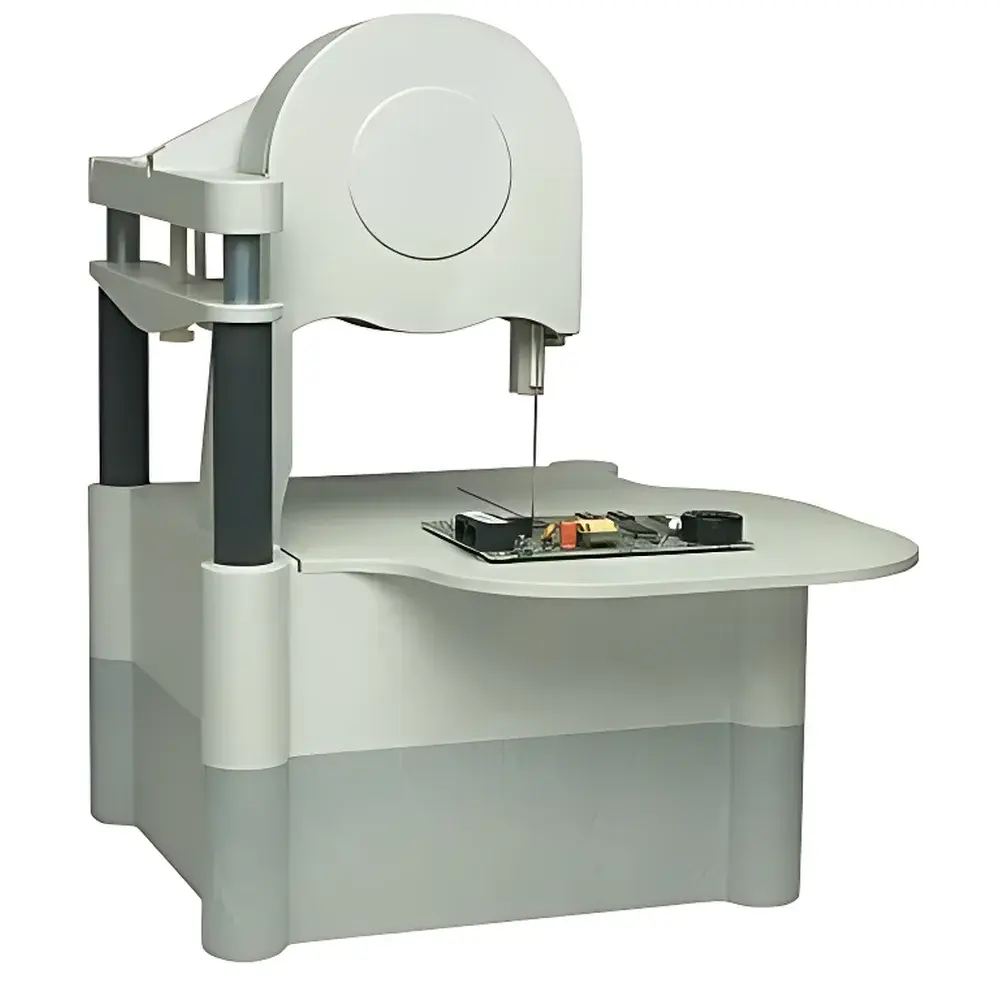
Allied TrimSaw 2™ Precision Wafer and Specimen Cutting System
| Brand | Allied |
|---|---|
| Model | TrimSaw 2™ |
| Motor Power | 0.25 HP (190 W) |
| Blade Speed Range | 500–3000 RPM (in 100 RPM increments) |
| Blade Diameter | 6" (150 mm) |
| Max Cutting Depth | 1.6" (41 mm) |
| Worktable Dimensions | 6.75" × 12.5" (171 × 318 mm) |
| Coolant Reservoir Capacity | 1 US gallon (3.8 L) |
| Overall Dimensions | 18" × 20" × 11" (457 × 508 × 279 mm) |
| Weight | 35 lb (15.9 kg) |
| Compatible Blade Sizes | 4"–6" (102–152 mm) |
| Enclosure Material | Corrosion-resistant acrylic shield |
| Housing Material | Anodized aluminum and stainless steel |
| Accessories | Linear guide (90° fixed), universal vise kit |
Overview
The Allied TrimSaw 2™ is a precision-engineered, benchtop specimen cutting system designed specifically for controlled sectioning of electronic wafers, semiconductor substrates, metallurgical samples, and brittle or composite materials used in R&D, quality control, and failure analysis laboratories. Unlike general-purpose saws, the TrimSaw 2™ employs a direct-drive, brushless motor coupled with a high-inertia flywheel to maintain stable rotational velocity across variable load conditions—critical for minimizing kerf loss, thermal damage, and microcracking during low-force, high-accuracy cuts. Its rigid cast-aluminum base, stainless-steel structural components, and vibration-damped mounting platform ensure mechanical stability during prolonged operation. The system operates on standard 100–240 V AC input and complies with IEC 61000-6-3 (EMC emission) and IEC 61000-6-2 (immunity) standards, making it suitable for integration into ISO/IEC 17025-accredited testing environments.
Key Features
- 0.25 HP (190 W) brushless DC motor delivering consistent torque from 500 to 3000 RPM in precise 100 RPM increments—enabling optimization for soft polymers, hard ceramics, silicon wafers, or copper-clad laminates.
- Adjustable blade arbor assembly accommodates 4″ to 6″ (102–152 mm) diameter blades, including diamond-impregnated, resin-bonded, and metal-bonded abrasive wheels commonly used in semiconductor metrology.
- Full-height, transparent acrylic safety shield with hinged access provides full splash containment while maintaining unobstructed operator visibility and facilitating rapid blade changes or coolant maintenance.
- Modular worktable features calibrated depth-stop scales, adjustable reference fence with vernier scale (±0.1 mm resolution), and removable T-slot surface for secure mounting of custom fixtures or vacuum chucks.
- Integrated 3.8 L coolant reservoir with submersible pump and directional nozzles ensures continuous, temperature-stable lubrication at the cut interface—reducing frictional heating and extending blade life.
- Compact footprint (457 × 508 × 279 mm) and lightweight design (15.9 kg) support deployment in cleanroom-adjacent labs, fume hood installations, or mobile analytical workstations without structural reinforcement.
Sample Compatibility & Compliance
The TrimSaw 2™ is routinely deployed for sectioning silicon, GaAs, SiC, sapphire, PCB laminates, solder joints, battery electrode stacks, and geological thin-section blanks. Its low-vibration architecture minimizes subsurface deformation in brittle-phase materials, supporting preparation protocols aligned with ASTM E3–22 (Standard Guide for Preparation of Metallographic Specimens) and ISO 14577–1:2022 (Metallic materials — Instrumented indentation test). The system’s electrical safety design conforms to UL 61010-1 and CSA C22.2 No. 61010-1. Optional accessories—including the 90° linear guide (P/N 5-3005) and universal vise kit (P/N 5-3010)—enable repeatable angular cuts and multi-axis fixturing compliant with MIL-STD-883H Method 2010.1 (Mechanical Shock and Vibration Testing).
Software & Data Management
While the TrimSaw 2™ operates as a manually controlled instrument, its operational parameters are fully documentable within laboratory information management systems (LIMS) and electronic lab notebooks (ELN). All speed settings, coolant flow status, and runtime logs can be recorded via external USB data loggers or integrated PLC interfaces (e.g., Allen-Bradley Micro850). The system supports audit-trail-capable documentation workflows under FDA 21 CFR Part 11 when paired with validated third-party software platforms. Calibration intervals (recommended annually) and maintenance records—including blade wear tracking and motor performance verification—are compatible with GLP/GMP-compliant record retention policies.
Applications
- Cross-sectional analysis of flip-chip interconnects and through-silicon vias (TSVs) prior to SEM/FIB imaging.
- Preparation of polished metallurgical mounts from cast alloys, heat-treated steels, or additive-manufactured nickel superalloys.
- Sectioning of geological core samples for petrographic microscopy, particularly in shale, basalt, and mineralized vein studies.
- Controlled trimming of ceramic substrates and LTCC/HTCC modules for impedance characterization and thermal cycling validation.
- Failure analysis of EV battery cells—cutting electrode stacks perpendicular to lamination direction to assess delamination, particle cracking, or SEI layer integrity.
FAQ
What blade types are recommended for silicon wafer dicing?
Diamond-impregnated resin-bonded blades (e.g., Allied P/N 11-2010, 6″ × 0.020″) operated at 2200–2800 RPM with deionized water coolant yield optimal edge quality and minimal chipping.
Is the TrimSaw 2™ compatible with automated sample positioning stages?
Yes—the worktable includes M6 threaded inserts and standardized T-slots, enabling integration with third-party XYZ translation stages (e.g., Thorlabs LTS300 or Prior ProScan III) using custom adapter plates.
Can the coolant system be upgraded to recirculating filtration?
The reservoir port is configured for optional inline particulate filters (5–10 µm) and magnetic coolant conditioners; full closed-loop recirculation requires external pump manifold integration per OEM technical bulletin TB-TRIMSAW-04.
Does the system meet cleanroom classification requirements?
The unit itself is not ISO Class 5-certified, but its non-shedding anodized housing, sealed motor housing, and low-outgassing acrylic shield permit safe operation in ISO Class 7–8 environments when equipped with HEPA-filtered coolant mist extraction.
What is the recommended preventive maintenance schedule?
Motor brush inspection every 2000 operating hours, arbor bearing lubrication every 6 months, and full coolant system flush and biocide treatment quarterly—per Allied Maintenance Protocol MP-TRIMSAW-2 Rev. D.




