
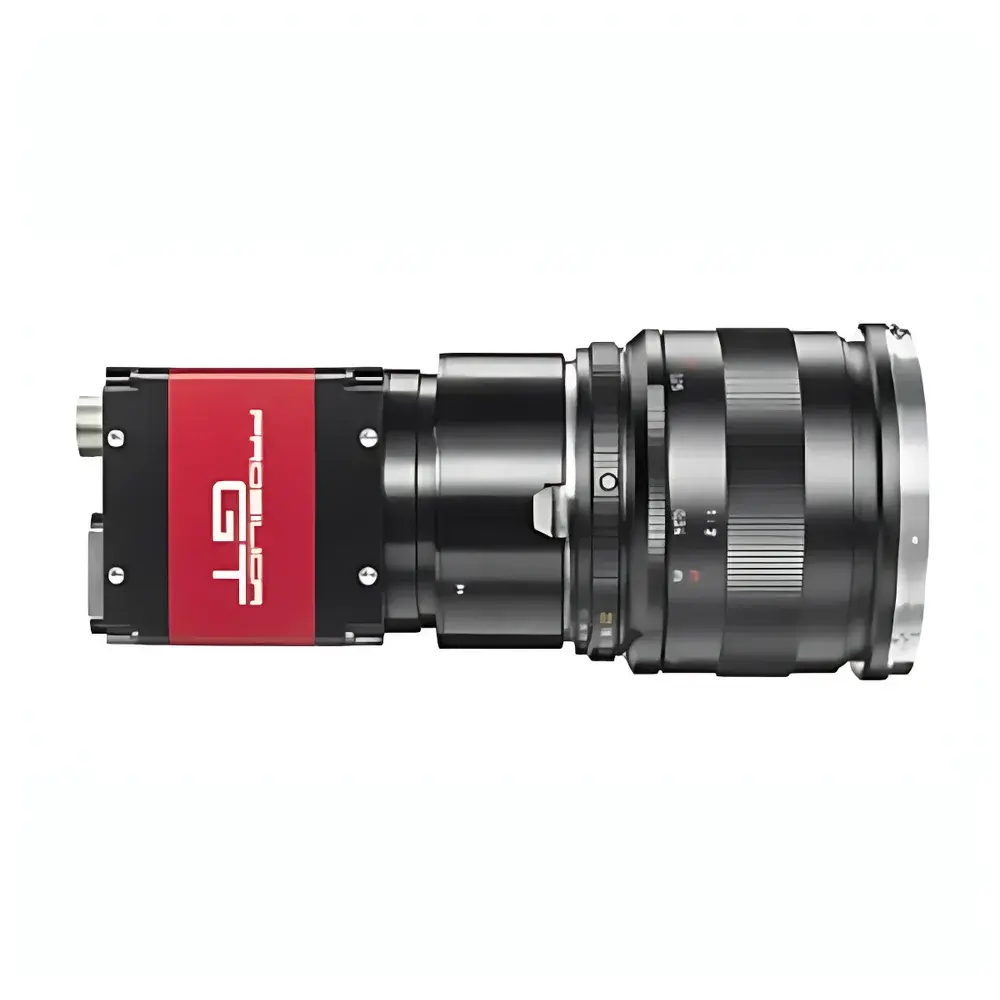
Allied Vision Infrared Camera Series – SWIR, VSWIR & VNIR Imaging Solutions
| Brand | Allied Vision |
|---|---|
| Origin | Germany |
| Manufacturer | Allied Vision Technologies GmbH |
| Product Type | Industrial & Scientific Infrared Imaging Cameras |
| Sensor Types | InGaAs, CMOS (Sony Pregius, ON Semiconductor), CCD |
| Spectral Ranges | 400–1700 nm (VSWIR), 900–1700 nm (SWIR), 400–1000 nm (VNIR) |
| Cooling | Uncooled Operation |
| Interface Standards | GigE Vision, USB3 Vision, Camera Link, IEEE 1394 |
| Pixel Resolution Range | 0.1 MP to 29 MP |
| Frame Rate Range | Up to 344 fps (model-dependent) |
| Operating Temperature Range | −10 °C to +65 °C (industrial grade) |
| Compliance | CE, FCC, RoHS, ISO 9001-certified manufacturing |
| Software Support | Vimba SDK (C/C++, Python, .NET), GenICam-compliant |
Overview
Allied Vision’s Infrared Camera Series represents a modular, application-agnostic platform engineered for precision imaging across short-wave infrared (SWIR), visible-short-wave infrared (VSWIR), and visible-near-infrared (VNIR) spectral bands. Leveraging physics-based detection principles—including photon absorption in InGaAs photodiode arrays for SWIR (900–1700 nm), back-illuminated CMOS quantum efficiency optimization for VNIR (400–1000 nm), and broadband anti-reflection coating architectures for seamless VSWIR (400–1700 nm) coverage—these cameras deliver quantitative radiometric data suitable for non-contact thermography, semiconductor inspection, agricultural phenotyping, laser beam profiling, and defense-related surveillance. Unlike cooled MCT or QWIP systems, Allied Vision’s uncooled architecture eliminates cryogenic dependencies while maintaining thermal stability under industrial ambient conditions (−10 °C to +65 °C), enabling integration into embedded OEM systems, automated optical inspection (AOI) stations, and laboratory-grade spectral analysis setups.
Key Features
- Sensor Flexibility: Native support for InGaAs (Goldeye series), global-shutter CMOS (Sony Pregius, ON Semiconductor PYTHON), and interline-transfer CCD architectures—each selected for optimal quantum efficiency, dark current suppression, and linearity in targeted spectral windows.
- Multi-Band Spectral Coverage: SWIR models optimized for 900–1700 nm with optional visible extension down to 400 nm; VSWIR variants certified for continuous response from 400 nm to 1700 nm; VNIR configurations delivering >80% QE at 850 nm with minimal pixel crosstalk.
- High-Fidelity Data Acquisition: On-sensor temporal noise reduction, programmable ROI readout, hardware-triggered exposure synchronization, and integrated flat-field correction reduce post-processing overhead and improve measurement repeatability across batch runs.
- Industrial Interface Ecosystem: Full compliance with GigE Vision 2.0, USB3 Vision 1.0, and Camera Link Base/Medium protocols ensures plug-and-play interoperability with National Instruments LabVIEW, HALCON, OpenCV, and MATLAB Image Acquisition Toolbox environments.
- OEM-Ready Form Factors: Board-level (Alvium), compact housing (Goldeye), and ruggedized enclosure (Manta G) variants support integration into space-constrained systems requiring IP65-rated ingress protection or shock/vibration tolerance per IEC 60068-2-64.
- Firmware Extensibility: Field-upgradable firmware via Vimba SDK enables custom LUT deployment, multi-camera timecode synchronization (IEEE 1588 PTP), and user-defined GPIO logic for inline process control feedback loops.
Sample Compatibility & Compliance
The Allied Vision Infrared Camera Series is validated for use with standard C-mount and F-mount optics featuring AR coatings optimized for SWIR/VNIR transmission. Calibration traceability follows NIST-traceable blackbody reference sources (e.g., CI Systems CB-1500) and adheres to ASTM E1933-19 for infrared thermographic system performance characterization. All models undergo electromagnetic compatibility (EMC) testing per EN 61000-6-2/6-4 and are certified for operation in Class I, Division 2 hazardous locations when deployed with appropriate enclosures. Manufacturing complies with ISO 9001:2015 quality management standards, and documentation packages include EU Declaration of Conformity, RoHS compliance statements, and CE marking evidence files for regulatory submission workflows.
Software & Data Management
Vimba SDK serves as the unified software development framework, providing native C/C++, Python (3.7+), and .NET (4.7.2+) bindings with full GenICam 3.3 feature naming consistency. The SDK includes real-time streaming utilities with zero-copy memory mapping, timestamp-accurate frame buffering (±1 µs jitter), and metadata-embedded TIFF/RAW export supporting 12-bit and 16-bit linear intensity encoding. For regulated environments, Vimba supports audit trail logging compliant with FDA 21 CFR Part 11 requirements—including electronic signature capture, immutable session logs, and role-based access controls—when deployed on validated Windows Server platforms. Integration with third-party platforms such as Keysight PathWave, MATLAB Production Server, and OPC UA-enabled MES systems is supported through standardized XML configuration exports and RESTful API wrappers.
Applications
- Semiconductor Wafer Inspection: SWIR imaging detects subsurface defects, dopant distribution anomalies, and bond interface voids in silicon wafers using 1310 nm laser illumination and lock-in amplification.
- Pharmaceutical Tablet Coating Analysis: VSWIR reflectance mapping quantifies film thickness uniformity and excipient distribution across tablet surfaces per USP guidance.
- Automotive LiDAR Validation: VNIR cameras synchronized with 905 nm pulsed lasers perform time-of-flight calibration and spot profile analysis in accordance with ISO 16750-4 environmental stress testing protocols.
- Food Quality Sorting: Hyperspectral VNIR line-scan configurations identify foreign material, bruising, and sugar content via PCA-based spectral unmixing algorithms trained on USDA reference libraries.
- Research-Scale Thermography: Uncooled SWIR imaging enables emissivity-corrected surface temperature mapping of high-reflectivity metals (e.g., aluminum, copper) during additive manufacturing build cycles without active cooling infrastructure.
FAQ
What spectral ranges are supported by the Goldeye SWIR camera series?
Goldeye models operate in the 900–1700 nm range; select variants extend sensitivity down to 400 nm via hybrid AR-coated InGaAs sensors.
Do these cameras support radiometric calibration out of the box?
Yes—factory-calibrated non-uniformity correction (NUC) tables and gain/offset coefficients are embedded in firmware; optional NIST-traceable calibration certificates are available upon request.
Is GigE Vision streaming compatible with deterministic latency requirements?
Latency is configurable via jumbo frame tuning and hardware timestamping; typical end-to-end delay is ≤12 ms for 1280×1024 @ 60 fps over standard Cat6a infrastructure.
Can I integrate these cameras into a GLP-compliant lab environment?
Vimba SDK’s audit trail module, combined with documented IQ/OQ/PQ validation templates, satisfies GLP Annex 11 and ISO/IEC 17025 data integrity requirements.
Are custom lens mounts or mechanical interfaces available?
Yes—Allied Vision offers mechanical customization services including threaded flange adaptation, hermetic sealing, and MIL-STD-810G shock mounting solutions under NDA.





