
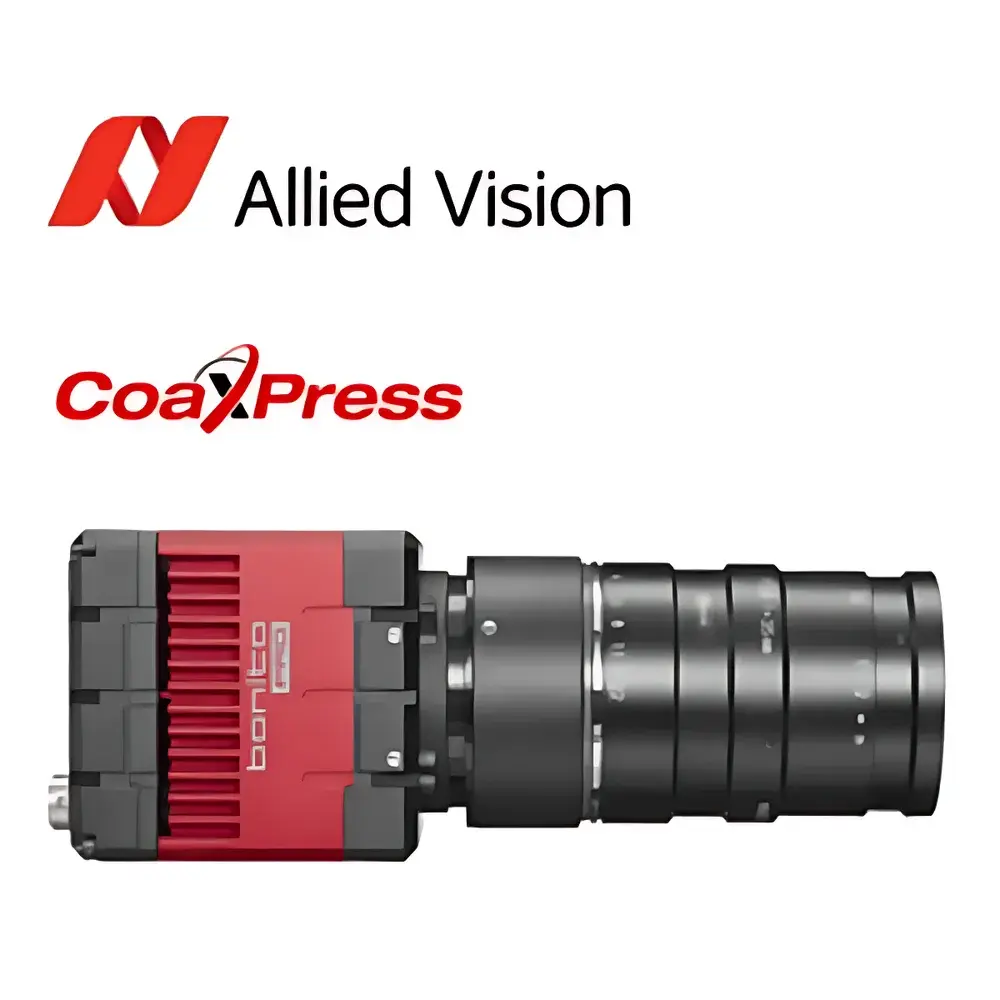
AlliedVision Alvium 1800 U-2620 CMOS Camera
| Brand | AlliedVision |
|---|---|
| Sensor | ON Semiconductor PYTHON 25K (APS-H optical format) |
| Resolution | 26.2 MP (6576 × 3944) |
| Frame Rate | 79.7 fps at full resolution |
| Interface | CoaXPress 2.0 (4× CXP-6 channels, 25 Gbps aggregate bandwidth) |
| Connector Type | 4× DIN 1.0/2.3 |
| Housing | Fanless, ruggedized aluminum enclosure |
| Compliance | CE, FCC, RoHS |
| Software Integration | Vimba SDK (C, C++, Python, .NET), GenICam compliant |
| Lens Mount | C-mount (standard), optional M42 or F-mount variants |
| Operating Temperature | 0–45 °C |
| Power | Power-over-CoaXPress (PoCXP) |
Overview
The AlliedVision Alvium 1800 U-2620 is a high-performance, industrial-grade CMOS camera engineered for demanding machine vision and scientific imaging applications requiring sustained high-resolution capture at exceptional frame rates. Built around the ON Semiconductor PYTHON 25K global-shutter CMOS sensor—featuring an APS-H optical format (23.2 × 13.9 mm active area)—this camera delivers 26.2 megapixels of spatial fidelity with precise pixel uniformity and low temporal noise. Its core architecture leverages the CoaXPress 2.0 standard, enabling deterministic, low-latency image acquisition via four independent CXP-6 links (6.25 Gbps per channel), resulting in a total bidirectional bandwidth of 25 Gbps. Unlike conventional USB3 Vision or GigE Vision solutions, CoaXPress ensures robust synchronization, minimal jitter, and stable power delivery over extended cable runs—critical for factory-floor automation, semiconductor inspection, and precision metrology systems where timing integrity and data throughput are non-negotiable.
Key Features
- Global-shutter 26.2 MP PYTHON 25K sensor with high quantum efficiency (>70% peak QE) and linear response across visible to near-infrared (400–900 nm)
- Sustained 79.7 fps at full resolution with zero line-skew or rolling shutter artifacts
- Fanless, IP50-rated aluminum housing optimized for thermal stability and EMI resilience in industrial environments
- Power-over-CoaXPress (PoCXP) eliminates separate power cabling and simplifies system integration
- GenICam-compliant firmware enables plug-and-play interoperability with third-party vision software and HALCON, OpenCV, and PyTorch-based pipelines
- Programmable GPIO (4 inputs / 4 outputs) supporting hardware triggering, strobe control, and encoder synchronization
- Onboard LUTs, defect pixel correction, and user-configurable ROI modes for real-time preprocessing
Sample Compatibility & Compliance
The Alvium 1800 U-2620 supports standard C-mount lenses (17.52 mm flange focal distance) with optional adapters for M42 and F-mount optics, facilitating compatibility with legacy and high-resolution telecentric, macro, and UV-enhanced lens assemblies. It meets electromagnetic compatibility requirements per EN 61000-6-2 (immunity) and EN 61000-6-4 (emission), carries CE and FCC marks, and complies with RoHS Directive 2011/65/EU. For regulated environments—including medical device manufacturing and pharmaceutical QA labs—the camera’s deterministic trigger latency (< 1 µs jitter), audit-trail-capable firmware logging, and support for timestamped metadata align with foundational expectations of ISO 13485 and FDA 21 CFR Part 11 when deployed within validated imaging workflows.
Software & Data Management
AlliedVision’s Vimba SDK provides comprehensive cross-platform support (Windows, Linux, macOS) with native bindings for C, C++, Python, and .NET. The SDK includes a GUI-based Vimba Viewer for rapid prototyping, command-line configuration tools, and production-ready APIs for multi-camera synchronization and streaming orchestration. All image data is delivered with embedded timestamps, sensor temperature telemetry, and exposure metadata—enabling traceable, reproducible acquisition. Integration with third-party frameworks such as OpenCV 4.x, HALCON 22.11+, and NVIDIA DeepStream is validated through official driver packages. Firmware updates are performed securely via signed binary images, preserving system integrity during lifecycle maintenance.
Applications
- Automated optical inspection (AOI) of PCBs, wafers, and flat-panel displays
- High-accuracy dimensional metrology using sub-pixel edge detection algorithms
- Dynamic process monitoring in additive manufacturing and laser welding cells
- Life science imaging including slide scanning, fluorescence time-series acquisition, and digital pathology pre-screening
- Transportation infrastructure inspection (railway track, bridge corrosion mapping) using drone-mounted or gantry-mounted configurations
- Scientific research requiring synchronized multi-sensor acquisition (e.g., PIV, Schlieren, or structured-light 3D reconstruction)
FAQ
What is the maximum cable length supported with CXP-6?
Up to 40 meters using standard 75 Ω coaxial cables (e.g., Belden 1694A), with signal integrity maintained via adaptive equalization and built-in link training.
Does the camera support external triggering with hardware debouncing?
Yes—programmable input filters allow adjustable debounce windows (1–100 µs) on all four opto-isolated trigger inputs.
Can I run the camera without the Vimba SDK?
Yes—GenICam-compliant drivers enable basic operation via any GenTL-conformant host application, though advanced features (e.g., multi-camera sync, firmware update) require Vimba.
Is there a version with extended temperature range?
The standard model operates from 0–45 °C; custom variants with industrial-grade components (–20–60 °C) are available under OEM agreements.
How is calibration handled for radiometric accuracy?
The camera supports user-defined flat-field correction and gain/offset tables; absolute radiometry requires external NIST-traceable reference sources and is implemented at the application layer.




