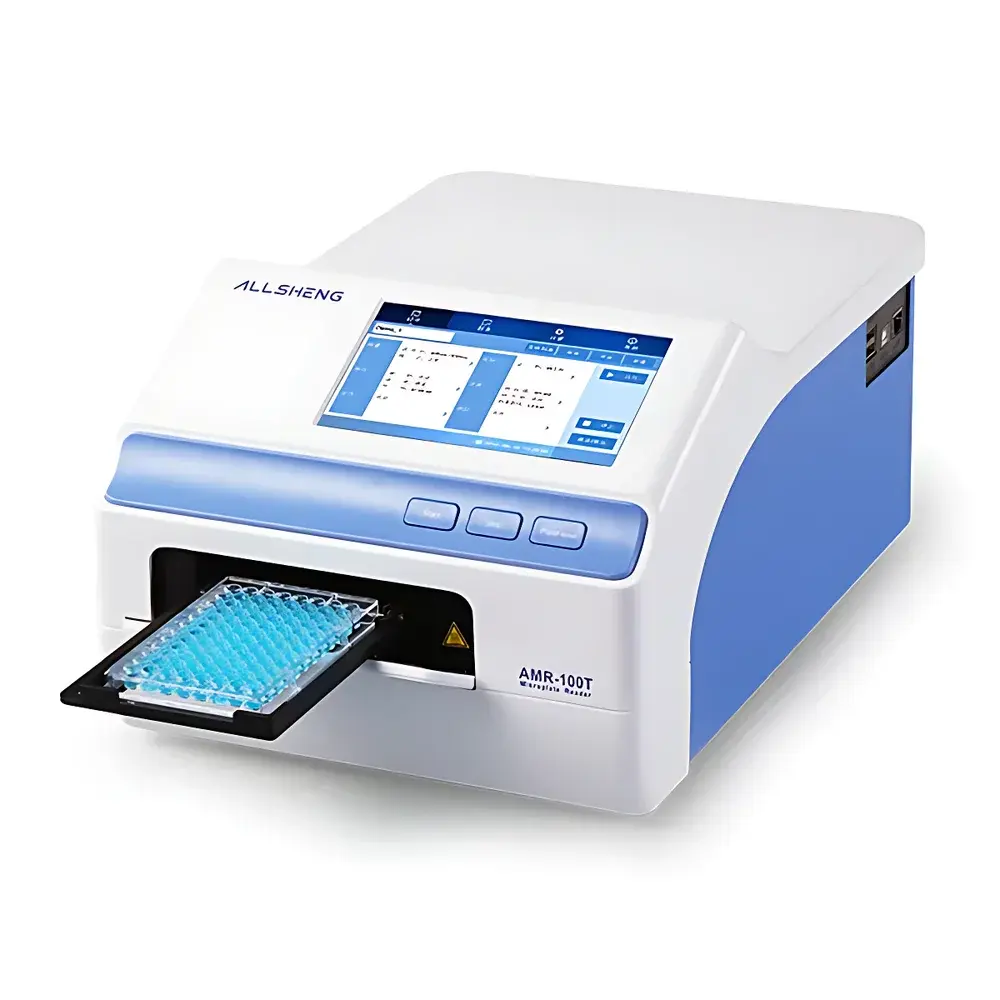
Allsheng AMR-100T Filter-Based Absorbance Microplate Reader
| Brand | Allsheng |
|---|---|
| Origin | Zhejiang, China |
| Model | AMR-100T |
| Detection Principle | Filter-based photometric absorbance |
| Wavelength Range | 340–750 nm |
| Absorbance Range | 0.000–4.000 Abs |
| Resolution | 0.001 Abs |
| Linearity (R²) | ≥0.995 (0–3.0 Abs) |
| Wavelength Accuracy | ≤±2 nm |
| Absorbance Precision (CV) | ≤0.3% (0–3 Abs), ≤1.0% (3–4 Abs) |
| Absorbance Stability | ≤0.005 Abs (0–3 Abs) |
| Absorbance Accuracy | ±0.005 Abs (0–2 Abs), ±0.01 Abs (2–3 Abs), ±1.5% (3–4 Abs) |
| Measurement Speed | 6 s/96-well (single wavelength, fast mode) |
| Filter Capacity | 8-position wheel (standard 4 filters: 405, 450, 492, 630 nm) |
| Incubation Function | Yes, 25°C to 50°C (RT + 4°C min) |
| Display | 7-inch capacitive touchscreen |
| Data Storage | Internal memory for 1000 protocols & results + USB export |
| Interfaces | 3× USB (host/device), supports printer, PC, and flash drive |
| Power | AC 100–240 V, 50–60 Hz, 2 A |
| Dimensions (W×D×H) | 295 × 440 × 225 mm |
| Weight | 10 kg |
Overview
The Allsheng AMR-100T is a high-performance, filter-based absorbance microplate reader engineered for precision quantification in enzyme-linked immunosorbent assay (ELISA), protein assays, cell viability studies, and other colorimetric applications. It operates on the principle of photometric absorbance measurement using a stable 6 V / 10 W halogen lamp as the broadband light source and a calibrated photodiode detector. Light passes through user-selected interference filters—mounted in an 8-position rotating wheel—to isolate specific wavelengths between 340 nm and 750 nm. This architecture ensures high spectral fidelity and minimal stray light, supporting compliance with internationally recognized photometric validation protocols including ASTM E275 and ISO 15195. Designed for routine laboratory use, the AMR-100T delivers robust performance across standard 96-well microplates with no requirement for external computing hardware, while maintaining full compatibility with GLP/GMP environments through audit-ready data handling and traceable calibration.
Key Features
- 7-inch high-resolution capacitive touchscreen interface enabling intuitive, keyboard-free operation and real-time parameter adjustment
- Integrated incubation module with programmable temperature control from ambient +4°C up to 50°C, eliminating the need for external plate warmers in kinetic ELISA or MTT assays
- Eight-position filter wheel with factory-installed 405 nm, 450 nm, 492 nm, and 630 nm filters—expandable with over 25 optional filters covering UV-Vis spectrum (340–750 nm)
- High-speed detection: completes full 96-well absorbance read in ≤6 seconds under fast mode; dual-wavelength measurements completed in <28 seconds
- Calibrated photodiode detector with sensitivity ≥0.01 Abs and resolution of 0.001 Abs across the full 0.000–4.000 Abs dynamic range
- Built-in software supports protocol creation, curve fitting (linear, 4PL, 5PL), QC flagging, and statistical analysis—including inter-plate and intra-plate CV calculation
- Onboard storage for up to 1000 measurement protocols and result sets, plus direct export via USB 2.0 to flash drives or printers
Sample Compatibility & Compliance
The AMR-100T is optimized for standard flat-bottom, U-bottom, and V-bottom 96-well polystyrene microplates compliant with ANSI/SBS standards. Its optical path geometry accommodates clear, white, and black plates for absorbance, luminescence (via optional upgrade), and fluorescence polarization modes (not enabled in base configuration). The instrument meets electromagnetic compatibility requirements per IEC 61326-1 and safety standards per IEC 61010-1. For regulated laboratories, the system supports ALCOA+ data integrity principles: all measurements are timestamped, user-logged, and stored with immutable metadata. Optional ReaderLT-I software enables 21 CFR Part 11-compliant electronic signatures, audit trails, and role-based access control—making it suitable for clinical research, quality control in biopharma, and contract testing laboratories operating under ISO/IEC 17025.
Software & Data Management
The embedded firmware provides complete standalone functionality: users create, save, and execute measurement protocols directly on-device without PC dependency. Protocols include wavelength selection, incubation timing, shaking parameters, endpoint vs. kinetic read modes, and multi-step wash-read cycles. Raw absorbance values, calculated concentrations, and fitted curves are displayed in real time and exportable as CSV or PDF reports. When connected to a Windows PC via USB, the optional ReaderLT-I software unlocks advanced capabilities: plate mapping visualization, batch processing of multiple runs, automated QC pass/fail evaluation against predefined limits, and integration with LIMS via ODBC or HL7 interfaces. All exported files retain full traceability—including operator ID, instrument serial number, calibration date, and environmental log (if external sensor is connected).
Applications
The AMR-100T serves core workflows across academic, clinical, and industrial life science labs. Primary applications include quantitative ELISA for cytokine profiling and infectious disease serology; Bradford/Lowry/BCA protein assays; cell proliferation and cytotoxicity assessments (e.g., MTT, XTT, CCK-8); microbial growth monitoring (OD600); and enzymatic activity kinetics (e.g., β-galactosidase, alkaline phosphatase). Its wide linear dynamic range (R² ≥ 0.995 up to 3.0 Abs) ensures accurate quantification of both low-abundance analytes and highly concentrated samples without dilution series. The integrated incubator further extends utility to temperature-sensitive assays such as thermal shift binding studies or time-resolved immunoassays requiring precise on-board reaction control.
FAQ
Does the AMR-100T support wavelength scanning or monochromator-based detection?
No—the AMR-100T uses fixed-wavelength interference filters only. It does not incorporate a monochromator or continuous scanning capability.
Can the instrument perform dual-wavelength correction automatically?
Yes—users can define primary and reference wavelengths during protocol setup; the system computes net absorbance (Aprimary − Areference) in real time.
Is calibration verification supported with certified reference materials?
Yes—optional ABS Optical Performance Validation Plate (AS-19011-03) enables periodic verification per CLSI EP17-A2 guidelines.
What is the maximum allowable plate height for compatible microplates?
The reader accommodates plates up to 21.5 mm in total height, including lid clearance.
Are firmware updates available, and how are they installed?
Firmware updates are distributed by Allsheng as signed .bin files and installed via USB drive following guided on-screen prompts.