
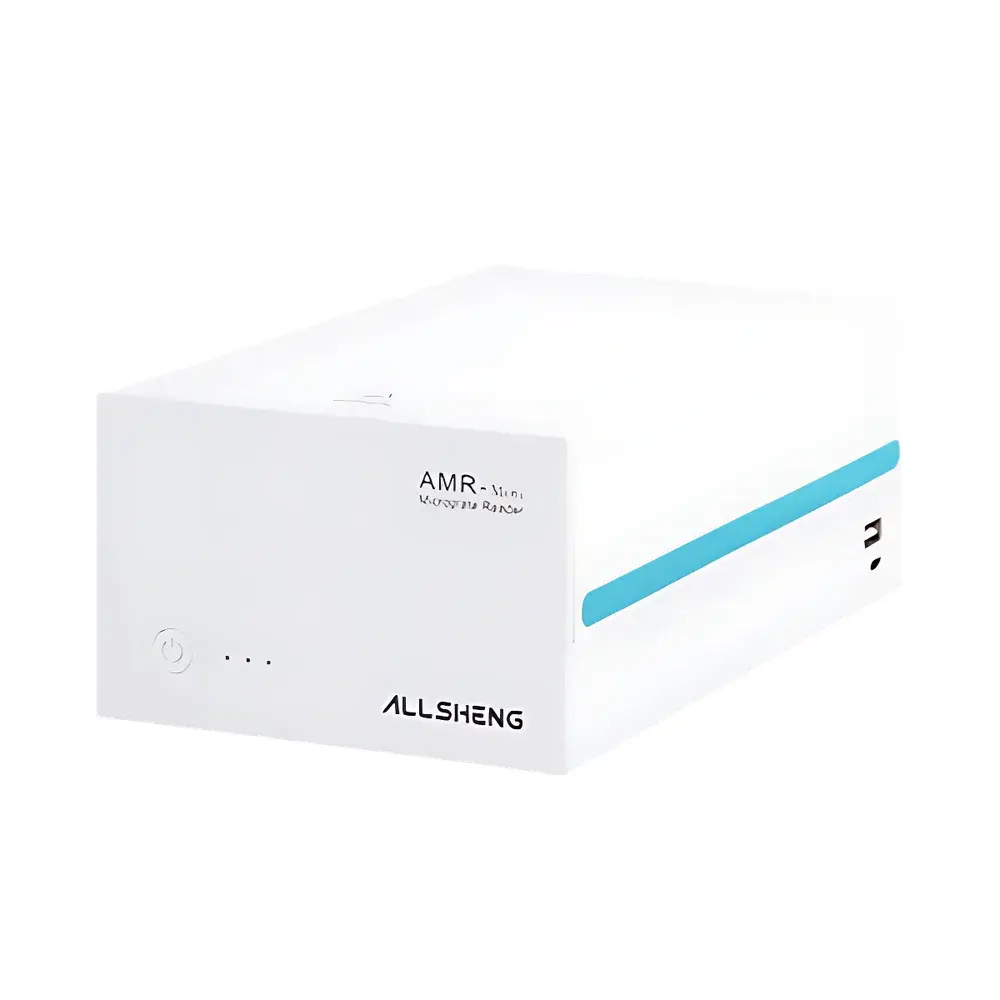
Allsheng AMR-Mini Microplate Reader
| Brand | Allsheng |
|---|---|
| Origin | Zhejiang, China |
| Model | AMR-Mini |
| Light Source | Dual high-stability LED (340–750 nm) |
| Detection Principle | Absorbance (Optical Density) |
| Standard Filters | 450/630 nm & 405/492 nm |
| Custom Filter Options | 340–750 nm (28 wavelengths available) |
| Detector | 9-photodiode array |
| Measurement Range | 0–4.0 Abs |
| Resolution | 0.001 Abs |
| Wavelength Accuracy | ≤ ±2 nm |
| Linearity | R² ≥ 0.995 (0.0–3.0 Abs) |
| Photometric Accuracy | ≤ ±(0.5% + 0.01 Abs) [0.0–2.0 Abs), ≤ ±(1.0% + 0.01 Abs) [2.0–3.0 Abs) |
| Precision (CV) | ≤ 0.5% [0–3.0 Abs) |
| Stability | ≤ 0.005 Abs [0.0–2.0 Abs) |
| Read Time | <15 s (single wavelength), <28 s (dual wavelength) for 96-well plate |
| Dimensions (W×D×H) | 135 × 225 × 89 mm |
| Weight | 2.0 kg |
| Power | USB-powered (12 V, 3 A) |
| Interface | 1 × USB-C, 1 × USB-A |
| Connectivity | Bluetooth 5.0, USB cable |
| Software | Cross-platform PC application (Windows 7/10 64-bit), bilingual UI (English/Chinese) |
| Optional Module | AMR-Mini T with integrated incubation (up to 45 °C) and orbital shaking (200–1,200 rpm) |
Overview
The Allsheng AMR-Mini Microplate Reader is an absorbance-based optical detection system engineered for precision endpoint and kinetic ELISA, protein quantification, cell viability assays (e.g., MTT, CCK-8), and other colorimetric microplate applications in academic research, clinical diagnostics development, and quality control laboratories. Operating on the principle of photometric absorbance measurement—where light attenuation through a sample well is quantified according to the Beer–Lambert law—the instrument delivers traceable, reproducible optical density (OD) data across the 340–750 nm spectral range. Its compact footprint (135 × 225 × 89 mm) enables seamless integration into space-constrained environments including biosafety cabinets, anaerobic chambers, and CO2 incubators—without compromising analytical rigor. The dual-LED illumination architecture, coupled with a dedicated reference photodiode channel, actively compensates for source drift and thermal fluctuation, ensuring long-term signal stability essential for multi-hour kinetic runs or high-throughput screening workflows.
Key Features
- Ultra-compact benchtop design: Occupies less than the area of two standard 96-well plates—ideal for modular lab setups, containment enclosures, and shared instrumentation spaces.
- Modular optical path: Interchangeable filter cartridges allow rapid reconfiguration between standard (450/630 nm, 405/492 nm) and custom wavelengths; 28 discrete filters spanning 340–750 nm are available as accessories.
- Dual high-stability LED sources: Low-power, thermally regulated LEDs eliminate warm-up delays and require no lamp replacement over the instrument’s operational lifetime.
- Reference-channel compensation: Real-time normalization against a dedicated photodiode reference beam corrects for intensity variance, enhancing inter-plate and intra-run reproducibility.
- Multi-mode detection capability: Supports single- and dual-wavelength endpoint reading, time-resolved kinetics (with programmable interval acquisition), and user-defined protocol sequencing.
- USB-powered operation: Eliminates need for external AC adapters—enables portable deployment and reduces electrical clutter in sensitive environments.
Sample Compatibility & Compliance
The AMR-Mini is validated for use with standard ANSI/SBS-compliant 96-well microplates (flat-bottom, U/V-bottom, and clear polystyrene). Its optical path geometry ensures uniform illumination and detection across all wells, minimizing edge effects and well-to-well variability. While not certified for IVD use under FDA 510(k) or CE-IVD directives, the system supports GLP- and GMP-aligned workflows via audit-trail-capable software logging (timestamped reads, user IDs, parameter revisions). Data output complies with common laboratory informatics standards—including CSV and Excel-compatible formats—and integrates with LIMS systems via exported structured files. Wavelength accuracy (≤ ±2 nm) and photometric linearity (R² ≥ 0.995 over 0.0–3.0 Abs) meet requirements outlined in ASTM E275, ISO 15197, and USP for spectrophotometric assay validation.
Software & Data Management
The AMR-Mini is controlled via a native Windows application (64-bit, Win7/Win10 compatible) featuring bilingual interface support (English/Chinese), intuitive protocol builder, and real-time graphing of kinetic traces. All measurement parameters—including wavelength selection, read order, incubation timing (AMR-Mini T), shaking speed/duration, and auto-zero calibration—are fully programmable and savable as reusable methods. Raw OD values, calculated concentrations (via 4-/5-parameter logistic or linear regression), and QC metrics (CV%, % recovery, Z’-factor) are stored with full metadata (operator ID, timestamp, instrument serial number). Bluetooth 5.0 and USB-C connectivity enable secure local data transfer without network dependency—critical for labs operating under air-gapped or HIPAA-compliant IT policies. Export options include PDF reports with embedded graphs and raw data tables compliant with 21 CFR Part 11–ready documentation practices when paired with institutional electronic signature protocols.
Applications
- Enzyme-linked immunosorbent assay (ELISA) quantification (IgG, cytokines, hormones)
- Cell proliferation and cytotoxicity assays (MTT, XTT, WST-1, CCK-8)
- Microbial growth monitoring (OD600)
- Protein concentration determination (Bradford, BCA, Lowry)
- Enzyme activity kinetics (e.g., β-galactosidase, LDH, ALP)
- Antibody titer analysis and vaccine potency testing
- High-content screening (HCS) pre-validation and secondary assay support
FAQ
Does the AMR-Mini support temperature-controlled measurements?
Yes—the AMR-Mini T variant integrates a Peltier-based incubation module (range: ambient +5 °C to 45 °C, ±0.5 °C accuracy) and programmable orbital shaking (200–1,200 rpm, 1–3 mm amplitude) for on-instrument kinetic assays requiring thermal regulation.
Can I validate the instrument per regulatory guidelines?
The AMR-Mini provides traceable photometric performance aligned with ASTM E275 and ISO 15197. Users may perform in-house verification using NIST-traceable neutral density filters and certified reference standards; full validation documentation templates are available upon request.
Is remote operation supported?
No remote desktop or cloud access is built-in; however, Bluetooth and USB-C interfaces enable local wireless or wired control from a nearby laptop—ensuring data sovereignty and compatibility with restricted network architectures.
How are filter changes performed?
Filter cartridges are tool-free and hot-swappable: simply open the front-access optical bay, eject the current cartridge, and insert the new wavelength-specific module—no recalibration required.
What is the maximum data retention capacity?
Data storage resides on the host PC; the instrument itself does not retain historical reads. Method files and export logs scale with available disk space on the controlling workstation.




