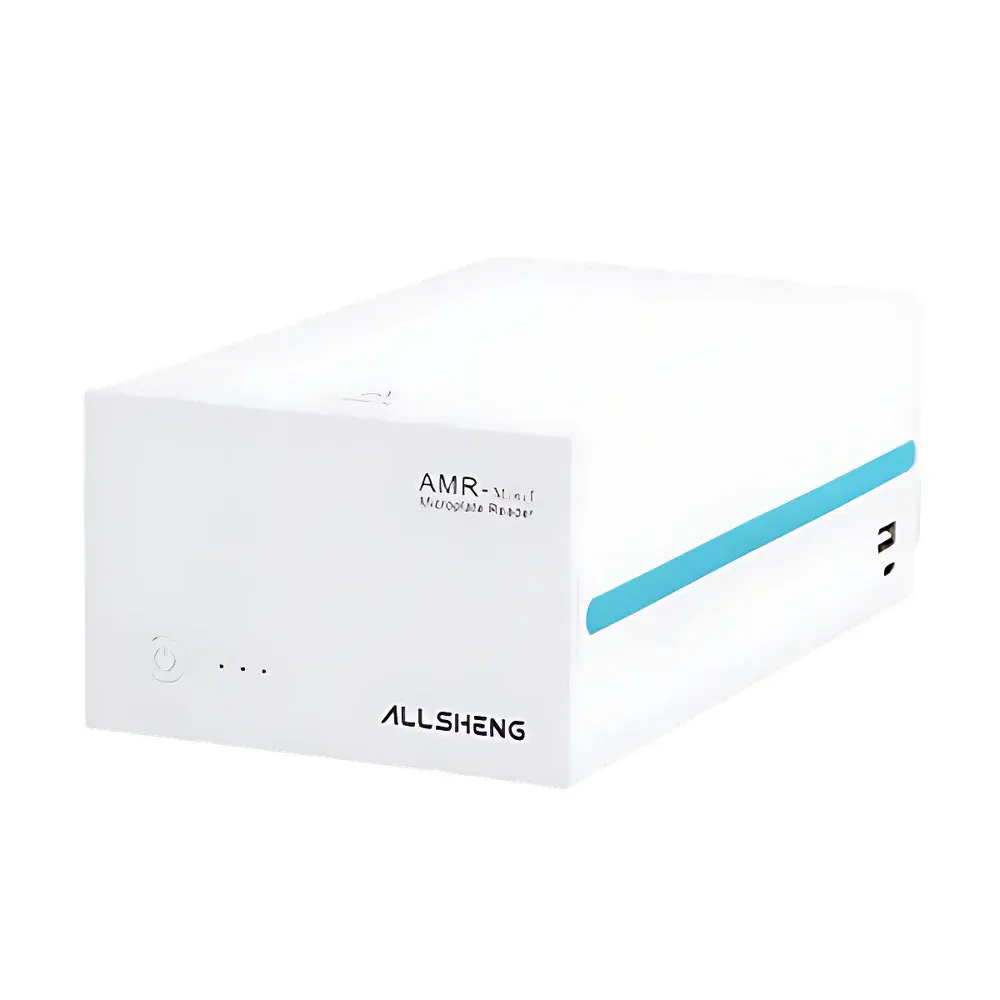
Allsheng AMR-Mini T Microplate Reader with Integrated Incubation
| Brand | Allsheng |
|---|---|
| Model | AMR-Mini T |
| Detection Principle | Absorbance (Optical Density) |
| Wavelength Range | 340–750 nm |
| Standard Filters | 450/630 nm & 405/492 nm |
| Optional Filters | 340–750 nm (28 discrete wavelengths available) |
| Light Source | Dual high-stability LED |
| Detector | 9-photodiode array |
| Measurement Modes | Endpoint, Kinetic, Dual-Wavelength |
| Absorbance Range | 0–4.0 Abs |
| Resolution | 0.001 Abs |
| Accuracy | ≤±(0.5% + 0.01 Abs) @ 0.0–2.0 Abs |
| Linearity | R² ≥ 0.995 (0.0–3.0 Abs) |
| Repeatability | CV ≤ 0.5% (0–3.0 Abs) |
| Stability | ≤0.005 Abs (0.0–2.0 Abs) |
| Read Time | <15 s (single-wavelength, 96-well), <28 s (dual-wavelength, 96-well) |
| Incubation Temp Range | RT+4°C to 45°C |
| Dimensions (W×D×H) | 135 × 245 × 91 mm |
| Weight | 2.5 kg |
| Interface | USB-A, USB-C, Bluetooth 5.0 |
| Power | 12 V DC, 3 A |
| Software | Cross-platform PC application (Windows 7/10 64-bit) and mobile app (iOS/Android), bilingual UI (English/Chinese) |
| Compliance | Designed per ISO 15197:2013 and CLSI EP17-A2 guidelines for quantitative absorbance-based immunoassays |
Overview
The Allsheng AMR-Mini T Microplate Reader is an integrated absorbance-based microplate detection system engineered for precision, portability, and workflow flexibility in life science laboratories. It operates on the principle of photometric absorbance measurement—quantifying optical density (OD) at user-selectable wavelengths between 340 nm and 750 nm—to support ELISA, cell viability assays (e.g., MTT, CCK-8), protein quantification (Bradford, BCA), and enzyme activity profiling. Unlike conventional benchtop readers, the AMR-Mini T embeds a thermally regulated incubation module directly into its compact chassis, enabling real-time kinetic monitoring without external environmental control. Its dual-LED illumination architecture—paired with a nine-channel photodiode array and reference-light-path compensation—ensures high photometric reproducibility across heterogeneous sample matrices and extended assay durations. The instrument’s mechanical footprint (135 × 245 × 91 mm) permits deployment inside biosafety cabinets, anaerobic chambers, or standard CO₂ incubators—addressing critical spatial constraints in high-density lab environments.
Key Features
- Integrated temperature-controlled incubation (RT+4°C to 45°C) with ±0.5°C uniformity across 96-well plates, eliminating need for external incubators during kinetic ELISAs.
- Modular optical design: Interchangeable filter cartridges allow rapid reconfiguration for custom wavelength pairs; 28 factory-calibrated filters available from 340 nm to 750 nm.
- Dual high-output LEDs with thermal stabilization ensure consistent intensity over >50,000 hours—no lamp replacement or alignment required.
- Reference-light-path channel continuously monitors source drift and compensates raw signal in real time, improving long-term baseline stability.
- High-speed acquisition: Full 96-well plate read completed in under 15 seconds (single wavelength) or 28 seconds (dual wavelength), minimizing assay turnaround time.
- Low-power architecture (12 V DC input) enables battery-powered operation via compatible power banks—ideal for field-deployable diagnostics or mobile labs.
Sample Compatibility & Compliance
The AMR-Mini T supports standard ANSI/SBS-compliant 96-well microplates—including flat-bottom, U-bottom, and V-bottom formats—as well as opaque, clear, and UV-transparent polystyrene and polypropylene plates. It accommodates common assay chemistries requiring absorbance detection at key immunodiagnostics wavelengths (e.g., 405 nm for TMB substrate, 450 nm for ELISA endpoint, 492 nm for alkaline phosphatase, 630 nm for background correction). Instrument firmware and software are structured to support audit-ready workflows: data files include embedded timestamps, operator IDs, plate maps, and full metadata (wavelength, gain, integration time). While not FDA-cleared as an IVD device, the system’s optical performance aligns with CLSI EP17-A2 limits for imprecision and linearity, and its design follows ISO 15197:2013 principles for quantitative in vitro diagnostic measurements. Traceable calibration is supported via optional NIST-traceable OD standards (not included).
Software & Data Management
The AMR-Mini T ships with two complementary software platforms: a Windows-native desktop application (64-bit, Win7/Win10) and a cross-platform mobile app (iOS/Android). Both interfaces provide bilingual (English/Chinese) configuration, protocol templating, real-time curve fitting (linear, 4PL, 5PL), and automated cutoff calculation per CLIA or laboratory-defined thresholds. Raw absorbance values, processed concentrations, and QC metrics (CV%, % recovery, linearity R²) are exportable in CSV, Excel (.xlsx), and PDF report formats. Bluetooth 5.0 and USB-C connectivity enable seamless data synchronization without driver installation. All software modules enforce role-based access control (admin/user modes), automatic session logging, and immutable audit trails—including parameter changes, result edits, and export events—supporting GLP and GMP-aligned documentation requirements. No cloud storage is enabled by default; all data remain local unless explicitly exported by the user.
Applications
- Quantitative ELISA for infectious disease serology (e.g., anti-SARS-CoV-2 IgG, HIV p24 antigen).
- Kinetic monitoring of β-galactosidase reporter assays in promoter activity studies.
- Cell proliferation and cytotoxicity screening using tetrazolium-based (MTT, XTT) or resazurin (AlamarBlue) dyes.
- Enzyme kinetics (e.g., LDH, HRP, AP) under controlled thermal conditions to assess inhibitor potency (IC₅₀).
- Quality control of monoclonal antibody production batches via indirect ELISA and titer determination.
- Point-of-care research settings where space, power, or environmental control is limited—e.g., field clinics, biorepository satellite labs, or teaching laboratories.
FAQ
Does the AMR-Mini T support wavelength scanning or spectral acquisition?
No. It is a fixed-wavelength filter-based reader, not a monochromator-based spectrophotometer. Wavelength selection is discrete and requires physical filter insertion.
Can the incubation function be disabled for ambient-temperature-only protocols?
Yes. Temperature control is fully software-disabling; the instrument defaults to ambient measurement mode unless incubation is explicitly activated.
Is the software compliant with 21 CFR Part 11 for electronic records and signatures?
The current release provides audit trail functionality and user authentication but does not include electronic signature modules or system validation documentation required for full Part 11 compliance. Validation packages are available upon request for regulated environments.
What is the maximum allowable plate height for compatibility with the incubation chamber?
The internal chamber accommodates plates up to 21 mm tall—including lid-on configurations for evaporation-sensitive assays.
Are calibration certificates traceable to NIST or other national metrology institutes?
Factory calibration uses internal reference standards. NIST-traceable OD verification kits (e.g., 0.5, 1.0, 2.0 Abs) can be ordered separately for user-performed periodic verification.