
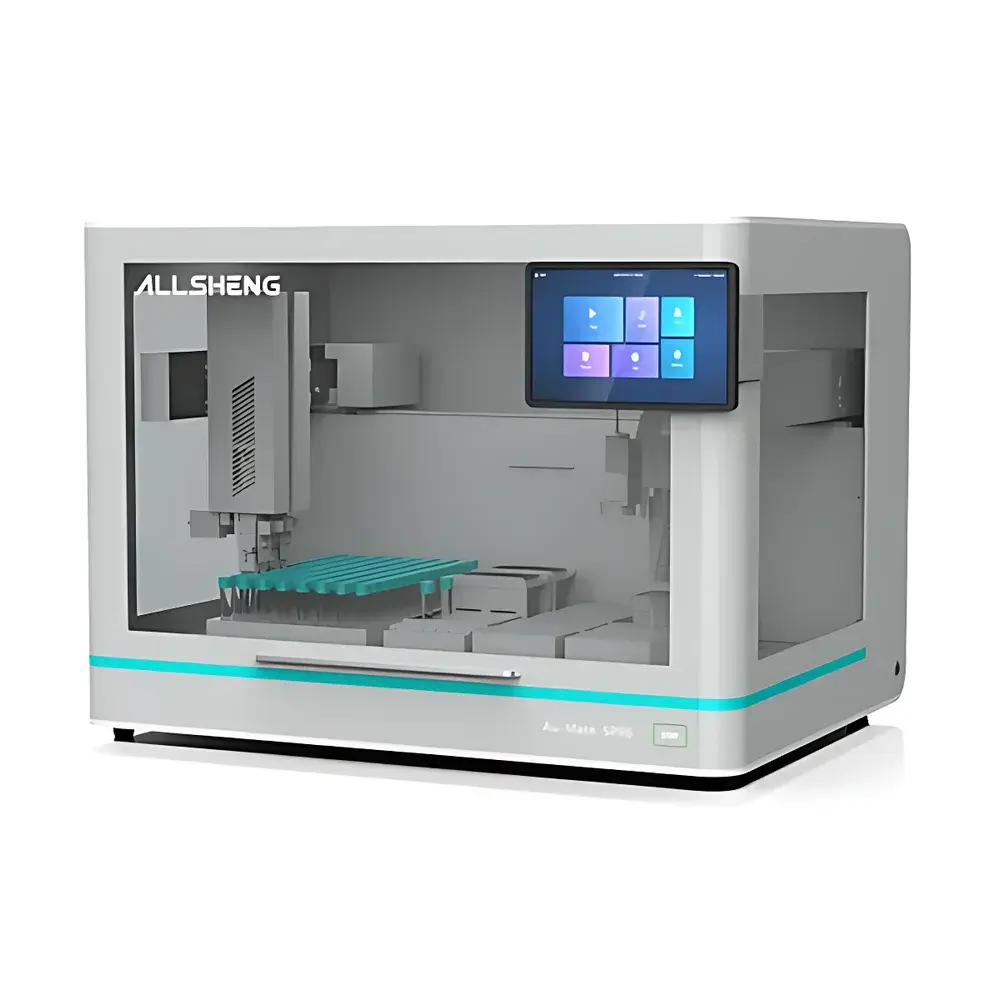
Allsheng Au-Mate SP96A Automated Sample Aliquoting System
| Brand | Allsheng |
|---|---|
| Origin | Zhejiang, China |
| Manufacturer Type | Authorized Distributor |
| Country of Origin | China |
| Model | Au-Mate SP96A |
| Pricing | Available Upon Request |
| Throughput | 1–96 samples per run |
| Sample Tube Capacity | 5–30 mL |
| Mixing Mode | Integrated orbital shaking on sample racks |
| Deep-Well Plate Slots | Up to 6 × 96-well plates |
| Tip Capacity | Up to 2 tip boxes |
| Reagent Dispensing | Yes (e.g., magnetic beads, Proteinase K, internal controls) |
| Pipetting System | Dual single-channel 1000 µL pipettors |
| Lid Handling | Dual robotic lid handlers |
| Cycle Time | ≤20 min for 96 samples |
| Pipetting Range | 1–1000 µL |
| Precision (CV) | ≤8.0% at 1 µL, ≤2.5% at 2 µL, ≤0.5% at 100/500 µL, ≤0.3% at 1000 µL |
| Accuracy | ±12% at 1 µL, ±5% at 2 µL, ±2% at 100 µL, ±1% at 500/1000 µL |
| Liquid Level Detection | Pneumatic + capacitive sensing with clog/leak detection |
| Swab Avoidance | Yes — automated swab position recognition and aspiration path adjustment |
| Contamination Control | HEPA filtration + UV-C sterilization chamber |
| Operating System | Android-based tablet interface |
| Predefined Protocols | 32-sample & 96-sample aliquoting modes |
| Connectivity | USB port, CAN bus interface |
| LIS Integration | Supported via configurable HL7 or ASTM interface |
| Power Supply | 100–240 VAC, 50/60 Hz, 400 W nominal |
Overview
The Allsheng Au-Mate SP96A is an automated sample aliquoting system engineered for high-integrity pre-analytical processing in clinical diagnostics and public health laboratories. It implements a closed-loop, walk-away workflow that integrates barcode-driven sample registration, robotic tube opening/closing, precision liquid handling, and contamination-mitigated dispensing—designed specifically for nucleic acid testing (NAT) workflows under time-sensitive regulatory frameworks such as 48-hour turnaround mandates. The system operates on a dual-pipettor architecture with pneumatic-capacitive liquid level detection, enabling reliable aspiration from heterogeneous sample matrices—including nasopharyngeal swabs suspended in viral transport media—while dynamically avoiding physical interference with swab shafts. Its mechanical design prioritizes reproducibility across variable tube geometries (5–30 mL), with integrated rack-level orbital shaking ensuring homogenization prior to aspiration. Unlike benchtop pipetting aids, the SP96A embeds process control logic directly into hardware sequencing, reducing manual intervention points and supporting audit-ready operation in GLP- and CLIA-aligned environments.
Key Features
- Dual independent 1000 µL single-channel pipettors with real-time pressure and capacitance-based liquid level sensing—enabling adaptive aspiration depth adjustment and automatic clog/leak detection.
- Swab-aware aspiration algorithm: identifies swab presence via optical pattern recognition and recalculates pipette tip trajectory to prevent contact during sample withdrawal.
- Integrated orbital shaker built into sample tube racks—programmable duration and frequency for uniform suspension of viscous or particulate-laden specimens before aliquoting.
- Modular deep-well plate staging: accommodates up to six 96-well deep-well plates (e.g., for master mix distribution, extraction buffer loading, or post-extraction storage).
- HEPA-filtered negative-pressure laminar flow cabinet combined with 254 nm UV-C irradiation cycles between runs—validated for ≥3-log reduction of airborne RNAse/DNAse and microbial contaminants.
- Two robotic lid handlers with torque-sensing feedback ensure consistent opening/closing force across diverse screw-cap tube types without cross-threading or seal damage.
- Android-based 10.1″ touchscreen HMI with intuitive drag-and-drop protocol builder—supports version-controlled protocol libraries and electronic signature capture for SOP compliance.
Sample Compatibility & Compliance
The Au-Mate SP96A accepts primary collection tubes ranging from 5 mL to 30 mL, including conical-bottom, round-bottom, and screw-cap variants commonly used in respiratory virus surveillance (e.g., COPAN UTM®, BD VTM™). It natively supports pooled testing configurations—5-in-1, 10-in-1, and 20-in-1—via configurable pooling logic embedded in the control firmware. Each pooling event logs tube barcode, destination well address, and volume dispensed with timestamped metadata, satisfying traceability requirements under ISO 15189:2022 Clause 5.9 and CLSI EP22-A. The system’s contamination mitigation subsystem—including tip retraction algorithms, disposable liquid catch trays, and UV/HEPA decontamination cycles—is documented in the manufacturer’s Risk Management File (ISO 14971:2019 compliant) and validated per IEC 61010-1 for laboratory equipment safety.
Software & Data Management
Control software runs on a locked-down Android 11 OS with FIPS 140-2 validated cryptographic modules for secure data transmission. All sample events—including scan timestamps, pipette calibration logs, error flags, and maintenance alerts—are stored locally in SQLite databases with SHA-256 hashing and daily encrypted backup to external USB drives. LIS integration follows ASTM E1384 and HL7 v2.5.1 standards, allowing bidirectional exchange of accession numbers, patient IDs, test orders, and result status codes. Audit trail functionality complies with FDA 21 CFR Part 11 requirements: all user actions are immutable, time-stamped, and linked to unique operator credentials with role-based access control (RBAC). Protocol versions are digitally signed and cannot be modified without administrative override and secondary approval.
Applications
- Clinical NAT preprocessing: high-throughput aliquoting of swab eluates into extraction plates prior to automated RNA isolation.
- Surveillance testing programs: scalable pooling execution for community-level SARS-CoV-2, influenza A/B, RSV, and MPXV screening.
- Bio-banking operations: standardized division of biobank specimens into cryovials or deep-well plates under controlled temperature conditions (when integrated with ambient or refrigerated enclosures).
- QC/QA workflows: preparation of calibration curves, dilution series, and positive/negative controls with volumetric consistency across batches.
- Microbiology labs: transfer of enriched broth cultures into antimicrobial susceptibility testing (AST) panels or MALDI-TOF target plates.
FAQ
Does the SP96A support integration with major LIS platforms such as Epic or Cerner?
Yes—via configurable HL7 v2.5.1 or ASTM interfaces; implementation requires site-specific mapping tables and validation by the laboratory’s IT team.
Can users modify pipetting parameters like aspiration speed or dispense height?
Yes—advanced settings are accessible under administrator mode and persist across power cycles; changes are logged in the audit trail.
Is the UV-C lamp intensity monitored and calibrated periodically?
UV irradiance is measured quarterly using NIST-traceable radiometers; calibration certificates are stored in the device’s maintenance log.
What happens if a tube cap is misaligned or over-torqued during opening?
The lid handler applies adaptive torque profiling and halts motion upon detecting abnormal resistance, triggering an alert and logging the incident for root-cause analysis.
Are consumables such as tips and catch trays supplied with traceable lot numbers?
Yes—all consumables shipped with the system include ISO/IEC 17025-certified CoA documents with lot-specific performance verification data.



