
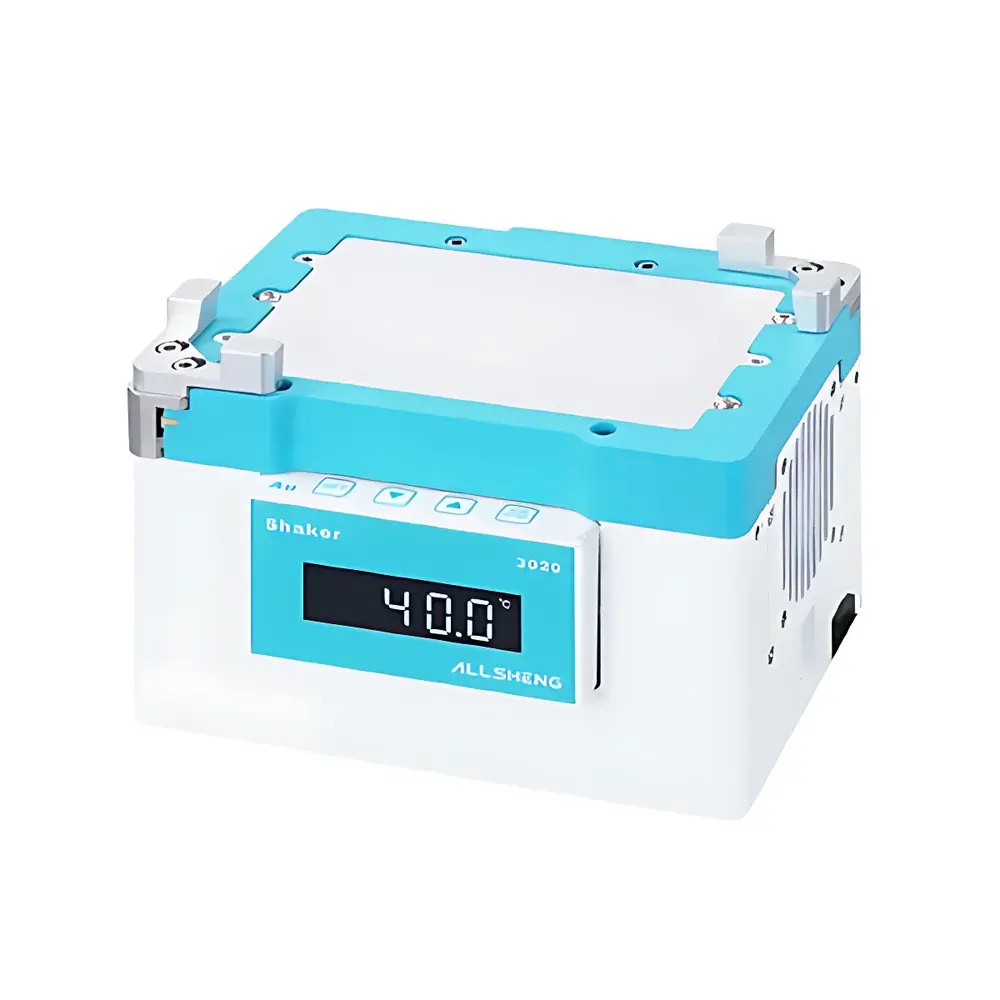
Allsheng Au-Shaker 5012L/3020L/2030L Automated Microplate Shaker with Edge-Locking Clamp and CAN-Enabled Integration
| Brand | Allsheng |
|---|---|
| Origin | Zhejiang, China |
| Model | Au-Shaker 5012L/3020L/2030L |
| Rotation Speed Range | 200–5000 rpm / 200–3000 rpm / 200–2000 rpm |
| Orbital Diameter | 1.2 mm / 2.0 mm / 3.0 mm |
| Timing Range | 99 h 59 min or 99 min 59 s |
| Speed Accuracy | ±7.5 rpm |
| Acceleration Time | 1–10 s |
| Zero-Positioning Accuracy | ±0.1 mm |
| Auto-Clamping Positioning Accuracy | ±0.1 mm |
| Power Input | 24 V DC, 48 W |
| Communication Interface | DB9 connector, CAN bus protocol |
| Dimensions (W×D×H) | 142 × 105 × 94 mm |
| Weight | 1.8 kg |
Overview
The Allsheng Au-Shaker 5012L/3020L/2030L is an engineered orbital microplate shaker designed for seamless integration into automated liquid handling workflows. Unlike conventional benchtop shakers, this series implements a precision-engineered edge-locking clamping mechanism that enables robotic grippers to reliably load and unload microplates without manual intervention. Each model operates on the principle of controlled orbital motion—generating uniform, low-shear agitation through precisely regulated eccentric rotation—ensuring consistent mixing across high-density formats including 96-, 384-, and 1536-well plates, as well as 0.5–2.5 mL deep-well plates and PCR plates. The system’s mechanical architecture supports bidirectional synchronization with laboratory automation platforms via industrial-grade CAN bus communication (ISO 11898-1 compliant), making it suitable for GLP-compliant assay preparation, ELISA plate conditioning, cell-based assay homogenization, and nucleic acid extraction workflows where reproducibility and traceability are critical.
Key Features
- Edge-locking automatic clamping mechanism ensures repeatable, hands-free microplate loading/unloading with ±0.1 mm positioning accuracy
- Three model variants optimized for distinct throughput and format requirements: Au-Shaker 5012L (1.2 mm amplitude, up to 5000 rpm) for ultra-high-density 384/1536-well plates; Au-Shaker 3020L (2.0 mm amplitude, up to 3000 rpm) and Au-Shaker 2030L (3.0 mm amplitude, up to 2000 rpm) for standard 96-well and deep-well applications
- Zero-position auto-homing function with sub-millimeter repeatability (±0.1 mm), enabling deterministic coordinate alignment for robotic arm integration
- Dual mounting holes (left and right side) allow rigid fixation onto liquid handling workstations, minimizing vibration transmission and improving positional stability during simultaneous pipetting and shaking
- Integrated OLED display supports standalone operation with intuitive parameter entry—speed, time, and amplitude selection—without external control software
- 24 V DC power architecture with 48 W nominal consumption ensures compatibility with standard lab automation power distribution systems and eliminates AC line noise interference
Sample Compatibility & Compliance
The Au-Shaker series accommodates standardized ANSI/SLAS-format microplates (SBS-compliant), including skirted, semi-skirted, and unskirted variants. It maintains mechanical compatibility with common plate materials—polypropylene, polystyrene, and cyclic olefin copolymer (COC)—without risk of warping or slippage under dynamic load. The clamping force is calibrated to avoid deformation of thin-walled PCR plates while ensuring secure retention at maximum rotational speeds. From a regulatory standpoint, the device’s CAN interface supports audit-trail-capable command logging when integrated with LIMS or ELN systems compliant with FDA 21 CFR Part 11 requirements. Its electromagnetic emissions conform to CISPR 11 Group 1 Class B limits, and mechanical safety meets ISO 13857 clearance specifications for automated equipment interfacing.
Software & Data Management
While fully functional as a stand-alone instrument, the Au-Shaker series is architected for interoperability within distributed automation environments. The CAN 2.0B interface (bit rate configurable up to 500 kbps) enables real-time status polling—including current speed, elapsed time, clamp state, and error codes—as well as synchronous start/stop commands synchronized to pipetting cycles. All communication follows a documented command set (available in datasheet Rev. 3.2), supporting deterministic timing for time-critical assays such as kinetic enzymatic reactions or thermal pre-incubation steps. When deployed in validated environments, the shaker’s firmware records timestamped operational events—including zero-position calibration cycles and clamp actuation sequences—to internal non-volatile memory, facilitating retrospective review during GMP audits. Optional SDKs provide Python and LabVIEW drivers for custom script integration.
Applications
- High-throughput screening (HTS) plate homogenization prior to detection readout
- Uniform resuspension of lyophilized reagents in multi-well assay development
- Cell dissociation and suspension maintenance during automated passaging protocols
- Antibody-antigen binding equilibration in immunoassay plate preparation
- Consistent mixing of viscous samples (e.g., glycerol-stabilized enzymes or genomic DNA solutions) across variable well volumes
- Integration into sample-to-answer NGS library prep workflows requiring timed agitation between enzymatic steps
FAQ
What microplate formats are supported by each model?
Au-Shaker 5012L is optimized for 384- and 1536-well plates; Au-Shaker 3020L and 2030L support 96-well, 384-well, 0.5–2.5 mL deep-well, and standard PCR plates.
Is the zero-positioning function mandatory for robotic integration?
Yes—the auto-homing routine establishes a fixed mechanical reference point required for repeatable robotic plate placement and clamp engagement.
Can the shaker operate without CAN communication?
Yes—all models feature an onboard OLED interface and rotary encoder for full local control independent of external systems.
What is the maximum allowable plate weight per model?
Each variant supports up to 250 g total plate mass, including liquid load, without compromising clamp integrity or orbital stability.
Does the device meet electromagnetic compatibility (EMC) standards for use in regulated labs?
Yes—it complies with CISPR 11 and IEC 61326-1 for laboratory equipment, with conducted and radiated emission testing performed per EN 61000-6-3.



