
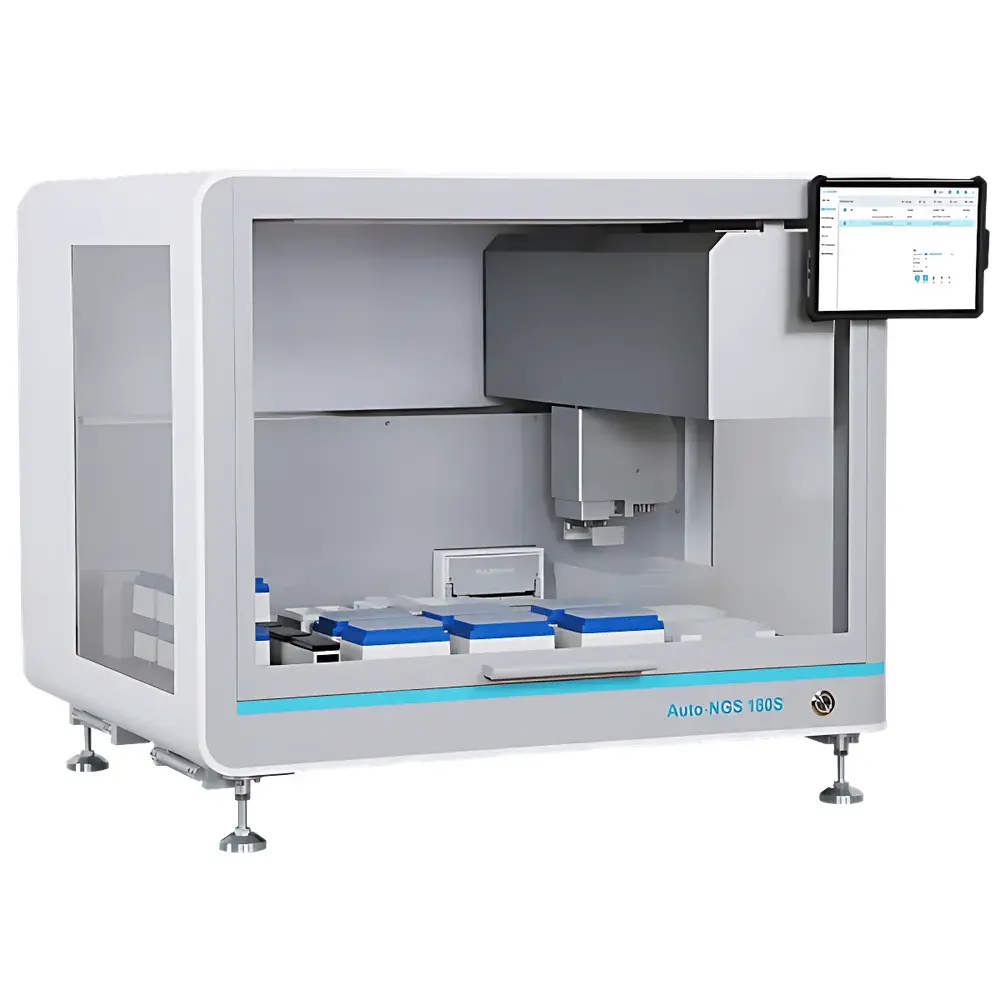
ALLSHENG Auto-NGS 180S Automated NGS Library Preparation System
| Brand | ALLSHENG |
|---|---|
| Origin | Zhejiang, China |
| Model | Auto-NGS 180S |
| Sample Throughput | 8–24 samples per run (full automation) |
| Pipetting Channels | 24-channel adjustable (1/8/16/24-channel modes) |
| Pipetting Range | 0.5–200 µL |
| Accuracy (A) | ±10% at 0.5 µL, ±2% at 20 µL, ±1% at 100/200 µL |
| Precision (CV) | ≤5% at 0.5 µL, ≤2% at 20 µL, ≤1% at 100/200 µL |
| Minimum Sample Volume for Fluorometric Quantification | 2 µL |
| dsDNA Detection Limit | 0.4 ng |
| Fluorescence Module | 24-well integrated fluorometer, CV ≤1.5% repeatability |
| Thermal Modules | Dual 4–105 °C refrigeration units (±0.5 °C accuracy/uniformity), one heating module (RT–105 °C), one heating-shaking module (RT–105 °C, 200–3000 RPM, 2 mm orbit), one PCR thermal cycler (block: 4–99 °C, lid: 30–120 °C, uniformity ±0.7 °C, accuracy ≤±0.3 °C) |
| Magnetic Bead Purification | 96-well circular magnetic stand (compatible with PCR/deep-well plates) |
| Tip Capacity | Up to 10 tip boxes (6 single-layer + 2 double-layer positions) |
Overview
The ALLSHENG Auto-NGS 180S is an integrated, benchtop automated workstation engineered for end-to-end next-generation sequencing (NGS) library preparation — from nucleic acid fragmentation and end-repair to adapter ligation, size selection, PCR amplification, and fluorometric quantification. Unlike modular or semi-automated platforms, the Auto-NGS 180S embeds core functional modules—including a 24-channel precision pipettor, dual refrigerated reagent storage, thermocycling, heating-shaking incubation, magnetic bead-based purification, and a dedicated 24-well fluorescence detection system—within a compact footprint (≤0.8 m²). Its architecture follows the “sample-in, library-out” paradigm: raw DNA/RNA extracts are loaded into standardized SBS-format plates; all enzymatic, thermal, and quantification steps execute sequentially under programmable protocol control, eliminating manual tube transfers, pipette reconfiguration, or off-instrument QC checks. This design reduces hands-on time by >85% compared to manual workflows while maintaining compatibility with major commercial NGS library prep kits (e.g., Illumina TruSeq, NEBNext, Agilent SureSelect) and supporting both whole-genome and targeted capture workflows.
Key Features
- Adaptive 24-channel pipetting system: Configurable for 1-, 8-, 16-, or 24-channel operation with simultaneous support for 20 µL, 50 µL, and 200 µL tip formats. Integrated capacitive and pressure-based liquid level sensing enables reliable aspiration/dispense across viscous, foaming, or low-volume samples (minimum detectable volume: 20 µL).
- Integrated fluorometric quantification: On-deck 24-well fluorescence module uses dsDNA-specific dyes (e.g., Qubit-compatible reagents) to deliver concentration data within 90 seconds per batch. With only 2 µL input, it achieves quantification down to 0.4 ng and meets ISO/IEC 17025 traceability requirements for calibration verification.
- Dual-refrigerated reagent management: Two independent 4–105 °C cooling zones maintain enzyme stability and prevent thermal degradation of temperature-sensitive reagents (e.g., ligases, polymerases) throughout multi-hour protocols.
- Unified liquid handling & plate manipulation: A single robotic arm performs both pipetting and plate transport — including stacking, unstacking, and inter-module transfer — reducing mechanical complexity and minimizing carryover risk. Plate stack management logic automatically allocates fresh and waste plates per protocol phase.
- Modular thermal control architecture: Independent heating-shaking, PCR cycling, and incubation modules operate concurrently without cross-interference. All thermal zones meet ASTM E2525-22 criteria for temperature uniformity (±0.5 °C) and stability (±0.3 °C over 30 min).
Sample Compatibility & Compliance
The Auto-NGS 180S accepts input nucleic acids from diverse sources — FFPE tissue, plasma cfDNA, cultured cells, and microbial isolates — and supports DNA and RNA library construction for Illumina, Ion Torrent, and MGI platforms. It accommodates standard SBS-compliant consumables: 96-well PCR plates, deep-well plates (0.5–2.2 mL), and strip tubes (0.2 mL). The system complies with ISO 13485:2016 for in vitro diagnostic device manufacturing environments and supports audit-ready electronic records per FDA 21 CFR Part 11 when paired with validated LIMS integration. All thermal modules undergo quarterly performance verification using NIST-traceable PT100 sensors; fluorescence module linearity is verified against certified dsDNA standards (0.4–100 ng/µL).
Software & Data Management
Controlled via ALLSHENG’s NGS-Link software (v3.2+), the platform provides drag-and-drop protocol builder, real-time run monitoring with event logging, and automatic generation of PDF-formatted run reports containing timestamped thermal profiles, pipetting logs, fluorescence readings, and QC flags. Raw fluorescence data exports in CSV/Excel format with metadata tags (sample ID, reagent lot, operator, instrument serial number). Software supports role-based access control (RBAC), electronic signatures, and full audit trail retention for ≥10 years — fulfilling GLP/GMP documentation requirements. Optional API integration enables bidirectional communication with laboratory information management systems (LIMS) and enterprise resource planning (ERP) platforms.
Applications
- Automated construction of whole-exome, targeted panel, and RNA-seq libraries for oncology biomarker discovery and clinical trial screening.
- High-fidelity cfDNA library prep with dual-indexing and unique molecular identifier (UMI) incorporation for liquid biopsy applications.
- Standardized library normalization prior to multiplexed sequencing runs — reducing inter-run variability in core facilities.
- Reproducible small RNA library preparation with 3′-adapter ligation optimization and size-selection control.
- Validation-ready workflows compliant with CAP/CLIA-accredited molecular pathology labs.
FAQ
Does the Auto-NGS 180S support custom protocol development?
Yes — NGS-Link includes a script editor supporting Python-based macro definitions for non-standard enzymatic steps, conditional branching, and external hardware triggers.
Can the fluorescence module be calibrated for alternative dyes (e.g., PicoGreen, RiboGreen)?
Yes — users may import custom calibration curves using reference standards; factory-default curves cover Qubit dsDNA HS/SS assays.
What maintenance is required for long-term reliability?
Quarterly tip ejector alignment verification, biannual pipette accuracy validation per ISO 8655-6, and annual thermal sensor recalibration using certified reference probes.
Is remote monitoring supported?
Yes — optional secure VPN-enabled web interface allows real-time status viewing, alarm notifications, and emergency pause/resume from offsite locations.
How does the system handle carryover prevention between samples?
Tip washing protocols (air-dry + ethanol rinse) are embedded in every transfer step; positive-displacement tips are supported for high-viscosity samples; UV-C irradiation of deck surfaces is available as an add-on module.





