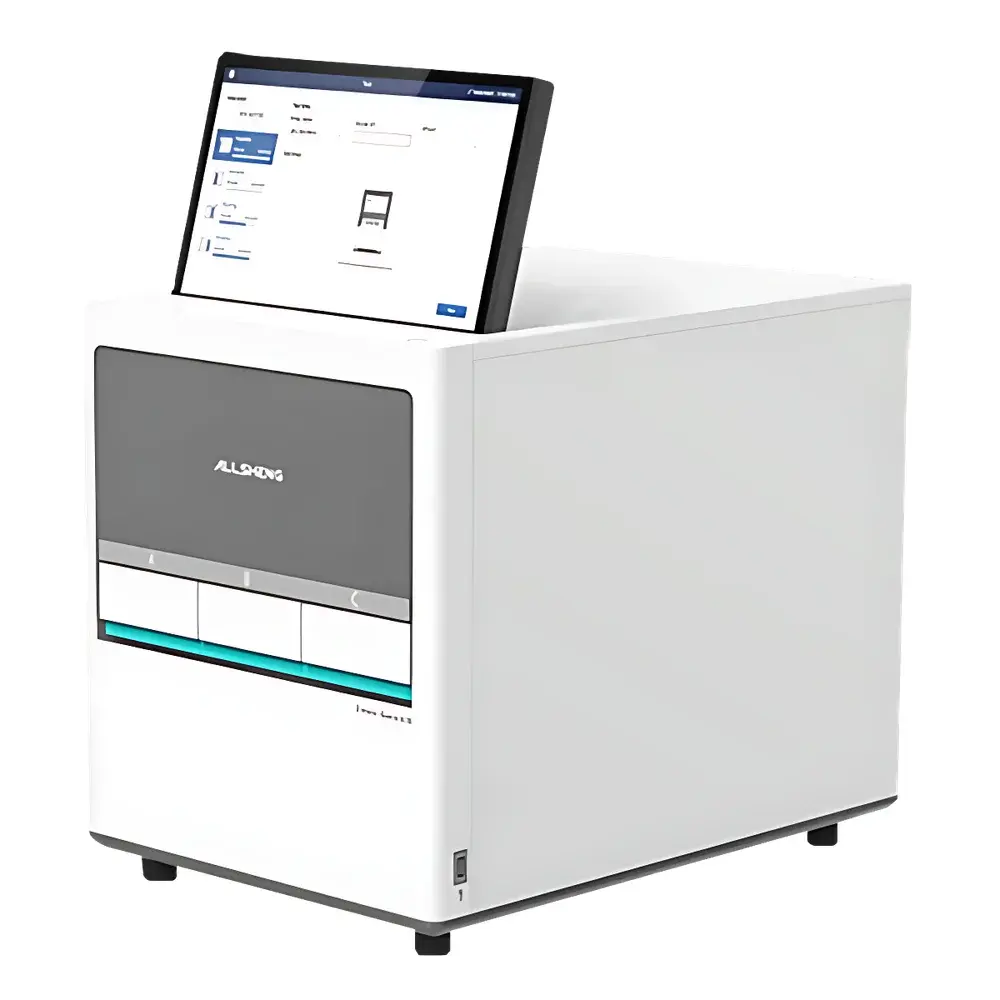
Allsheng Emos-Gene 600/600A Real-Time Fluorescence Quantitative PCR System
| Brand | Allsheng |
|---|---|
| Origin | Zhejiang, China |
| Model | Emos-Gene 600 / Emos-Gene 600A |
| Sample Capacity | 3 × 32-well (0.2 mL for 600 |
| Detection Channels | 6 independent optical channels (C1–C6) |
| Excitation Source | High-power white LED array |
| Detection Sensor | High-sensitivity CMOS imaging system with precision filter wheel |
| Temperature Range | 4 °C to 99.9 °C |
| Temperature Uniformity | ±0.2 °C @ 95 °C |
| Temperature Accuracy | ±0.15 °C |
| Ramp Rate | 4 °C/s (both heating and cooling) |
| Thermal Lid | Auto-adjustable pressure, 30–110 °C |
| Gradient Capability | Single-module gradient control |
| Display | 13.3-inch capacitive touchscreen |
| OS | Windows 10 or later |
| Power Input | 100–240 V~, 50 Hz, 1400 VA |
| Dimensions (D×W×H) | 504 × 360 × 410 mm |
| Weight | 35 kg |
Overview
The Allsheng Emos-Gene 600/600A is a real-time fluorescence quantitative polymerase chain reaction (qPCR) system engineered for high-fidelity nucleic acid detection in dynamic laboratory environments. It employs a three-module, 32-well-per-module architecture—totaling 96 wells per run—with independent thermal and optical control across all modules. Unlike conventional single-block instruments, this modular design enables true parallel processing: users may run three distinct assays simultaneously under different cycling protocols, or consolidate resources into a single high-throughput assay. The system operates on the principle of sequence-specific fluorescent probe hybridization (e.g., hydrolysis probes) or intercalating dye binding (e.g., SYBR Green I), with real-time signal acquisition via top-illuminated CMOS imaging. Each module is thermally isolated and actively regulated, ensuring minimal crosstalk and enabling precise melt curve analysis, allelic discrimination, and absolute quantification without reference dyes—facilitated by proprietary Ct calculation and spatial fluorescence intensity normalization algorithms.
Key Features
- Three independently controlled thermal modules (3 × 32 wells), supporting concurrent multi-assay workflows and adaptive throughput allocation (“tidal throughput”)
- Six-channel optical detection system (C1–C6) with user-configurable excitation/emission filter combinations via motorized filter wheel
- Top-illumination optical path using high-efficiency fiber-optic light delivery—eliminating edge-effect signal attenuation and improving inter-well reproducibility
- Auto-adjusting thermal lid with real-time height sensing and force calibration, optimizing seal integrity across variable tube heights (0.1 mL or 0.2 mL formats)
- High-precision Peltier-based temperature control with ±0.15 °C accuracy and ±0.2 °C uniformity at 95 °C, validated per ISO 13485-aligned thermal mapping protocols
- Integrated 13.3-inch industrial-grade touchscreen running Windows 10 IoT Enterprise, enabling full workflow autonomy: protocol design, run execution, data analysis, PDF report generation, and USB export
- Dye flexibility covering FAM/SYBR Green I, VIC/HEX/TET/JOE, ROX/Texas Red, Cy5/Quasar-670, Cy5.5/Quasar-705, and custom FRET pairs
Sample Compatibility & Compliance
The Emos-Gene 600 accepts standard 0.2 mL tubes and strips (including white and clear options), while the 600A variant supports 0.1 mL formats—both requiring optically transparent caps. Tube compatibility has been verified against ANSI/SLAS microplate footprint standards. The instrument complies with IEC 61010-1 (safety) and IEC 61326-1 (EMC) for laboratory equipment. Data integrity safeguards include audit-trail-enabled software logging (aligned with FDA 21 CFR Part 11 principles), electronic signature support, and GLP/GMP-ready metadata capture (user ID, timestamp, cycle thresholds, amplification curves, melt profiles). All thermal and optical performance specifications are traceable to NIST-calibrated reference materials and validated per ISO/IEC 17025 internal procedures.
Software & Data Management
The embedded Allsheng qPCR Analysis Suite provides intuitive assay setup, real-time monitoring, and automated result interpretation—including qualitative call (positive/negative), relative/absolute quantification, genotyping cluster analysis, and high-resolution melt (HRM) profiling. Raw fluorescence data (.fam, .vic, etc.) and normalized reporter signals are stored in vendor-neutral CSV and JSON formats. The system supports direct export to LIMS via configurable ODBC drivers and includes built-in tools for MIQE-compliant reporting templates. Software updates are delivered via encrypted OTA packages with SHA-256 verification. Local data storage utilizes AES-256 encryption; optional network backup to SMB/CIFS shares or cloud S3-compatible endpoints is available under IT-administered policy controls.
Applications
The Emos-Gene 600/600A serves core applications across clinical diagnostics, public health surveillance, food safety testing, agricultural biotechnology, and academic research. Validated use cases include SARS-CoV-2 and influenza A/B multiplex detection, antibiotic resistance gene screening (e.g., mecA, vanA), GMO quantification (e.g., MON810, NK603), viral load monitoring (HIV, HBV, HCV), SNP genotyping in pharmacogenomics, and expression profiling of miRNA and lncRNA targets. Its six-channel capacity supports up to six-plex assays without spectral unmixing artifacts, while the modular architecture allows dedicated validation runs (e.g., no-template controls, standard curves) to proceed alongside routine testing—reducing instrument downtime and improving lab utilization efficiency.
FAQ
Does the Emos-Gene 600/600A support remote monitoring or network integration?
Yes—via Ethernet or Wi-Fi, the system supports secure remote access through HTTPS-based web interface, enabling real-time run status viewing, alert notifications (email/SMS), and centralized fleet management using Allsheng’s LabConnect platform.
Can the instrument perform high-resolution melt (HRM) analysis?
Yes—the independent module temperature control, sub-degree ramp precision, and high-frame-rate CMOS imaging enable HRM with ≤0.02 °C resolution and <1% inter-run CV for Tm determination.
Is the software compliant with 21 CFR Part 11 requirements?
The system implements role-based access control, electronic signatures, immutable audit trails, and data integrity checks aligned with Part 11 Annex A guidance—though formal validation documentation must be configured per site-specific SOPs.
What maintenance is required for optical calibration?
No routine user calibration is needed; factory calibration is performed using NIST-traceable fluorescent standards, and system self-diagnostics verify optical path integrity before each run.
Are consumables proprietary or compatible with third-party tubes/strips?
The system accepts generic 0.1 mL or 0.2 mL PCR tubes and strips meeting ANSI/SLAS dimensional specifications—no proprietary consumables are mandated.