
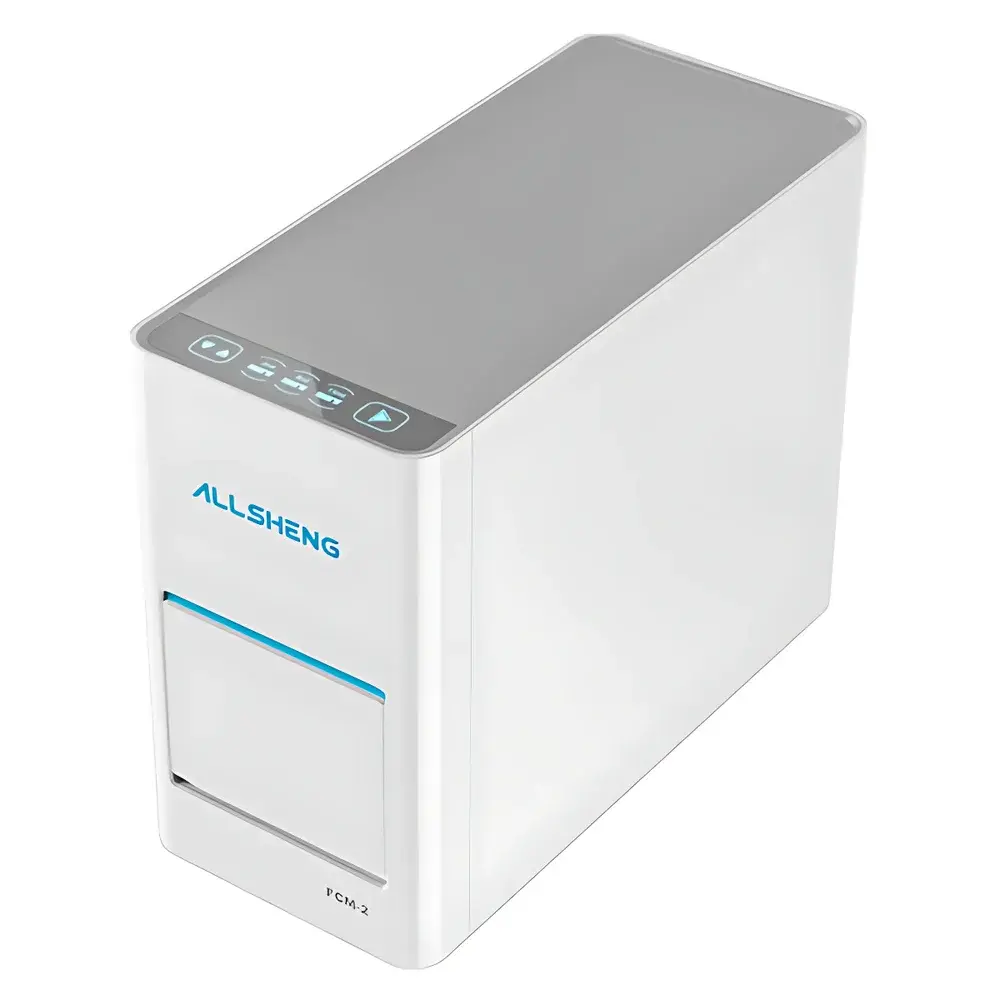
ALLSHENG FCM-2 Automated Membrane Cutting System
| Brand | ALLSHENG |
|---|---|
| Origin | Zhejiang, China |
| Manufacturer Type | Authorized Distributor |
| Product Origin | Domestic (China) |
| Model | FCM-2 |
| Pricing | Available Upon Request |
Overview
The ALLSHENG FCM-2 Automated Membrane Cutting System is a precision-engineered laboratory instrument designed for high-throughput, reproducible sectioning of polymeric and hydrogel-based membranes used in electrophoresis, blotting, microfluidics, and diagnostic assay development. Operating on a programmable stepper-motor-driven linear actuation principle, the FCM-2 executes controlled vertical blade descent with adjustable cutting force and dwell time to minimize membrane deformation, delamination, or thermal artifacts. Unlike manual scalpel-based methods or generic guillotine cutters, the FCM-2 integrates optical edge detection and real-time position feedback to ensure sub-millimeter positional repeatability across heterogeneous membrane batches—critical for downstream quantitative analysis in Western blot normalization or lateral flow strip calibration.
Key Features
- Programmable cutting parameters: blade speed (0.1–5 mm/s), dwell time (0–5 s), and cutting depth (0.05–3.0 mm) configurable via intuitive touchscreen interface
- Modular blade holder compatible with stainless-steel, ceramic, and disposable polymer blades (standard 25 mm width; optional custom geometries)
- Integrated LED-guided alignment system with crosshair projection for precise registration against pre-marked membrane grids or fiducial markers
- Sample stage with vacuum-assisted fixation (≤ –60 kPa) and removable silicone-coated clamping plates to accommodate membranes ranging from 5 × 5 cm to 20 × 30 cm
- Onboard memory for up to 99 user-defined protocols, each supporting multi-step sequences (e.g., trim → score → full cut)
- CE-compliant electrical architecture with IP20-rated enclosure and emergency stop circuitry aligned with IEC 61000-6-2/6-4 electromagnetic compatibility standards
Sample Compatibility & Compliance
The FCM-2 supports a broad range of membrane substrates including nitrocellulose (NC), polyvinylidene fluoride (PVDF), nylon, cellulose acetate, and functionalized hydrogels (e.g., PEGDA, agarose). It accommodates thicknesses from 10 µm to 500 µm and tensile strengths up to 25 MPa. All operational parameters are traceable and timestamped, enabling compliance with GLP and ISO/IEC 17025 documentation requirements. While not FDA-cleared as a medical device, the system’s design adheres to ISO 13485 risk management principles for ancillary lab equipment used in IVD assay manufacturing environments. Routine calibration verification is supported using NIST-traceable gauge blocks and certified reference membranes.
Software & Data Management
The embedded firmware (v3.2+) enables protocol export/import via USB 2.0 and supports audit trail logging compliant with ALCOA+ principles (Attributable, Legible, Contemporaneous, Original, Accurate, Complete, Consistent, Enduring, Available). Optional Ethernet connectivity permits integration into LIMS environments through standard OPC UA v1.04 interfaces. No proprietary cloud service is required; raw log files (CSV/JSON) include operator ID, timestamp, protocol ID, actual vs. setpoint parameters, and pass/fail status per cut cycle. Software updates are delivered as signed firmware packages validated via SHA-256 checksums.
Applications
- Preparation of uniform membrane strips for semi-quantitative immunoassays and rapid antigen tests
- High-fidelity sectioning of 2D gel electrophoresis membranes prior to mass spectrometry excision
- Manufacturing of standardized lateral flow test pads with defined capture zone dimensions
- Quality control slicing of hydrogel-based biosensor patches for impedance or fluorescence readout validation
- Research-scale fabrication of membrane-based microfluidic chips requiring precise inlet/outlet port definition
- Standardization of blotting membrane dimensions in academic core facilities to reduce inter-lab variability in densitometry
FAQ
What membrane thicknesses can the FCM-2 handle reliably?
The system is validated for membranes between 10 µm and 500 µm thick, with optimal performance observed at 25–200 µm for NC and PVDF.
Is blade replacement tool-free?
Yes—blade cartridge insertion and ejection require no tools; alignment is auto-compensated via spring-loaded kinematic mounts.
Can the FCM-2 integrate with robotic liquid handlers?
It features TTL-level I/O ports (4 input, 4 output) for hardware handshake with third-party automation platforms such as Hamilton STAR or Tecan Fluent.
Does it support GMP documentation workflows?
Full electronic records—including calibration logs, maintenance history, and user access control—are exportable in PDF/A-2 format for regulatory submission.
What is the maximum unsupported membrane area before vacuum distortion occurs?
At full vacuum (–60 kPa), flatness deviation remains ≤ ±0.15 mm across 15 × 15 cm areas when using the standard silicone clamping plate configuration.





