
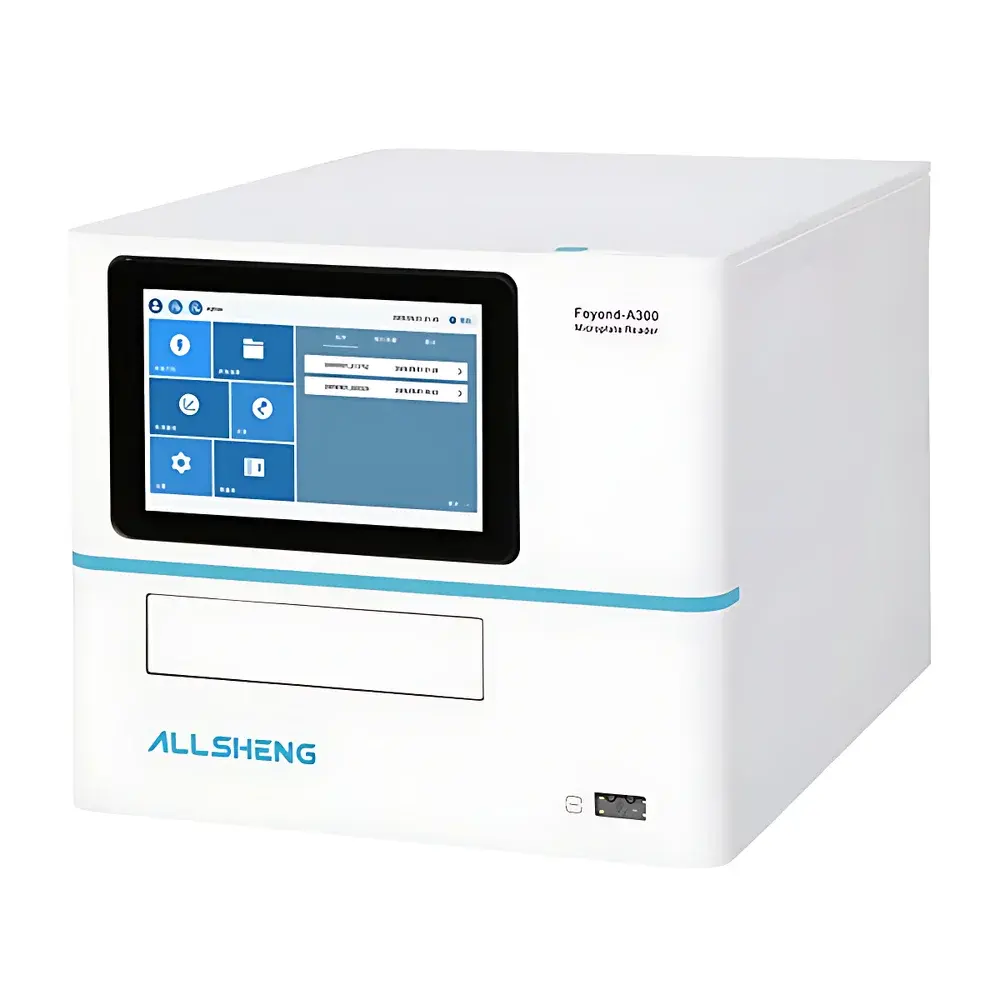
Allsheng Feyond-A500 Multimode Microplate Reader
| Brand | Allsheng |
|---|---|
| Origin | Zhejiang, China |
| Model | Feyond-A500 |
| Detection Modes | Absorbance, Fluorescence (Top-Read), Chemiluminescence, Time-Resolved Fluorescence (TRF), Fluorescence Polarization (FP) |
| Wavelength Range (Abs) | 200–1000 nm, 1 nm step |
| Absorbance Range | 0–4 OD |
| Absorbance Accuracy | ±(1.0% + 0.003 OD) at 450 nm (0.0–2.0 OD) |
| Absorbance Precision | CV < 1.0% or SD < 0.003 OD (96-well, precise mode) |
| Read Time (96-well) | <15 s (fast mode) |
| Luminescence Sensitivity | ≤15 amol/plate (ATP assay) |
| Dynamic Range (Luminescence) | 6 decades |
| Fluorescence Sensitivity | ≤1 pM (FITC in 96-well) |
| TRF Sensitivity | ≤0.05 pM (Eu-labeled conjugate) |
| FP Sensitivity | ≤5 mP (standard assay) |
| Excitation/Emission Filter Capacity | 3 pre-installed dual-filter sets (e.g., EX470/EM525), modular & barcode-readable |
| Incubation | PID-controlled, dual-zone (top/bottom), 25–45 °C ±0.5 °C |
| Display | 10-inch motorized rotatable touchscreen (standalone operation) |
| Software | Onboard analysis suite including endpoint, kinetics, spectral scan, standard curve fitting (4PL/5PL), qualitative/quantitative modules, GLP-compliant audit trail (optional PC software: ReaderLT-I) |
Overview
The Allsheng Feyond-A500 Multimode Microplate Reader is an integrated, standalone benchtop instrument engineered for high-throughput and high-fidelity detection across five core assay modalities: absorbance (ABS), fluorescence intensity (FI), chemiluminescence (CL), time-resolved fluorescence (TRF), and fluorescence polarization (FP). Its optical architecture employs a monochromator-based absorbance pathway—eliminating the need for fixed filters—and delivers continuous spectral scanning from 200 to 1000 nm with 1 nm resolution, ensuring compliance with ASTM E308 and ISO 17025 requirements for wavelength accuracy and photometric linearity. For fluorescence and TRF measurements, the system utilizes a filter-based top-read optical path featuring xenon flash lamp excitation, high-transmission dichroic mirrors, and low-noise photomultiplier tube (PMT) detection. This configuration enables optimal signal-to-noise ratio across diverse fluorophores—including lanthanide chelates—and supports kinetic assays requiring sub-second temporal resolution. The Feyond-A500 meets essential regulatory expectations for life science instrumentation, including traceable calibration routines, onboard self-diagnostics (light source, detector, position, and optical alignment), and hardware-level temperature uniformity control—critical for reproducible cell-based and enzymatic assays under GLP or early-stage GMP-aligned workflows.
Key Features
- Monochromator-driven absorbance detection with ±2 nm wavelength accuracy and <2.5 nm FWHM bandwidth, supporting spectral scanning, endpoint, and kinetic protocols without filter replacement.
- Dual-zone PID incubation (25–45 °C, ±0.5 °C) mitigates edge effects in microplates by independently regulating top and bottom plate surfaces—essential for extended kinetic assays involving adherent cells or thermally sensitive enzymes.
- Modular, barcode-scannable filter cartridges enable rapid, error-free exchange of excitation/emission filter pairs; each module auto-identifies its optical specifications upon insertion.
- 10-inch motorized touchscreen interface allows full instrument control—including protocol upload, parameter adjustment, real-time data visualization, and onboard analysis—without external PC dependency.
- Integrated dual-channel programmable injector supports precise reagent addition during kinetic runs on 96- and 384-well plates, with volume accuracy ±2% across 5–500 µL range.
- Automated PMT gain optimization dynamically adjusts detector voltage based on sample signal intensity, extending linear dynamic range while eliminating manual gain calibration steps.
Sample Compatibility & Compliance
The Feyond-A500 accommodates standard ANSI/SLAS-format microplates (6–384-well), opaque white/black plates for luminescence and fluorescence, and transparent polystyrene/cyclo-olefin plates for absorbance. Its optical design minimizes well-to-well crosstalk (<0.005% in CL mode) via optimized fiber-optic light collection geometry and spatially isolated detection paths. Regulatory readiness is embedded in both hardware and firmware: automatic calibration logs are timestamped and stored with user ID; all critical parameters (lamp usage hours, filter IDs, temperature profiles) are retained for audit review. Optional ReaderLT-I PC software provides 21 CFR Part 11-compliant electronic signatures, role-based access control, and full audit trail functionality—aligning with FDA-recognized validation frameworks for QC laboratories and contract research organizations.
Software & Data Management
Onboard firmware includes a comprehensive analytical engine supporting 4-parameter logistic (4PL), 5-parameter logistic (5PL), linear, and quadratic curve fitting; kinetic slope calculation; delta-absorbance trending; and ratiometric analysis (e.g., FRET, dual-emission FP). Raw data export is available in CSV, Excel (.xlsx), and XML formats, preserving metadata (wavelengths, integration times, gain settings, plate maps). QR code integration allows one-touch import of preconfigured protocols or calibration curves—reducing setup errors and accelerating method transfer between instruments. For centralized data governance, ReaderLT-I software extends capabilities to batch processing, statistical outlier detection (Dixon’s Q-test), and report generation compliant with ISO/IEC 17025 documentation standards.
Applications
The Feyond-A500 serves as a primary detection platform in academic, pharmaceutical, and clinical research settings. Its TRF capability enables ultrasensitive immunoassays for biomarkers such as cardiac troponin I or hepatitis B surface antigen (HBsAg), achieving sub-picomolar LODs without wash steps. FP mode supports real-time monitoring of small-molecule binding events—e.g., kinase inhibitor screening against fluorescently labeled ATP analogs—or protein-protein interactions using labeled peptide substrates. Chemiluminescent detection meets requirements for luciferase reporter gene assays (e.g., NF-κB activation) and ELISA-based cytokine quantification, leveraging six-decade dynamic range to avoid sample dilution. Absorbance scanning facilitates nucleic acid purity assessment (A260/A280), enzyme activity profiling (NADH/NADPH kinetics), and microbial growth monitoring (OD600) with traceable photometric performance.
FAQ
Does the Feyond-A500 support FDA 21 CFR Part 11 compliance?
Yes—when used with optional ReaderLT-I software, the system provides electronic signature capability, audit trail logging, and user access controls aligned with Part 11 Annex A expectations.
Can I perform simultaneous dual-wavelength absorbance measurements?
No—the monochromator operates sequentially; however, rapid wavelength switching (<100 ms) enables quasi-simultaneous dual-band acquisition for ratiometric applications like pH-sensitive dyes.
Is the incubation chamber compatible with gas-controlled environments?
Not natively—the current design supports ambient air incubation only. For CO₂-dependent cell assays, external humidified chambers or plate sealers are recommended.
What maintenance is required for the xenon flash lamp?
The lamp is rated for ≥1×10⁹ flashes; no routine replacement is needed within typical 3–5 year service intervals. Automatic intensity monitoring triggers alerts when output drops below 90% of baseline.
How does the instrument handle plate barcode reading for sample tracking?
It reads standard 1D/2D plate barcodes (Code 128, QR) to auto-populate plate IDs in run logs and link results to LIMS identifiers—supporting ALCOA+ data integrity principles.
Related Products




